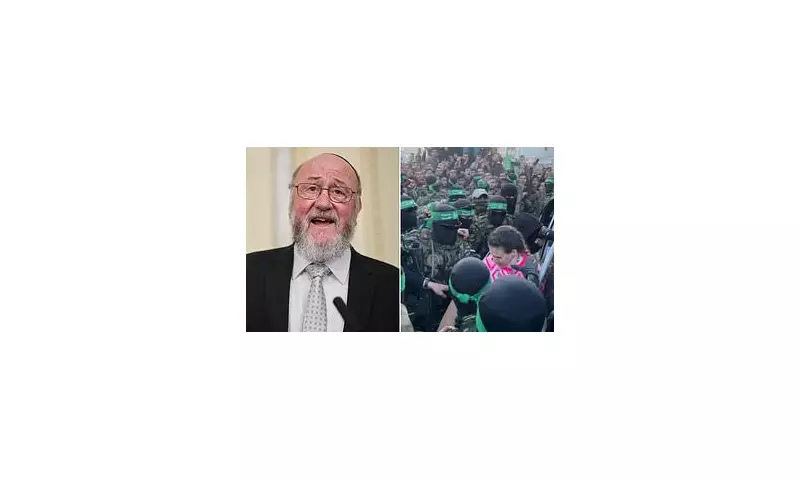
Britain's Chief Rabbi has launched a powerful critique against those labelling the Israel-Gaza conflict a 'genocide', arguing it dangerously cheapens one of humanity's most serious crimes and undermines the very foundation of human rights.
A Term That Must Remain Protected
In a forthright article, Sir Ephraim Mirvis stated that the term genocide carries a specific, grave meaning that must be safeguarded. He asserted that casually applying it to Israel's military actions, regardless of the motivation, transforms a profound legal and moral concept into a mere political insult.
He emphasised that the conflict, which began with the Hamas-led terrorist attack on southern Israel on October 7, 2023, was not sought by Israel. That assault resulted in approximately 1,200 deaths and 251 people taken hostage. The Chief Rabbi contended that Israel's aims are the return of its hostages and the disarmament of Hamas, whereas Hamas seeks the total destruction of Israel.

"If Hamas lays down its arms there will be no fighting and no suffering. If Israel were to lay down its arms there would be no Israel," he said.
The Crucial Element of Intent
Sir Ephraim stressed that the legal definition of genocide hinges on the specific intent to destroy a national, ethnic, racial, or religious group. This intent, he argued, is what separates the tragic collateral damage of war from a premeditated monstrous crime.
He used the historical example of the Allied strategic bombing of Nazi Germany, which caused heavy civilian casualties but is not considered genocide, to illustrate his point. "Intent is the moral and legal hinge," he wrote.
The Chief Rabbi also criticised certain non-governmental organisations, which he described as 'so-called human rights organisations'. He accused them of expanding the definition of genocide to include military actions where harm might occur, even without specific intent, calling this a 'truly troubling moral deceit'.
Consequences of Rhetorical Escalation
Mirvis warned that the 'race to linguistic escalation' has real-world consequences. He linked the inflammatory rhetoric to a rise in anti-Jewish attacks, citing the Manchester synagogue attack in October, where two were killed on Yom Kippur, and the Bondi Beach terror attack in Sydney last month, where 15 people were shot dead during Hanukkah celebrations.
He expressed concern that the constant repetition of the genocide accusation, often driven by social media outrage culture, leads people to mistakenly believe its veracity. He argued that Gaza lacks the unmistakable signatures of genocide, such as systematic massacres or sanctioned executions.
"To invoke the term 'genocide' as an accusation against Israel is to strip it of its true meaning, reducing humanity’s gravest crime to a political insult," he concluded, adding that this 'moral inversion' damages the cause of human rights itself.
The Chief Rabbi's comments are seen as a direct response to the Archbishop of York, Stephen Cottrell, who last November accused Israel of 'genocidal acts' and described the situation in the West Bank as akin to apartheid. Mirvis had previously called those remarks an 'irresponsible approach'.
The article also noted that the UK government, under then Foreign Secretary David Lammy, has stated it does not believe Israel is acting with genocidal intent, though a separate UN commission reached a different conclusion. The Hamas-run health ministry in Gaza claims over 70,000 Palestinians have been killed in the conflict.
Sir Ephraim welcomed recent assurances from the Metropolitan Police and Greater Manchester Police that protesters inciting hatred at pro-Palestinian marches would face arrest, calling it an important step against hateful rhetoric.