High Court Considers Appeal Over Quran Burning Protest and Free Speech Boundaries
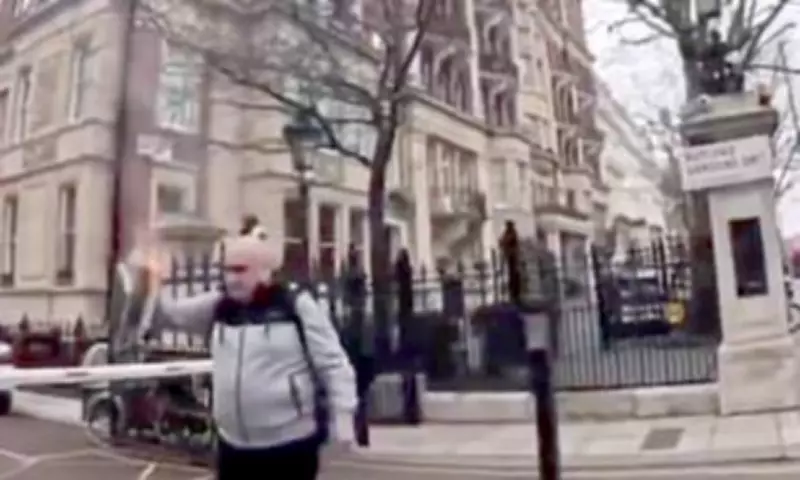
The High Court has heard arguments that a man who publicly burned the Quran should have his conviction reinstated because burning a religious text "is in itself disorderly." Hamit Coskun, a 51-year-old atheist, held a flaming copy of the Islamic holy book aloft and shouted expletives directed at Islam outside the Turkish embassy in central London on February 13 last year.
Legal Battle Over Public Order and Expression
Coskun was originally convicted of a religiously aggravated public order offence last June for his controversial protest on Rutland Gardens in Knightsbridge, near Hyde Park. However, he successfully appealed with support from free speech campaigners, and Mr Justice Bennathan at Southwark Crown Court overturned the conviction in October, stating that "blasphemy" is not a crime under English law.
The Crown Prosecution Service is now appealing that decision at the High Court, requesting that the case be sent back to the Crown Court for reconsideration. Barristers argued during a hearing on Tuesday that the judge was incorrect last autumn in finding Coskun's behaviour not "disorderly" and unlikely to cause harassment, alarm, or distress.

Arguments from Both Sides
David Perry KC, representing the CPS, told the court: "Burning a book in a residential or commercial part of central London, between Knightsbridge and Hyde Park, is in itself disorderly and even more so when the book is a holy text, whatever the religion." In written submissions, Perry argued that Coskun's actions "did not involve an exercise of legitimate freedom of expression" and instead "crossed the border into criminal conduct and was deliberately intended to be disorderly."
Coskun, who is half-Armenian, half-Kurdish, and Turkish-born, resisted the legal challenge and attended the hearing before Lord Justice Warby and Ms Justice Obi. The hearing concluded on Tuesday, with judgment reserved for a later date.
Background and Context of the Protest
During his protest, Coskun also shouted, "Islam is religion of terrorism," and, "Quran is burning." He later explained that he burned the Quran to highlight how Turkish President Recep Tayyip Erdogan's constitutionally secular government had become an "Islamist regime." Following the protest, Coskun was attacked by others, including a Muslim man named Moussa Kadri, 59, who slashed at him with a knife, later telling police he was protecting his religion. Perry told the court this attack was "effectively provoked" by Coskun.
The CPS emphasized that their case was neither "an attempt to introduce an offence of blasphemy" nor "an impermissible encroachment" on Coskun's right to free speech. Blasphemy laws were abolished in England and Wales in 2008 and in Scotland in 2021, though they remain offences in Northern Ireland.
Defence and Free Speech Advocacy
In written submissions on behalf of Coskun, Tim Owen KC argued that the CPS's appeal was "unarguable" and "merely seeks to rehash arguments" that "ultimately failed to persuade the court of the respondent's guilt." Owen stated: "This ill-judged, frivolous attempt to convert what is a question of fact into one of law should be rejected."
Stephen Evans, chief executive of the National Secular Society, which funded Coskun's appeal along with the Free Speech Union, criticized the CPS's approach ahead of the hearing. He said it "casts those subjected to violence for offending religious sensibilities as the wrongdoer" and represents a "stark inversion of justice." Evans added: "It is not the role of prosecutors to determine what citizens should think or feel about contentious expression. The law should never be used to enforce religious orthodoxy."
Personal Circumstances and Broader Implications
Coskun has been provided accommodation by the Home Office since his protest due to the number and severity of threats made against him. At a High Court hearing earlier this month, Mr Justice Linden noted that Coskun requested this because his "life has been threatened on a number of occasions" and there had been "several acts of violence against him." Coskun, who came to the UK from Turkey, applied for asylum in Britain after his protest and is still awaiting a decision.

Originally, Coskun was fined £240, with District Judge John McGarva stating he had a "deep-seated hatred of Islam and its followers." However, Mr Justice Bennathan ruled in October that the right to freedom of expression "must include the right to express views that offend, shock or disturb." He clarified: "There is no offence of blasphemy in our law. Burning a Quran may be an act that many Muslims find desperately upsetting and offensive. The criminal law, however, is not a mechanism that seeks to avoid people being upset, even grievously upset."
Political and Social Reactions
In a written statement after the judgment, Coskun said he had come to England "to be able to speak freely about the dangers of radical Islam" and was now "reassured that - despite many troubling developments - I will now be free to educate the British public about my beliefs." The Free Speech Union stated that the ruling sent a message that "anti-religious protests, however offensive to true believers, must be tolerated."
Lord Young, director of the FSU, warned: "Had the verdict been allowed to stand it would have sent a message to religious fundamentalists that all they need to do to enforce their blasphemy codes is to violently attack the blasphemer, thereby making him or her guilty of having caused public disorder." Shadow justice secretary turned Reform MP Robert Jenrick commented that while he did not agree with Coskun's actions, he didn't think "it was a crime."
Ongoing Debates and Future Considerations
The High Court hearing comes as US state department officials are reportedly preparing to assist Coskun if he loses his appeal, with the case noted by the Trump administration among several regarding free speech. Coskun has expressed fears he may have to flee the UK amid threats, potentially moving to the USA where he believes there is stronger support for free speech against Islamic extremism.
Meanwhile, Labour is considering a draft definition of anti-Muslim hatred that does not include the term "Islamophobia," opting instead for "anti-Muslim hostility." Free speech activists have warned that any official definition could risk outlawing criticism of the religion itself. Lord Young of the FSU cautioned: "The danger of any definition, however carefully drawn, is that it will make people think twice before referring to Muslims doing anything wrong, prioritising them above all other faiths."
A working group established last year submitted a proposal for a non-statutory definition to the government in October, which would guide public bodies on unacceptable treatment of Muslims without being legally binding. The outcome of Coskun's case could significantly influence the ongoing national conversation about the limits of free speech, religious sensitivity, and public order in modern Britain.