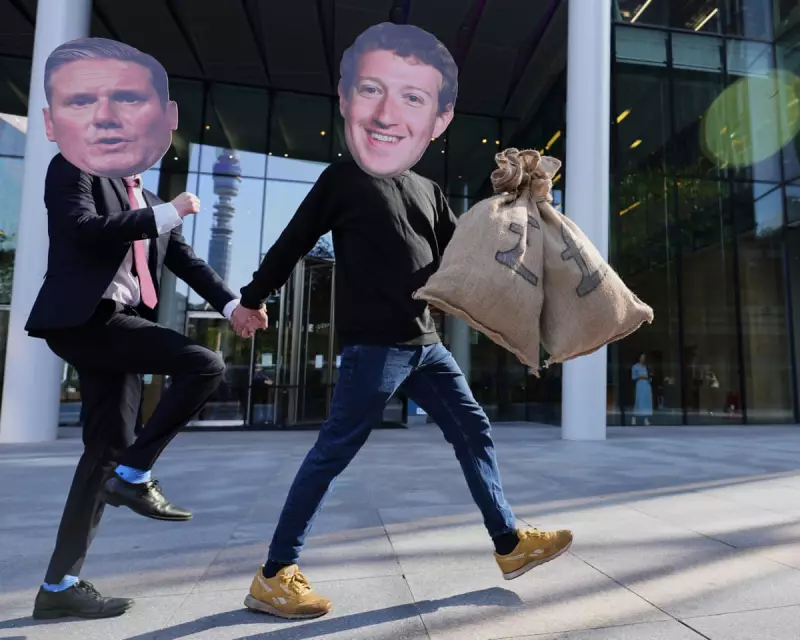
Major US technology corporations have enjoyed unparalleled access to the heart of the UK government, holding hundreds of meetings with ministers while groups campaigning for child safety and creators' rights are granted far less time, an exclusive investigation reveals.
A Stark Imbalance in Political Access
An analysis of official records covering the two years to October 2025 shows that tech companies and their lobbyists attended at least 639 meetings with ministers. In stark contrast, organisations fighting for stronger online protections for children secured only 75 meetings in the same period.
The data, uncovered by The Guardian, highlights a profound disparity. The industry's main lobbying group, Tech UK, met with ministers more than once every eight working days. Individual tech behemoths also had significant access: Google alone participated in over 100 ministerial meetings.

Andy Burrows, chief executive of the Molly Rose Foundation—established after 14-year-old Molly Russell took her own life following exposure to harmful online content—called the frequency "astounding." He said it "points to the incredible power imbalance at stake when it comes to protecting children online." His organisation had fewer meetings than Elon Musk's X, which attended 13.
Government Defence and Campaigner Outrage
The government defended the high level of engagement, with a spokesperson for the Department for Science, Innovation and Technology (DSIT) stating that regular dialogue with tech firms is "vital to delivering economic growth and transforming public services." They added that meetings cover issues from investment to implementing online safety laws.
Campaigners, however, view the figures as evidence of undue influence. Ed Newton-Rex, a campaigner for creators' rights, labelled the statistics "shocking." He argued they explain why a recent government consultation on AI and copyright launched with a "preferred option" that resembled a "wishlist from big tech."
"It is imperative that the government stop bending the knee to US big tech companies—which, as the recent Grok debacle has shown, don't have the interests of the British people at heart," Newton-Rex stated, referencing the controversy around X's AI image generator.
Broader Concerns Over AI and Accountability
The findings emerge amid growing public concern over AI regulation and child safety online. A recent resurgence calls for the UK to follow Australia in considering a social media ban for under-16s—a move opposed by tech companies. Polling suggests 84% of people in the UK worry ministers will prioritise tech partnerships over the public interest in AI rules.
Dame Chi Onwurah, Labour chair of the science and technology select committee, said the access underscores the reality that these firms have "turnovers larger than the GDP of many countries." Their influence, she noted, "stands in stark contrast to that of their users, our constituents, or those campaigning to make the internet safer."
Crossbench peer Lady Beeban Kidron, a campaigner on child safety and copyright, described successive governments' approach as "disturbing." She argued that "this privileged access is mirrored in their policy, and tech industry talking points are parroted by officials. This capture creates harm."
While Labour in opposition promised stronger safeguards, Kidron accused the party in government of refusing "to take necessary actions." She concluded: "A government of a sovereign state has a duty to its own citizens, not to the tech bros."