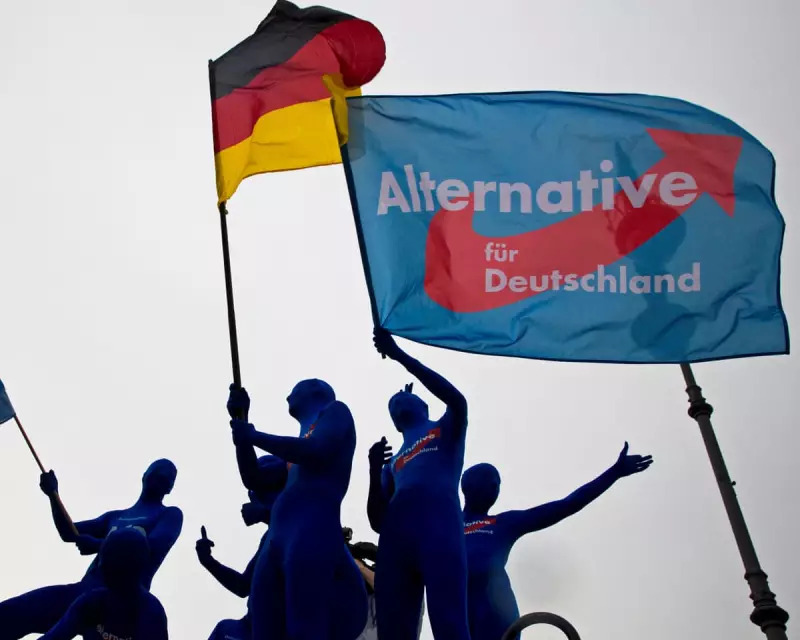
Political experts have issued stark warnings, analysing the complex and seemingly unstoppable rise of the far-right Alternative für Deutschland (AfD) party in Germany. Their insights, shared in a series of letters, move beyond simple historical parallels to dissect the modern economic, ideological, and institutional factors fuelling this shift.
Economic Grievances and Government Failure
Dr Jens Holst, writing from Berlin, argues that while symbolic opposition is important, the core drivers are material. He contends that the federal government's failure to address the rising cost of living and soaring rents is the primary engine pushing voters towards the AfD.
He states that by prioritising the interests of global finance capital over social cohesion, the coalition of conservatives, reactionaries, and the Social Democratic party is reinforcing the very insecurities the far-right exploits. Holst draws a potent historical comparison, suggesting that just as 1930s National Socialism fed on fears of big business and Bolshevism, today's right-wing authoritarianism gains momentum from combined anxieties about global financial elites and the perceived threats of ecological restructuring.

The Evolution into 'Fascism 2.0'
From San Jose, California, Ahmed Dirie warns against looking solely for the markers of 1930s fascism, such as uniformed paramilitaries. He identifies a new, insidious model: 'administrative fascism'.
Dirie explains that where historical fascism was explicitly based on race science, the modern far-right, or 'Fascism 2.0', pivots to 'civilisational exclusion'. Islamophobia, he argues, has become the functional equivalent of 1930s antisemitism, framing prejudice as a defence of 'western values'. This allows for racialisation without using the word 'race', making the ideology more palatable.
Crucially, Dirie highlights that the requirement for a separate paramilitary force is outdated. Modern fascism weaponises the state's own machinery—through militarised borders and bureaucratic 'remigration' plans—turning violence into a legalised procedure. The narrative has shifted from racial 'superiority' to a defensive 'siege' mentality, weaponising grievances over 'wokeness' and 'demographic replacement'.
The Role of the State and Media
Paul Gander, writing from London, broadens the perspective beyond Germany. He cautions that while monitoring explicit far-right parties is vital, equal scrutiny must be applied to the state itself and dominant media platforms.
He points to the UK as an example, where a creeping heavy-handedness in policing and the expansive use of 'terrorism' designations can warp the rule of law in ways reminiscent of fascist tactics. Meanwhile, he argues, popular media often ignores or distracts from these abuses while giving a free pass to far-right figures.
This convergence of state power and media compliance, Gander suggests, is as concerning as the rise of any single anti-democratic party, creating a fertile ground for authoritarianism to take root across Western democracies.
The collective analysis presents a sobering picture: the rise of the AfD and similar movements is not a simple historical echo but a modern phenomenon powered by economic neglect, evolved ideological packaging, and the concerning acquiescence or active participation of established institutions.