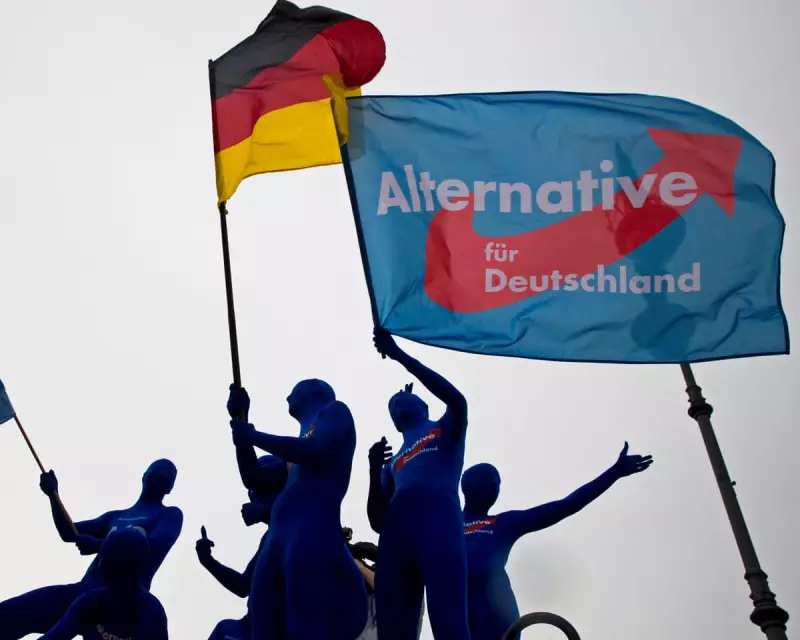
Political analysts and academics are sounding the alarm over the sustained rise of Germany's far-right Alternative für Deutschland (AfD) party, arguing that contemporary threats differ starkly from historical fascism and require a new understanding.
Economic Grievances and Government Failure
In a series of pointed letters, Dr Jens Holst from Berlin contends that the federal government's policies are a primary catalyst for the party's growth. He argues that rising living costs, soaring rents, and deepening social inequality are the core reasons voters are drifting towards the AfD.
He states that as long as the coalition government, comprising conservatives and the Social Democratic Party, fails to address these "subjectively and objectively threatening developments," support for extremist groups will continue. Dr Holst draws a parallel to the 1930s, suggesting today's combined fear of global financial elites and necessary ecological restructuring is fuelling right-wing authoritarianism in a similar manner.

The Evolution into 'Fascism 2.0'
Ahmed Dirie, writing from San Jose, California, warns against solely looking for 1930s markers like paramilitaries and explicit biological racism. He identifies a modern variant: 'administrative fascism'.
Dirie explains that where historical fascism focused on ethnic purity, today's far-right employs a framework of "civilisational exclusion." Islamophobia, he argues, has become the functional equivalent of 1930s antisemitism, allowing racialisation under the guise of defending "western values."
He emphasises that the requirement for a paramilitary force is outdated, as modern fascism weaponises the state itself through militarised borders and bureaucratic "remigration" plans, making violence legal and procedural.
The Role of the State and Media
From London, Paul Gander adds a crucial dimension, urging vigilance not just towards explicit far-right parties but also towards the state and dominant media. He points to a "creeping heavy-handedness in policing" and the use of terrorism designations as tools of state oppression in the UK, which he finds reminiscent of fascism's distortion of the rule of law.
Gander criticises popular media for glossing over state abuses and giving a free pass to far-right figures, mimicking the propaganda of past totalitarian regimes. He concludes that it is this convergence of state and media interests, alongside specific anti-democratic parties, that presents the gravest concern for democratic integrity across Europe.
The collective analysis presents a multifaceted threat, moving beyond traditional symbols of fascism to highlight economic desperation, sophisticated new exclusionary ideologies, and the complicity of mainstream institutions in the rise of the far-right.