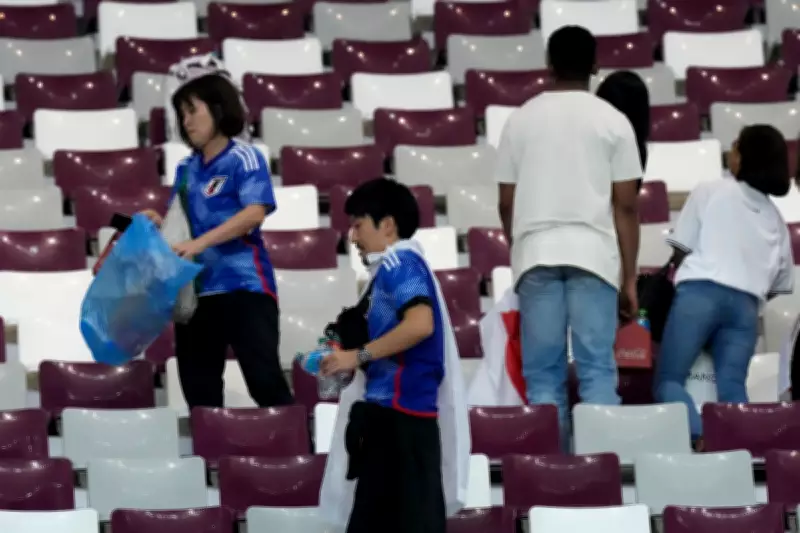
If there is one nation guaranteed to leave a spotless impression at the World Cup, it is Japan. Literally. The image of Japanese soccer fans sweeping stadiums and collecting litter after matches first captured global attention in France in 1998, marking Japan's debut at the tournament. This tradition has persisted every four years, including at the 2022 World Cup in Qatar, and will undoubtedly continue when Japan begins its campaign in June with group matches in Arlington, Texas, and Monterrey, Mexico.
Such behaviour astonishes many non-Japanese spectators, who may be accustomed to leaving stadiums strewn with half-eaten food, shredded paper wrappers, and cups—some empty, others still dripping liquid. During the 2018 World Cup in Russia, Japanese players famously tidied their dressing room after a defeat and left a thank-you note written in Russian. In 2022, fans attached thank-you notes to rubbish bags in Arabic, English, and Japanese.
Why Do Japanese Fans Clean Up?
The explanation is straightforward. From elementary school, Japanese students are socialised to behave this way—whether in the classroom, the schoolyard, or on the playing field. Koichi Nakano, a professor of politics and history at Sophia University, told The Associated Press: “Japanese sports fans at world events who clean up the stadium are behaving much the same way they did when they learned how to enjoy sports as school boys and girls.”

A Japanese phrase encapsulates this ethos: “Tatsu tori ato wo nigosazu.” Literally translated as “A bird leaves nothing behind,” the intended message is: “Return it the way you found it.” Many Japanese elementary schools lack janitors, so students handle the cleaning themselves. Office workers similarly dedicate time to tidying their workspaces. Moreover, public spaces in Japan have relatively few rubbish bins, prompting people to take their waste home. This practice keeps pavements cleaner, reduces the cost of emptying bins, and deters vermin.
“The way most ordinary soccer fans experience soccer at school is no different from other sports, and the emphasis is not just on physical education but also on moral education as well,” Nakano added.
Collective vs. Individual Responsibility
Barbara Holthus, deputy director of the German Institute for Japanese Studies in Tokyo and a sociologist raised in Germany, cautions against placing Japan on a pedestal. Like any country, Japan faces its own challenges. “An academically sound explanation is that people in Japan just happen to be socialised different,” she told The AP. “If you grew up with a certain way of how things are being done, you apply that to even cleaning up a stadium afterwards.”
At play is the Japanese concept of “meiwaku,” meaning not causing trouble or inconveniencing others. From a Japanese perspective, leaving rubbish piled up in a stadium would be a nuisance to others. Japan is densely populated; Greater Tokyo alone houses about 35 million people, roughly the population of California. People must coexist harmoniously. “Japanese learn early on that you don't want to inconvenience other people,” Holthus said. She noted the focus on the collective, contrasting with Western emphasis on the individual and individual rights. “You don’t want to bother people. It goes to all areas of life in Japan,” she added. “We are raised (in the West) that we don’t have to clean up after ourselves in public spaces because there is going to be some kind of public service doing that.”
Widespread praise for the cleanup behaviour has reinforced it. Jeff Kingston, a history professor at Temple University in Japan, wrote in an email: “Now that the media has latched onto the story and lavished praise on Japanese fans, they have made it a point of pride to display those values and norms.”
A Tradition Beyond the World Cup
The cleanup tradition extends beyond soccer's premier tournament. Last year, Japanese fans cleaned up after matches at the Under-20 World Cup in Chile. More recently, at Wembley Stadium in London, where Japan defeated England 1-0 in an international friendly, the practice continued. “It’s one of our traditions,” said Toshi Yoshizawa, who led the cleanup in Chile. “We grew up with the teaching that we should leave a place cleaner than when we arrived.”

William Kelly, an emeritus professor of anthropology at Yale University and a Japan specialist, linked the tradition more closely to soccer than other sports. He speculated it stems from the establishment of Japan's professional football league over 30 years ago. “It (the J-League) was trying to distinguish itself from baseball by emphasizing teams’ community embeddedness and commitment,” Kelly wrote in an email. “Soccer fans felt, and feel, more a part of the club and its stadium.”