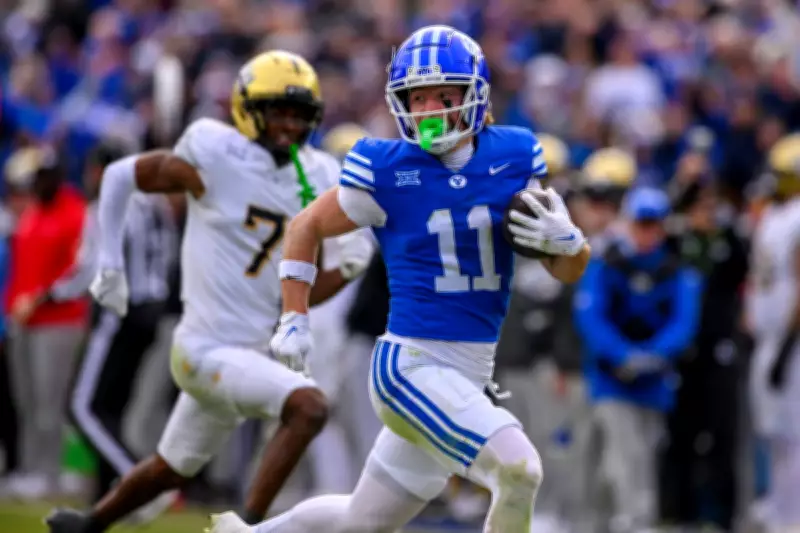
Brigham Young University has officially stated that its star wide receiver, Parker Kingston, is no longer enrolled as a student at the institution. This announcement comes in the wake of Kingston's arrest this week on a serious first-degree felony rape charge, which has sent shockwaves through the university community and beyond.
Arrest and Initial Court Proceedings
Kingston, aged 21, was taken into custody following a comprehensive yearlong investigation conducted by authorities. The investigation involved the meticulous collection of digital and forensic evidence, as well as interviews with multiple witnesses, according to Washington County Attorney Jerry Jaeger. The case centers on allegations made by a woman, who was 20 years old at the time, claiming that Kingston assaulted her at her residence in February of the previous year.
During his initial court appearance on Friday in St. George, Judge John Walton presided over the hearing. Judge Walton expressed his concern, stating, "I found by clear and convincing evidence that Mr. Kingston was a danger to the community." Despite this assessment, the judge permitted Kingston's release on a $100,000 bond, with $10,000 paid in cash to the court immediately. Prior to this decision, Kingston had been held without bail.

Strict Conditions for Release
The conditions of Kingston's release are stringent and designed to ensure community safety. His defense attorney, Cara Tangaro, agreed to a set of restrictions that include no contact with the accuser or any potential witnesses. Additionally, Kingston must abstain from using social media platforms and will be required to wear a GPS ankle monitor. This monitoring is intended to prevent his return to southwestern Utah county, except for mandatory court appearances. Kingston participated in the hearing via remote video link from jail.
If convicted of the felony rape charge, Kingston faces a severe prison sentence ranging from five years to life. Tangaro did not respond to requests for comment via email and phone messages on Friday, leaving many questions unanswered regarding the defense strategy.
University Response and Honor Code Implications
BYU spokesperson Jon McBride clarified that the university administration and coaching staff were only informed about the investigation and allegations against Kingston after his arrest this week. McBride declined to specify whether Kingston was expelled from the university or left voluntarily, leaving the circumstances of his departure ambiguous.
This situation highlights the strict honor code enforced at BYU, the flagship university of the Church of Jesus Christ of Latter-day Saints, commonly known as the Mormon church. The code prohibits all sexual relations outside of marriage between a man and a woman. Violations can result in suspension, and for athletes, this often means extended periods on the bench. Historically, other prominent athletes, such as Tulane quarterback Jake Retzlaff, have chosen to leave BYU when faced with lengthy suspensions for honor code breaches.
Contrasting Accounts of the Incident
According to an affidavit unsealed on Thursday, Kingston told St. George Police that "all sexual activity" with the woman was "consensual." However, the woman's account, as detailed in the affidavit, contradicts this. She informed investigators that she had explicitly communicated to Kingston before his visit that she did not wish to engage in sexual activity. Furthermore, she stated that she repeatedly told him to stop when he initiated sex during the encounter.
Kingston was a key player for BYU, serving as the leading receiver last season. His absence from the team and the university marks a significant development in this case. He is scheduled to make his next court appearance on February 25, where further legal proceedings will unfold.