

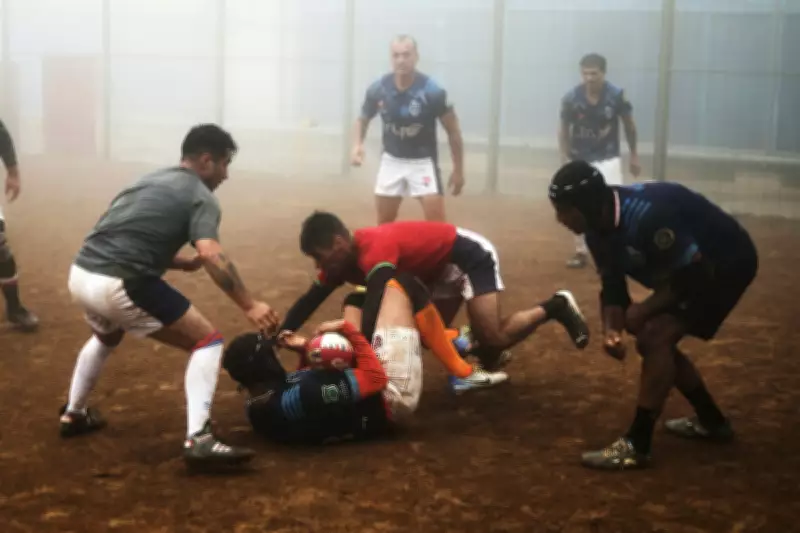
From Concrete Walls to Rugby Fields: Chile's Groundbreaking Prison Team
What began as a simple workshop behind barbed wire has evolved into Chile's first official rugby team formed within prison walls. Rugby Unión Libertad, based at the Valparaíso Penitentiary Complex, is transforming lives through sport, discipline, and hope for social reintegration.
Intense Training Behind Bars
The team follows a demanding schedule that mirrors professional rugby leagues: three days of field training, two days in the gym, and matches every weekend. This rigorous routine serves a purpose far beyond athletic development—it prepares inmates for life after incarceration.
"Rugby freed me; it healed my soul," said Alex Javier Silva, 48, who has been incarcerated since 1999. "Here you have no heart, no mind—you're not at peace with anything. You're like an animal."

The program began in 2016 as part of a workshop led by the Addiction Treatment Center. Initially attracting about 50 inmates, participants used rugby's oval ball—affectionately called the "pill"—as a means to cope with the psychological weight of imprisonment.
Overcoming Prison Challenges
Playing rugby in prison presents unique difficulties. The Valparaíso facility operates at nearly double its capacity, with 3,351 inmates crammed into space designed for 1,919. This overcrowding leads to precarious hygiene conditions and fuels internal violence.
"Violence is rampant here," explained Jorge Henríquez, 42. "There's a lot of rage; sometimes you explode for no reason, and so with rugby you regulate that, you start to distance yourself from conflicts."
Coach Leopoldo Cerda, who has spearheaded the project since its inception, noted the remarkable transformation in players. "The first thing is discipline, mastering self-control and anger management, since there's a lot of physical contact in rugby," he said. "And they've managed to overcome that."
From Prison Yard to National Competition
The team's journey reached a historic milestone in 2024 when Rugby Unión Libertad faced Los Cóndores, Chile's national rugby team that will compete in the 2027 Rugby World Cup in Australia. This marked the first time prisoners left Valparaíso prison to compete against a national team.
"It was an epic battle," recalled Silva. "Nobody has ever done that in Chile. And there we were, some mere prisoners, playing against them. Everyone was watching, we were on TV."
The match, held at another prison north of Santiago, provided unprecedented visibility for the program and attracted more supporters to the cause.
Building a Foundation for Freedom
Off the field, the team became the cornerstone of Fundación Libertad (Freedom Foundation), established in November by former inmates, educators, psychologists, and coaches. The nonprofit supports released prisoners through rugby, training, counseling, and therapy.
"They want to change," said psychologist and former national rugby player Cynthia Canales, president of the foundation. "We also want to show that there is a lack of opportunities, that we have to address the stigma."
Guillermo Velásquez, 42, who participated in the first rugby workshop a decade ago, credits the program with saving his life. "If the Libertad team hadn't existed inside the prison, society would have had one more criminal," said Velásquez, who left prison seven months ago.
Beyond the Barbed Wire
The program's success has created a model for other inmates hoping to join Unión Libertad. "New guys keep arriving," said coach Gonzalo Delgado. "They see from the cellblocks how they train and start preparing, even improving their behavior so they can train."
To participate, inmates must demonstrate good behavior and cultivate teamwork skills. Isaac Falcón Espinace, head of the Valparaíso Penitentiary Complex, emphasized how rugby provides constructive use of time that might otherwise be spent on antisocial activities.

Now, former inmates continue their training through "All Free"—the external branch of Unión Libertad. Instead of practicing on a tiny dirt field under constant surveillance, they train on the vast grass fields of Valparaíso, maintaining the discipline and camaraderie that began behind bars.
"Often, many of these men have the desire to change, but all they find are closed doors," said coach Cerda. "Society remains deeply prejudiced." Through rugby, Rugby Unión Libertad is working to open those doors, one tackle at a time.





