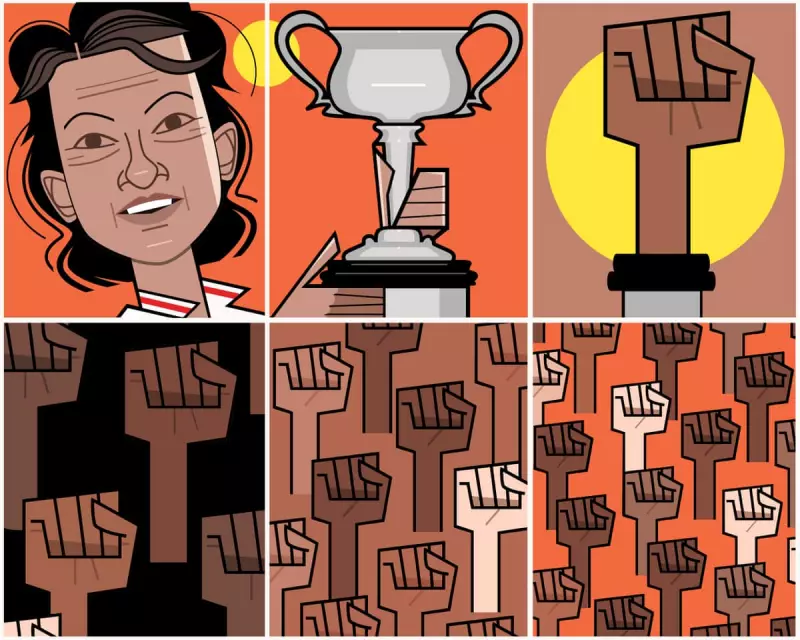
Evonne Goolagong Cawley, a tireless campaigner for Indigenous peoples in sport, now has a day named in her honour at the Australian Open, symbolising a step towards equality in the sporting world. This initiative, while welcomed, underscores the ongoing challenges faced by First Nations communities in accessing and thriving in sports like tennis.
A Scenic Path to Progress
The riverside walk to the Australian Open courts in Melbourne offers a picturesque journey for fans, with rowing crews on the Yarra River and the Melbourne Cricket Ground visible in the distance. Beneath the feet of crowds, a concrete path transforms into an artwork featuring twisting eels, honouring the traditional migration that once provided food for the Wurundjeri people. This setting provides a backdrop for the tournament's efforts to celebrate Indigenous culture.
Celebrating Indigenous Heritage
On Evonne Goolagong Cawley Day, the Australian Open hosted a packed schedule of events to honour First Nations people and culture. Activities included a smoking ceremony on the steps of Margaret Court Arena, a Q&A session with Olympic champion Cathy Freeman, and a performance by pop star Budjerah. Additionally, taster sessions, weaving workshops, and ball kids from Indigenous tennis programmes were featured, highlighting the day's focus on inclusivity.

Although Goolagong Cawley, now 74, was unable to attend due to illness, her influence remains profound. A recent TV drama depicting her career has been acclaimed for portraying her rural upbringing and grand slam success, emphasising her role as a barrier-breaking athlete and mentor to future generations.
Barriers to Participation
Rob Hyatt, an educator for the Koorie Heritage Trust, explains that initiatives like Evonne Goolagong Cawley Day serve a dual purpose: they engage broader communities with Indigenous cultures and encourage sporting participation among First Nations people. "What we're trying to do here is link tennis to people's own culture," says Hyatt. "When participation supports their Aboriginality and identity, that can really encourage them to stick in sport."
However, participation levels for Indigenous Australians lag behind non-Indigenous groups, particularly in tennis, which is often perceived as an elitist sport. Hyatt notes, "You can play football anywhere, any time, but you can't play tennis without a court or a racket. So it's still breaking down those barriers."
The Context of Racism in Sport
This effort must be viewed against the backdrop of Australian sport's ongoing struggle with racism. High-profile cases, such as Taylor Walker's racial slur against teammate Robbie Young in Australian rules football, have sparked debates about permissive clubhouse cultures. In response, Walker's apology video was criticised by some as overly judged, illustrating the complexities of addressing such incidents.
A study by Sport Integrity Australia found that 43% of athletes refrain from calling out racism, a reluctance highlighted by the backlash to cricketer Usman Khawaja's retirement speech. Furthermore, research indicates that more than half of Indigenous players in the AFL are dissatisfied with how racism incidents are handled, and over half of those surveyed in community sports have experienced or witnessed racism recently.
Need for Structural Change
Dr Franka Vaughan, a researcher on anti-racism in sport, acknowledges the value of Evonne Goolagong Cawley Day but stresses the need for deeper reforms. "Representation matters: to see someone like her highlighted is really important," she says. "Still, the question is: how do we go beyond the symbolic nature of that and transform our systems?"
Meaningful change requires a collective approach, as current measures often focus on crisis management rather than prevention. Sports sociologist Ramon Spaaij argues that clubs, often autonomous and resistant to change, need external pressure. "If you want access to public investment in your sport, there should be conditions you have to comply with," he suggests, advocating for government and sports bodies to enforce anti-racism policies.

A Combined Effort for Equality
As visitors enter Melbourne Park through the Birrarung Marr entrance, they pass Indigenous art representing the Kulin Nation's five language groups, with spears of unique shapes for different purposes. This metaphor underscores that tackling racism in Australian sport requires diverse strategies, but ultimately, a unified effort is essential to achieve lasting equality and inclusion.