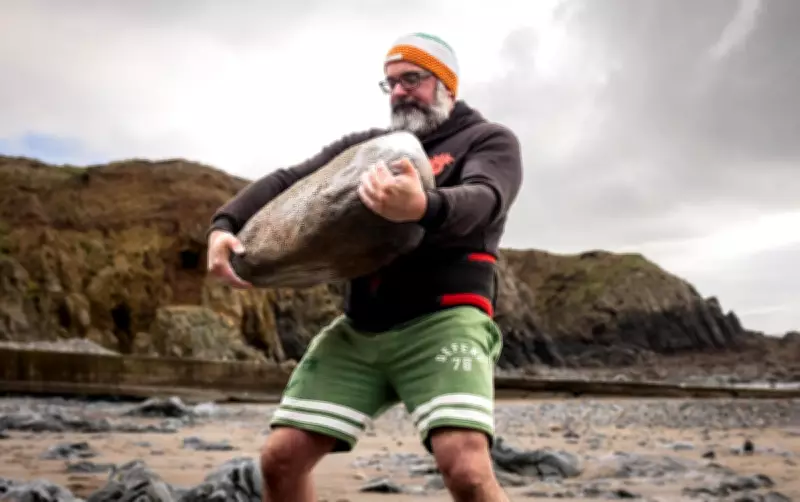
Irishman Revives Ancient Stone Lifting Sport, Unearthing Lost Cultural Heritage
David Keohan, widely recognised by his Instagram alias Indiana Stones, has embarked on a remarkable journey to resurrect the ancient Irish sport of stone lifting. On a beach in County Waterford, he recently demonstrated this forgotten practice by hoisting a 115kg limestone boulder, a feat that echoes centuries of tradition where communities tested strength and forged bonds.
The Revival of a Lost Art
Keohan, a 47-year-old former kettlebell lifting champion, stumbled upon stone lifting during the Covid-19 pandemic when gym closures forced him to use garden stones as weights. Inspired by documentaries on similar practices in Scotland, Iceland, and the Basque region, he made a post-pandemic pilgrimage to lift the 127kg Fianna stone in Scotland. "It was strength, mythology, history. I fell in love with it," he recalls, sparking a passion that has since ignited global interest.
Through his Instagram and TikTok presence, Keohan has become a scholarly Hercules, delving into myth, folklore, and literature to locate boulders across Ireland. He has identified 53 lifting stones in beaches, fields, and graveyards, with hopes to find dozens more. "Every single lifting stone has an amazing story attached to it," Keohan explains. "It's opened up a whole culture that was lost."

Historical Significance and Community Bonds
Historically, stone lifting served various purposes in Irish society. Some boulders were lifted at funeral games to honour the dead, others during harvest festivals, or to mark a chieftain's ascension. "One stone was almost like a job interview to become a stonemason – you had to be strong enough to lift it," Keohan notes. The act of lifting a designated stone, some weighing up to 170kg, was a rite of passage. Lifting it a few inches was known as "getting the wind under it," while raising it to the knees or chest signified champion or phenomenal strength, respectively.
Conor Heffernan, a cultural historian at Ulster University, highlights the broader context. "Stone lifting practices existed across Europe, Asia and Africa," he says, noting Ireland's rocky landscape connection, as seen in legends like Finn McCool's Giant's Causeway. Heffernan adds that in Ireland, stone lifting sometimes served as a proxy for colonial rebellion, with communities using it to assert identity.
Modern Impact and Cultural Renaissance
Keohan's efforts have spurred a devoted following, with groups like Irish Stone Monsters organising competitions and companies like Lyft sponsoring stone lifting studios in Dublin. Enthusiasts now trek to remote areas to attempt lifts, including stones named after figures like Mrs Kildea in County Clare, inspiring women's participation. Last year, the Cloch Bán (White Stone) was even shipped to enthusiasts in Boston, showcasing the sport's growing reach.
Beyond physical strength, Keohan emphasises the cultural reattachment. "This dam burst of information came out," he says, referring to tips from followers and resources like the National Folklore Collection. "It has given me purpose and a reattachment to what it means to be Irish. I'm just showing people the story, and to me that has become more important than the actual lifting."
Future Prospects and Legacy
Keohan, who works at a construction depot in Waterford and is a father of three, has tapped into a broader resurgence of Irish culture, alongside trends in the Irish language and traditional sports. He has written a forthcoming book, The Wind Beneath the Stone, and is applying for a PhD, potentially earning the title Dr Indiana Stones. "I have this mad double life where I'm still working the same job during the week but at weekends I could be anywhere," he grins.
Together with Heffernan, Keohan is advocating for stone lifting to be included in Ireland's inventory of intangible cultural heritage, a step toward potential Unesco recognition. This revival not only celebrates physical prowess but also reconnects Ireland with its rich, storied past, ensuring that a once-forgotten sport continues to inspire future generations.