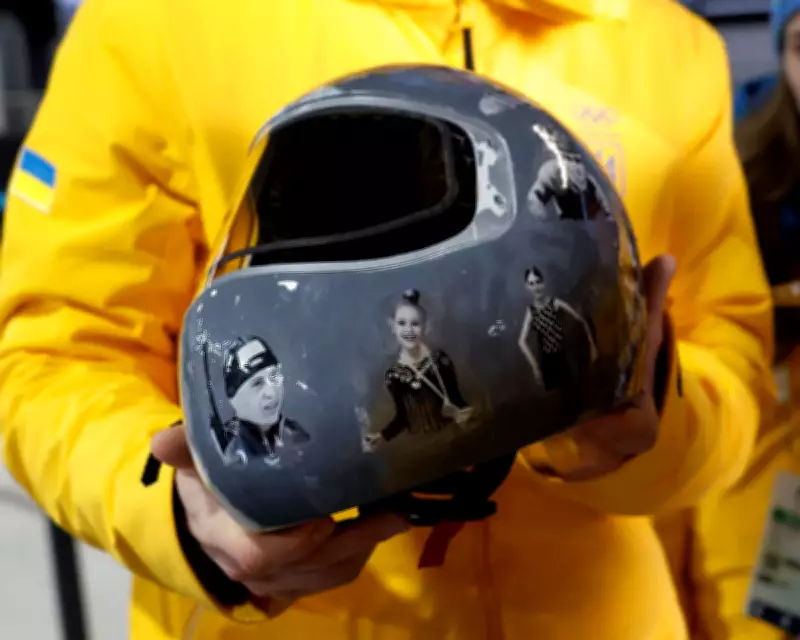
Olympic Controversy Erupts Over Ukrainian Athlete's Memorial Helmet
The Winter Olympics, often heralded as a global stage for unity and athletic excellence, have been plunged into controversy following a contentious decision by the International Olympic Committee. The dispute centres on the Ukrainian skeleton racer Vladyslav Heraskevych, who was barred from competing after refusing to remove a helmet adorned with images of Ukrainians killed during Russia's invasion. This incident has ignited a fierce debate about the boundaries of political expression and neutrality in international sports.
A Helmet of Memory Sparks Disqualification
Vladyslav Heraskevych, determined to honour his fallen compatriots, wore what he termed a "helmet of memory" during his event. The helmet featured portraits of 24 individuals, including athletes and artists who lost their lives in the conflict. Among them were teenage weightlifter Alina Perehudova, boxer Pavlo Ishchenko, and ice hockey player Oleksiy Loginov. For Heraskevych, this was not a political act but a profound gesture of remembrance. "Some of them were my friends," he stated, emphasising the personal significance of the tribute.
The artwork was created by Ukrainian artist Iryna Prots, who described the figures as representing lost potential. "Each pair of eyes could be seeing this world right now, could be fighting for their own medals, could be standing on their own pedestals," she remarked. Despite these heartfelt intentions, IOC President Kirsty Coventry informed Heraskevych just 21 minutes before his race that he would be disqualified if he did not change his helmet. Coventry later addressed the media in tears, unable to persuade the athlete to comply.

Widespread Backlash and Support for Heraskevych
The disqualification triggered an immediate and powerful response from Ukrainian officials and citizens alike. Denys Shmyhal, Ukraine's first deputy prime minister, condemned the IOC's decision as "a disgrace" and "moral surrender dressed up as 'neutrality'." President Volodymyr Zelenskyy echoed this sentiment, awarding Heraskevych a state honour and asserting that "the Olympic movement should help stop wars, not play into the hands of aggressors." In a show of solidarity, Monobank co-founder announced a prize of 1 million hryvnia (approximately £17,000) in recognition of the racer's stance.
This controversy extended beyond Heraskevych. Ukrainian short-track speed skater Oleh Handei revealed that he had been ordered to tape over a quote from poet Lina Kostenko on his helmet, which read: "Where there is heroism, there can be no final defeat." Olympic officials deemed the quotation war propaganda, violating neutrality rules. Handei complied to avoid disqualification, highlighting the broader crackdown on symbolic expressions.
Historical Context and Broader Implications
The IOC's stance on political symbolism is not new. Earlier in the Games, Haiti's delegation faced similar restrictions. Their uniforms, designed by Stella Jean, originally featured Toussaint Louverture, the leader of the Haitian Revolution, on horseback. The IOC ruled the image violated political symbolism rules, forcing its removal and leaving only a red horse against a tropical backdrop. Haitian officials, however, framed their participation as a statement of resilience. Ambassador Gandy Thomas noted, "Haiti's presence at Winter Olympics is a symbol, is a statement, not a coincidence... absence is the most dangerous form of erasing."
These incidents underscore the IOC's delicate balancing act. The Olympic Charter mandates political neutrality, yet athletes inherently represent their nations, carrying with them the weight of history, conflict, and memory. The controversy raises critical questions about whether the pursuit of neutrality inadvertently silences meaningful expressions of identity and remembrance.

Olympic Highlights and Medal Standings
Amid the turmoil, the Games continued with notable achievements. South Korea's Gaon Choi, aged 17, dethroned two-time champion Chloe Kim to win gold in the women's snowboard halfpipe final with a score of 90.25. In the medal standings, Norway led with 14 medals, followed by Italy with 17, and the United States with 14. Australia celebrated its first medal, while Great Britain anticipated potential success in upcoming events like skeleton, where Matt Weston and Marcus Wyatt aimed to become Britain's first male Olympic skeleton champions.
Looking ahead, key events included cross-country skiing, biathlon, snowboard finals, speed skating, figure skating, and skeleton competitions. Italian athlete Federica Brignone's emotional victory in the women's super-G, after recovering from a severe leg injury, captured the spirit of perseverance. "One of those films that you don't believe in, because it's not possible for it to end that well. A fake," she reflected on her gold medal win at age 35.
As the Winter Olympics progress, the debate over Heraskevych's helmet serves as a poignant reminder of the complex interplay between sports, politics, and human expression. It challenges the IOC to reconsider how neutrality is enforced in an increasingly polarised world, where athletes' voices often echo far beyond the arena.