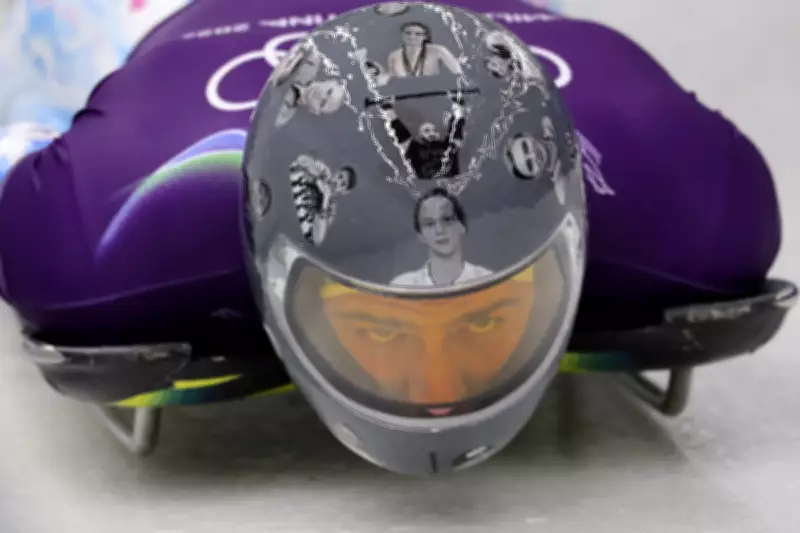
Ukrainian skeleton star Vladyslav Heraskevych has made a poignant statement at the Winter Olympics by training in a helmet adorned with portraits of compatriots killed during the ongoing war in Ukraine. The 26-year-old athlete, who serves as his country's flag bearer, is delivering on a pledge to use the global sporting platform to maintain focus on the devastating conflict that has ravaged his homeland.
A Personal Tribute to Fallen Friends and Athletes
Visible on Heraskevych's distinctive helmet are images of seven individuals who lost their lives in the war: teenage weightlifter Alina Perehudova, boxer Pavlo Ischenko, ice hockey player Oleksiy Loginov, actor and athlete Ivan Kononenko, diving athlete and coach Mykyta Kozubenko, shooter Oleksiy Habarov, and dancer Daria Kurdel. "Some of them were my friends," Heraskevych revealed to Reuters following his training session at the Cortina sliding centre, adding a deeply personal dimension to his symbolic gesture.
Olympic Committee Scrutiny and Rule 50.2
The International Olympic Committee has contacted Ukraine's Olympic Committee regarding Heraskevych's helmet, with the athlete confirming "It's still being processed." This development comes as Heraskevych navigates the complex terrain of Olympic regulations, particularly Rule 50.2 of the Olympic Charter which explicitly prohibits "political, religious or racial propaganda" in Olympic venues and areas.

Neither the IOC nor the Ukrainian committee provided immediate comment on the specific case. Heraskevych, who famously held up a "No War in Ukraine" sign at the Beijing Olympics just days before Russia's 2022 invasion, had previously stated his intention to respect Olympic rules while ensuring Ukraine's plight remained visible throughout the Games.
Historical Context of Olympic Protests
This incident joins a long history of political demonstrations at Olympic events. The most iconic protest occurred at the 1968 Summer Olympics in Mexico City when American sprinters Tommie Smith and John Carlos raised black-gloved fists during the 200 metres medal ceremony to protest racial injustice in the United States. Their action resulted in expulsion from the Games, though both retained their medals.
More recently, at the 2024 Paris Olympics, Afghan breakdancer Manizha Talash was disqualified after wearing a cape bearing the slogan "Free Afghan Women" during a pre-qualifying competition. However, not all symbolic gestures have resulted in sanctions. Australia's women's football team faced no punishment for unfurling a flag representing the first peoples of Australia at the Tokyo Olympics, while two Chinese cyclists received only warnings for wearing badges featuring former leader Mao Zedong on the podium.
The Broader Sporting Landscape
Following Russia's 2022 invasion of Ukraine, athletes from Russia and its ally Belarus were largely excluded from international sport. The IOC has since supported their gradual return under strict conditions, a position that contrasts with Moscow and Minsk's assertion that sport should remain separate from international conflicts.
Heraskevych's helmet serves as a powerful reminder of the human cost of war, transforming his athletic equipment into a moving memorial for fallen Ukrainian athletes and artists. As the Olympic community grapples with the boundaries between sport and politics, this gesture underscores how global sporting events continue to serve as platforms for athletes to address critical issues beyond competition.