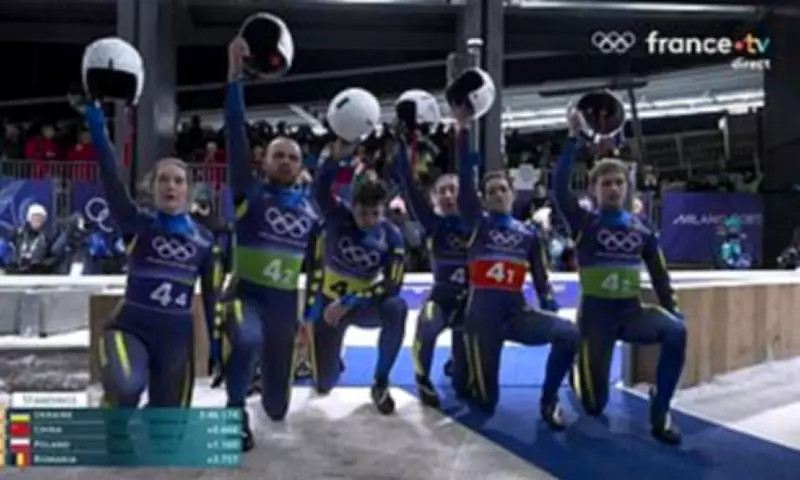
In a powerful display of solidarity, the Ukrainian luge team staged an emotional protest on Thursday following the controversial disqualification of their compatriot, skeleton athlete Vladyslav Heraskevych, from the Milan-Cortina Winter Olympics. The dramatic gesture unfolded just hours after Heraskevych was expelled from the games for refusing to replace a helmet featuring images of victims from the Russian invasion of Ukraine.
Defiant Gesture on the Olympic Stage
The protest occurred during the team relay event on Thursday evening, shortly after Heraskevych's disqualification was officially confirmed. After the women's double pairing of Olena Stetskiv and Oleksandra Mokh completed their run, the entire six-member Ukrainian luge team gathered at the bottom of the track. In a coordinated act of defiance, all six athletes took a knee and held up their helmets, creating a poignant visual statement against the International Olympic Committee's decision.
The Controversial Disqualification
Vladyslav Heraskevych, a serious medal contender in the skeleton event, was disqualified less than an hour before his scheduled competition. The International Olympic Committee announced the decision at 8:10 AM local time, stating that Heraskevych had been given "one final opportunity" to comply with guidelines on athlete expression but had refused to back down.

The IOC's statement explained: "The decision followed his refusal to comply with the IOC's guidelines on athlete expression. It was taken by the jury of the International Bobsleigh and Skeleton Federation based on the fact that the helmet he intended to wear was not compliant with the rules."
The statement continued: "Despite multiple exchanges and in-person meetings between the IOC and Mr. Heraskevych, the last one this morning with IOC President Kirsty Coventry, he did not consider any form of compromise."
IOC's Position and Failed Negotiations
IOC President Kirsty Coventry made a final attempt to persuade Heraskevych to end the standoff on Thursday morning. Coventry, who appeared emotional while addressing reporters, emphasized that the issue wasn't about the message itself but where it was being expressed.
"No one, especially me, is disagreeing with the messaging," Coventry stated. "It's a powerful message, it's a message of remembrance, of memory. The challenge was to find a solution for the field of play. Sadly, we've not been able to find that solution. I really wanted to see him race. It's been an emotional morning."
The IOC noted that Heraskevych had been allowed to display his helmet during all training runs and was offered the option to show it immediately after competition in the mixed zone. The organization highlighted alternative avenues for expression available to athletes, including multifaith centers in Olympic Villages, places of mourning, black armbands during competition under certain circumstances, and opportunities in media zones and press conferences.
Heraskevych's Response and Principle Stand
Heraskevych, who has family members fighting on the frontlines in Ukraine, responded defiantly to his disqualification. The 27-year-old athlete, who served as Ukraine's flag bearer during the opening ceremony, posted on social media: "This is the price of our dignity."
Speaking to reporters while holding the controversial helmet, Heraskevych declared: "I am disqualified from the race. I will not get my Olympic moment. They were killed, but their voice is so loud that the IOC is afraid of them. I told Coventry that this decision plays along with Russia's narrative."
He added passionately: "I sincerely believe that it is precisely because of their sacrifice that these Olympic Games can take place at all today. Even though the IOC wants to betray the memory of these athletes, I will not betray them."
Emotional Fallout and Family Impact
The disqualification created heartbreaking scenes beyond the competition venue. Heraskevych's father and coach, Mykhailo Heraskevych, was seen perched on a mound of snow crying after learning the news of his son's expulsion from the games. The emotional response underscored the personal stakes involved in what became a matter of principle versus Olympic protocol.

The Ukrainian luge team's protest represents one of the most visible acts of solidarity at the Winter Games, highlighting the ongoing tension between athletic competition and political expression in international sports. Heraskevych's sacrifice of his medal prospects for what he described as a matter of dignity and remembrance has created a lasting image of the complex intersection between sports and global conflicts.