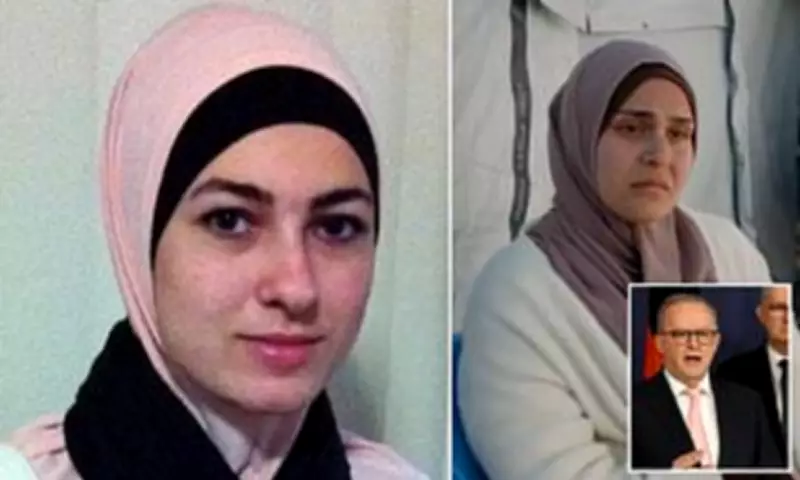
An ISIS bride linked to a terrorist involved in a plot to bomb a flight from Australia once vowed she would never return home, but is now attempting to return with her young son. Sydney woman Janai Safar and her son Uthman, believed to be about nine, were among 13 women and children whose planned flight back to Australia on Friday was cancelled after Syria's foreign ministry was told the Australian government had refused to accept them. The group had been travelling to Damascus International Airport when they were turned back.
Background on Janai Safar
Safar, now in her late 20s, joined Islamic State in 2015 after travelling to Lebanon on a family holiday, where she later married one of the terror group's fighters in Syria. In 2019, Safar lashed out at the Australian government and said she would never return to Australia, claiming she did not want her son raised in the country's culture. 'It was my decision to come here to go away from where women are naked on the street. I don't want my son to be raised around that,' Safar told The Australian.
Links to Terror Plot
Safar's cousin is understood to have married Islamic State commander Tarek Khayat, who was allegedly involved in a plot to bomb an international flight from Australia. Safar and her son were also joined on their failed trip home by another family of 11, who are from Melbourne. The family includes matriarch Kawsar Abbas, her two adult daughters Zahra Ahmad and Zeinab, and their eight children. Zahra, who is in her early 30s, was the second wife of Muhammad Zahab, a former Sydney maths teacher who recruited at least a dozen Australians to join Islamic State in occupied Syria and later rose to a leadership role within the terror group. He was killed in an air strike in 2018.

Funding and US Pressure
It is understood Zahra's father, Mohammed Ahmad, funnelled money to Islamic State through a fake humanitarian charity that raised funds in Australia. He is now believed to be held in an Iraq jail with other alleged ISIS fighters. The United States has been pressuring countries to bring home their citizens from Al Roj refugee camp, where the Australian women have been living, so the camp can be closed. 'The Trump administration is in active communication with nations that have citizens in Syria, specifically within the [Al Roj] camp, to facilitate repatriation of both those with and without ISIS affiliation,' a senior White House official said.
Expert Analysis
Terrorism and religious extremism expert Josh Roose said the camps are very expensive for the US to run. 'This is a very practical problem for the United States. On the one hand, they fund the camps via Kurdish forces in the region, and they want to basically save resources,' he told Sunrise. 'These camps are expensive to run. And in the context of the wider conflict, they're keen to pull back and expend those resources elsewhere.' He said there were also growing security concerns about allowing the camps to continue operating. 'Also, they're on record as having stated that the al-Roj camp and others like it are security problems,' Mr Roose added. 'You've got a concentration of Islamic State former fighters, extended families, and really what that entails is a space for potential further radicalisation and consolidation of that group.'
Government Response
Prime Minister Anthony Albanese said on Thursday that the United States' position was not new. 'That has been their position for some time, and we have indicated our position for some time,' he said. On Friday, Mark Butler denied reports the federal government told Syrian authorities it would not accept the return of the women. 'The prime minister said yesterday quite clearly that we're not engaged with Syrian authorities about this matter,' Butler told Channel Seven. 'We're not across the detail of what these people are trying to do because we're not providing any assistance.'
Former IS fighters from multiple countries, along with their wives and children, were held in a network of camps and detention centres in northeast Syria after the militant group lost control of its territory there in 2019. Though defeated, the group still has sleeper cells that carry out deadly attacks in Syria and Iraq. The Department of Home Affairs and Opposition home affairs spokesman Jonno Duniam have been contacted for comment.