An explosive interview has ignited a political firestorm after a key Donald Trump aide labelled the President's character as that of an 'alcoholic's personality'.
Explosive Claims from the Inner Circle
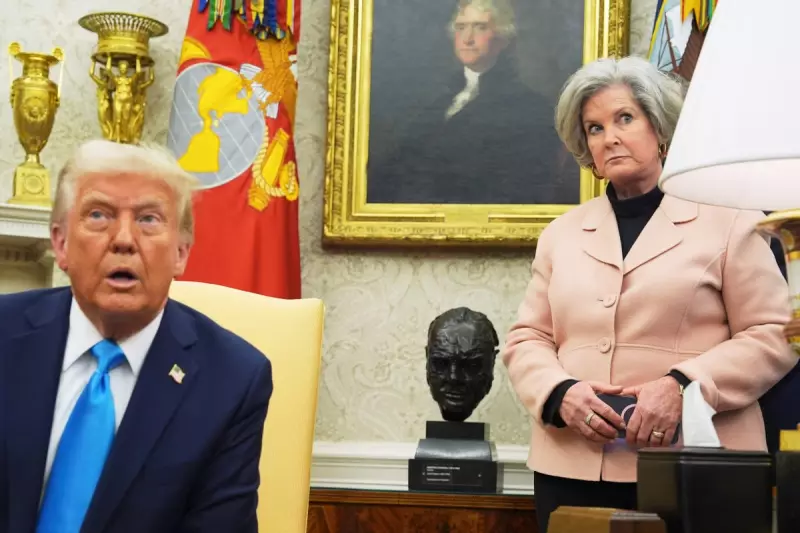
In a detailed Vanity Fair interview published on Tuesday 16 December 2025, White House Chief of Staff Susie Wiles offered a candid view of life inside Trump's Washington. The 68-year-old, who played a pivotal role in Trump's successful 2024 campaign before becoming the first woman to hold her post, did not hold back.
She described Senator JD Vance as having been a 'conspiracy theorist for a decade' and called billionaire Elon Musk an 'odd, odd duck' and an 'avowed ketamine user' who reportedly sleeps in the Executive Office Building. However, her most striking character assessment was reserved for the famously teetotal President.

Wiles, whose own father was the legendary NFL broadcaster and recovering alcoholic Pat Summerall, stated Trump operates with a view that 'there's nothing he can't do'. She explicitly linked this mindset to an 'alcoholic's personality', a term also known in addiction circles as 'King Baby' syndrome.
Although Wiles later distanced herself from the piece on X, calling it a 'disingenuously framed hit piece', the Vanity Fair writer Chris Whipple – who met with her 11 times over 11 months – insists 'everything is on tape'.
Understanding the 'King Baby' Syndrome
For a recovering alcoholic with over two decades of sobriety, like the author of the original piece, these claims resonate deeply. The 'alcoholic personality' persists even without substance use, manifesting as a 'dry drunk'. Key traits, often outlined in recovery literature, include:
- Difficulty accepting criticism or feedback.
- Blaming others for problems or mistakes.
- Expecting special treatment and believing normal rules do not apply.
- A constant need for approval and validation.
- All-or-nothing, extreme thinking.
Addiction specialist Dr Cosmo Duff Gordon of Chelsea Recovery Associates explains this personality is driven by a sense of 'never enough' and is accompanied by a 'disregard for other people', rooted in a belief that one is the 'centre of the universe'.
Trump's aversion to alcohol is well-documented, stemming from the tragic death of his older brother, Fred Trump Jr., who died in 1981 at age 42 from a heart attack brought on by alcoholism. The President has stated that not starting to drink prevents the problem. However, experts and those in recovery stress that addictive tendencies can simply transfer to other domains like power, work, or relationships.
The Path of Recovery and Self-Awareness
Overcoming such ingrained behaviour requires intense self-work. The journey involves developing self-awareness, learning to sit with difficult feelings rather than acting on them impulsively, and shifting focus from self-centredness to being of service to others.
Without this conscious effort, the 'alcoholic personality' leads to an inflexible, authoritarian stance – what recovery circles call 'self will run riot'. The single-minded determination Wiles described can be effective in achieving goals but often at a great personal and relational cost, with the individual being the 'last to realise' the impact of their behaviour.
While Wiles's comments have sparked controversy, they open a rare window into the psychological dynamics at the heart of power. They underscore a challenging truth: behavioural change is only possible with profound self-awareness and a willingness to confront one's own 'blind spots', a process that often begins only when one hits a personal 'rock bottom'.