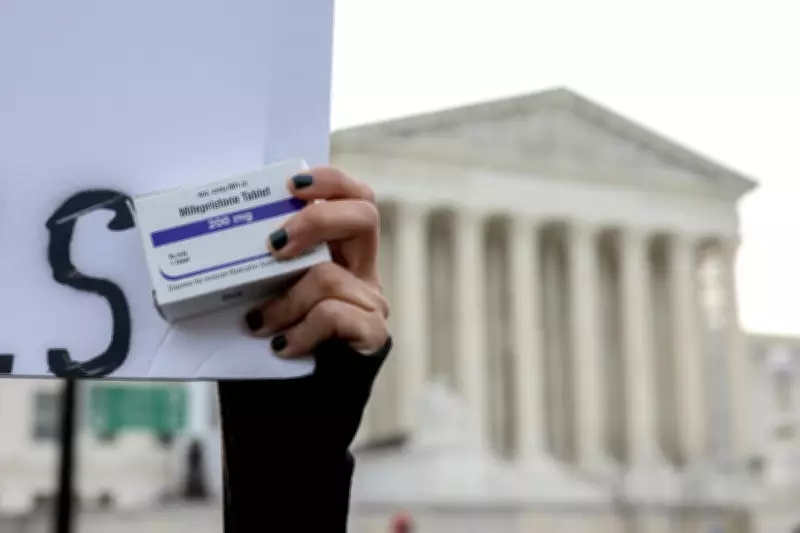
Abortion pills are increasingly becoming a primary method for terminating pregnancies in the United States, prompting a significant legislative response from opponents in states where abortion is already prohibited. Lawmakers across these jurisdictions are now focusing intensely on measures designed to crack down on the distribution and use of these medications, particularly those sent by out-of-state providers via telehealth services.
Survey Highlights Shift to Telehealth in Ban States
A survey released on Tuesday underscores the growing reliance on abortion pills in states with strict bans. The data indicates that in 2025, for the first time, more women in the thirteen states that prohibit abortion at all stages of pregnancy obtained pills through telehealth prescriptions than by traveling to states where the procedure remains legal. This shift has galvanized anti-abortion efforts, with legislators aiming to stem the flow of these medications across state lines.
Legislative Actions Target Pill Distribution
Several states have moved aggressively to restrict access to abortion pills. In South Dakota, Republican Governor Larry Rhoden recently signed a bill making it a felony to advertise, distribute, or sell these medications. Similar measures have advanced through both legislative chambers in Mississippi, though differences between House and Senate versions must be reconciled before reaching Republican Governor Tate Reeves.

According to a Guttmacher Institute survey, which supports abortion rights, at least three states—Florida, Oklahoma, and Texas—already have laws specifically banning providers from mailing pills to patients. Louisiana has taken a further step by classifying mifepristone, one of the key drugs used in medication abortions, as a controlled dangerous substance.
Bills Advance in Multiple States
Legislation aimed at blocking abortion pills has cleared one chamber in Arizona, Indiana, and South Carolina this year. Republicans control the legislatures in all three states and hold the governor's office in two. However, in Arizona, any restrictions that pass could face a veto from Democratic Governor Katie Hobbs, highlighting the political tensions surrounding this issue.
Court Battles Focus on Federal Rules
Legal challenges are also centering on abortion pills, with multiple states contesting federal regulations that allow mifepristone to be prescribed via telehealth. If these lawsuits succeed in requiring in-person prescriptions, they could significantly hinder the ability of out-of-state providers to supply pills to ban states.
Louisiana has filed a federal lawsuit, while the attorneys general of Florida and Texas have initiated one in Texas. Additionally, Florida, Texas, Idaho, Kansas, and Missouri are pursuing a similar case in a Missouri court. Texas has launched civil cases, and Louisiana has pursued criminal charges against providers accused of sending pills into their jurisdictions.
New Ban in Wyoming Faces Uncertainty
Wyoming stands out as the only state to impose a new abortion ban this year. Signed into law by Republican Governor Mark Gordon in March, it prohibits abortion at approximately six weeks' gestational age—often before many women realize they are pregnant. This makes Wyoming the fifth state with such an early-term ban, typically based on detecting cardiac activity.
However, the ban's future is uncertain, as courts have previously rejected Wyoming's efforts to limit abortion. In January, the state Supreme Court struck down a broader ban on abortion at all stages of pregnancy, indicating potential legal hurdles ahead.
Punishing Women Remains Unpopular
Despite legislative efforts, no state has adopted measures allowing criminal prosecutions against women who obtain abortions. Proposals to do so have repeatedly stalled early in the legislative process. For instance, a bill in South Carolina reached a Senate subcommittee hearing last year, while one in Tennessee was scheduled for a hearing this month but did not proceed.

Pregnancy Justice, an advocacy group, reports tracking new "abortion-as-homicide" measures in six states in 2026, down from thirteen the previous year. Major anti-abortion organizations, such as National Right to Life, oppose prosecuting women, with state legislative director Ingrid Duran stating, "Women require compassion and support, not prosecution."
Academic Perspectives on Legal Shifts
Melissa Murray, a professor at New York University School of Law, notes that introducing bills with penalties against women can gradually normalize such policies. "You keep pushing the boundary, pushing the envelope, eventually you will get what you're seeking," she said. "It will no longer feel fanciful or shocking." Murray also points out that women are already sometimes charged with crimes related to their pregnancies, citing a recent case in Georgia where a woman was charged with murder after allegedly using an abortion pill and oxycodone.
Abortion on the Ballot in November
Abortion will be a key issue in several state elections this November. In Missouri, lawmakers are asking voters to repeal a constitutional right to reproductive freedom established in 2024. Conversely, voters in other states will consider adding constitutional amendments that largely mirror existing abortion laws.
In Nevada, a constitutional amendment to allow abortion until fetal viability—generally after 21 weeks of pregnancy—passed in 2024 but requires a second voter approval to take effect. Virginia will also have a measure on the ballot guaranteeing the right to reproductive freedom, including access to contraception and abortion care during the first two trimesters.
As state legislatures conclude their 2026 sessions, the focus on abortion pills reflects a broader national struggle over reproductive rights, with telehealth emerging as a critical battleground in the post-Roe era.