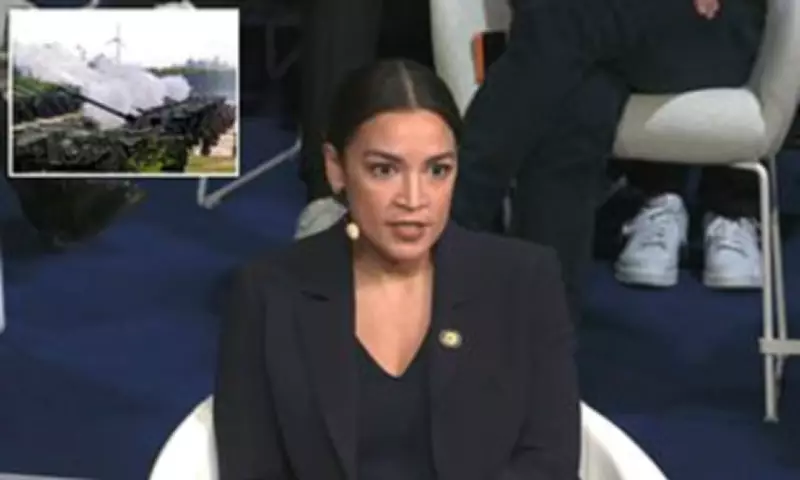
Progressive Congresswoman Alexandria Ocasio-Cortez delivered a surprisingly disjointed and hesitant answer when questioned about how the United States would defend Taiwan in the event of a Chinese invasion. The Democratic Representative from the Bronx, often touted as a potential future presidential candidate, struggled to articulate a clear position during a panel at the Munich Security Conference in Germany on Friday.
A Halting Response on Critical Taiwan Question
When asked directly, 'Would and should the US actually commit US troops to defend Taiwan if China were to move?' Ocasio-Cortez began with a series of verbal stumbles. 'Um, you know, I think that I, uh, this is such a, you know, I think that this is a, um, this is of course, a, uh, very longstanding, um, policy of the United States,' she stated initially.
She continued, 'And I think what we are hoping for is that we make sure we never get to that point and we want to make sure that we are moving all of our economic, research and our global positions to avoid any such confrontation and for that question to even arise.' The congresswoman's unclear response marked a significant stumble as she attempts to bolster her foreign policy credentials, potentially impacting her political future should she pursue a White House bid.

Contrasting Answers from Fellow Panelists
Other participants on the panel offered more definitive responses to the same Taiwan question. Matthew Whitaker, the US Ambassador to NATO since April of last year, provided clearer guidance on US policy regarding Chinese expansionism. 'Well, I mean obviously that would be the president's prerogative as to how to deploy our military. I would just say that we have to deter and defend like we do here on the European continent,' Whitaker remarked about Taiwan.
Michigan Governor Gretchen Whitmer gave a brief but pointed answer, equating the defense of Taiwan's independence with the importance of defending Ukraine from Russia's ongoing invasion. The contrast between Ocasio-Cortez's hesitant response and her fellow panelists' more direct answers was noticeable throughout the discussion.
Strategic Positioning Against Potential Rival
Ocasio-Cortez was likely aiming for a decisive performance in Munich while seeking to establish a stark contrast with Vice President JD Vance's appearance at the conference last year. In February 2023, Vance criticized European countries for what he described as efforts to undermine free speech and free expression, while simultaneously demanding they increase their national defense spending.
If Ocasio-Cortez decides to run for president, Vance could potentially be her opponent. Interestingly, she celebrated a December poll that showed her beating him 51 percent to 49 percent in a hypothetical matchup. During her two panels in Munich, Ocasio-Cortez struck a markedly different tone from Vance, arguing that extreme income inequality fuels the rise of authoritarianism globally.
'Extreme levels of income inequality lead to social instability,' she asserted, adding that countries must 'get their economic houses in order and deliver material gains for the working class, or else we will fall to a more isolated world governed by authoritarians.'
More Confident on Other Foreign Policy Issues
On other international matters, Ocasio-Cortez demonstrated greater confidence and clarity in her responses. When questioned about whether the US should initiate strikes against Iranian nuclear facilities if diplomacy fails, she quickly characterized such action as 'a dramatic escalation no one in the world wants to see.'
'Right now, what the Iranian regime is doing particularly with respect to protesters is a horrific slaughter of, some estimates have it at tens of thousands of people,' she noted. 'I think that jumping into strikes is, I think that right now we have so much, to me, there's still so much runway, so much that we can do to avoid that scenario.'
Regarding US aid to Israel, Ocasio-Cortez offered perhaps her most unambiguous position. 'I think that the United States has an obligation to uphold its own laws, particularly Leahy Laws,' she began, referencing statutes that prohibit funding foreign militaries committing human rights violations.

'The idea of completely unconditional aid no matter what one does, does not make sense. I think it enabled a genocide in Gaza, and I think that we have thousands of women and children dead that was completely avoidable,' she continued forcefully.
Presidential Speculation and Political Future
The topic of a potential presidential run permeated many questions directed at Ocasio-Cortez during the conference, though she consistently avoided direct engagement. When New York Times reporter Katrin Bennhold asked if she would impose a wealth tax or billionaire's tax as president, Ocasio-Cortez laughed and shook her head.
'I don't think...we have to wait for any one president to impose a wealth tax. I think it needs to be done expeditiously,' she responded, sidestepping the hypothetical. The 36-year-old congresswoman, who met the constitutional minimum age requirement to run for president last year, has not announced any intention to seek the office.
While immensely popular among progressive voters, Ocasio-Cortez would face significant challenges winning centrist Democrats and undecided voters in a presidential campaign. Additionally, speculation persists that she might launch a primary campaign against Senate Minority Leader Chuck Schumer, adding another layer to her complex political trajectory following her uneven performance on the global stage in Munich.