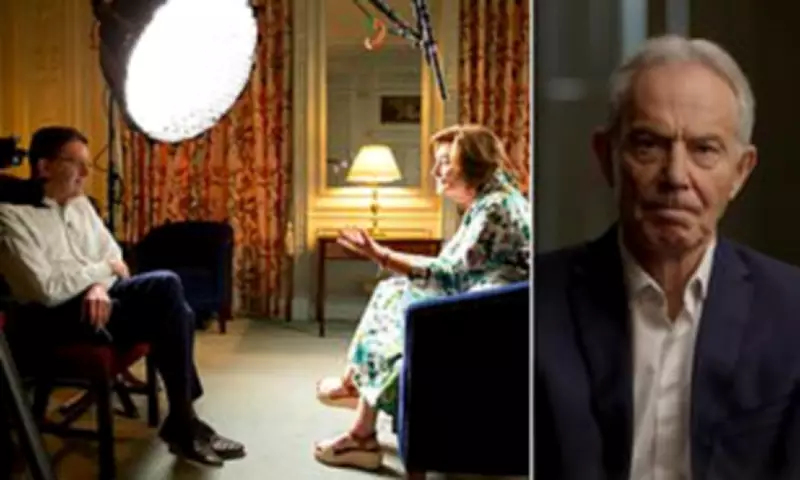
In a remarkably candid television interview, Cherie Blair has openly admitted that her husband, former Prime Minister Sir Tony Blair, excels more as a politician than as a husband. The revelations come from a new Channel 4 documentary series titled 'The Tony Blair Story', where Lady Blair, 71, provides intimate insights into their personal and political lives.
A Candid Assessment of Flaws
When questioned about Sir Tony's shortcomings during the documentary, Cherie Blair did not hold back. "He is an amazing politician," she stated. "As a husband and as a human being, that's a different matter, but that's really between me and him." This frank admission highlights the complex dynamics of their long-standing relationship, which has weathered decades of intense political scrutiny.
Early Political Ambitions and Jealousy
One of the most revealing moments comes as Lady Blair discusses their early political careers. She was selected by the Labour Party as the candidate for North Thanet in the 1983 general election, securing this opportunity before her husband managed to win a last-minute selection for the Sedgefield constituency. When asked how Tony reacted to her securing a parliamentary seat before him, she admitted: "Badly. He felt he had missed his chance. I was going to go and fight a hopeless seat, but at least I was fighting a seat."

This early competition between the couple sheds light on the intense drive that characterized both their careers, with Cherie's advancement initially outpacing Tony's own political trajectory.
Romantic Deficiencies Revealed
The documentary also explores the more personal aspects of their relationship. When questioned about whether Tony had been romantic during their courtship, Cherie laughed and responded: "No, not really. Tony's not very romantic. He's never bought me flowers." This admission adds a humanizing dimension to the former prime minister, contrasting sharply with his public image as a charismatic leader.
Denying the Lady Macbeth Allegations
One of the most persistent rumors about Cherie Blair's role in Downing Street has been the comparison to Shakespeare's Lady Macbeth - the ambitious wife who manipulates her husband for power. Lady Blair firmly rejected this characterization during the interview.
"I thought that was a joke," she stated. "I thought it was Gordon who described me as Lady Macbeth. If anyone thinks Tony's my puppet, they just don't understand the nature of the man."
Influence on Labour Leadership Succession
Despite denying puppet-master allegations, Cherie did reveal she encouraged her husband to allow other politicians besides Gordon Brown to challenge for the Labour leadership. "I was saying to him you need to make space for others than Gordon to come forward," she explained. "And he would always say to me, 'I cannot choose my successor'. And I would say, 'by not doing that, you're effectively choosing Gordon'."
This insight into the Blair-Brown relationship dynamics provides new context to one of the most significant political rivalries in modern British history.
Tony Blair's Reflections on Iraq
The documentary also features Sir Tony, now 72, reflecting on his controversial decision to join the US invasion of Iraq in 2003. He claims that history may yet vindicate this choice, revealing that he was inspired by the 1993 film 'Schindler's List' in making his decision.
"I could not be a 'bystander'," Sir Tony explained. "I owed 'some responsibility to the bigger world'." This cinematic inspiration offers a unique perspective on how popular culture can influence major geopolitical decisions.
Losing Touch with Reality
In perhaps the most startling revelation, Cherie Blair admitted that by the time her husband resigned after a decade in Number 10, he had "lost contact with reality." This candid assessment of the psychological toll of leadership provides a sobering counterpoint to the glamour often associated with high office.
The three-part documentary series begins airing on Tuesday, promising further revelations about one of Britain's most influential political couples. Through these intimate disclosures, viewers gain unprecedented access to the personal costs and private dynamics behind one of the most significant political partnerships in modern British history.