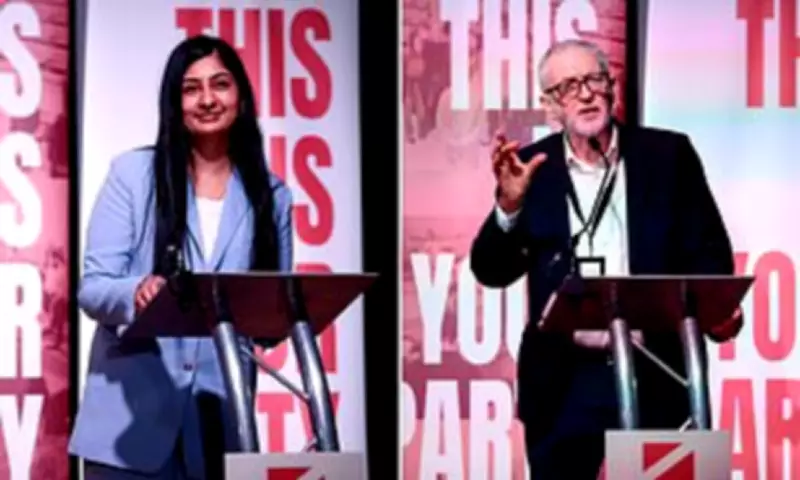
Jeremy Corbyn's newly formed political party, Your Party, is preparing for a significant period of internal conflict and hard-left infighting as it officially announces the permanent results of its leadership elections today. The party will publicly reveal the outcomes of the elections for its 24-member central executive committee (CEC), a process that has been dominated by a fierce rivalry between two distinct factions led by former Labour MPs Jeremy Corbyn and Zarah Sultana.
Factional Battle for Ideological Control
While the majority of the elected positions on the CEC will be filled by ordinary party members, the entire electoral contest has been widely interpreted as a proxy war between Corbyn and Sultana for ultimate control over the party's ideological direction and future trajectory. This power struggle has exposed deep divisions within the fledgling organisation, threatening its cohesion from the outset.
Historical Tensions and Public Accusations
The foundation of Your Party has been marred by persistent conflict between these two prominent figures. Zarah Sultana, who resigned from the Labour Party last summer and initially announced she would co-lead the new party alongside Corbyn, saw that arrangement fail to materialise. Instead, a major and very public dispute erupted between their respective camps.

At the height of the tensions, Ms Sultana publicly criticised Mr Corbyn and his closest allies, labelling them a 'sexist boys club'. In retaliation, she and her supporters successfully pushed through significant rule changes late last year. These changes effectively blocked Jeremy Corbyn from assuming the role of sole leader, forcing the party to adopt a model of collective leadership instead.
The Electoral Contest and Slate Politics
The adoption of a collective leadership structure has technically avoided a direct, head-to-head contest between Corbyn and Sultana for a single top position. However, both MPs have strategically put forward competing slates of candidates for election to the CEC. Furthermore, they have both personally stood for election within the committee's 'public office holders' section, which is reserved for MPs and councillors.
This setup means that whichever faction secures more influence within this section could effectively determine the public face and de facto leadership of the party, regardless of the official collective title. Jeremy Corbyn's faction, operating under the banner 'The Many', includes the former Labour leader himself alongside MPs Shockat Adam and Ayoub Khan. Both Adam and Khan were elected to Parliament in 2024 as so-called 'Gaza Independents', highlighting the party's initial focus.
In contrast, Zarah Sultana's 'Grassroots Left' slate does not feature any other sitting MPs but has notably also endorsed Jeremy Corbyn's candidacy, indicating a complex and layered political dynamic.
Structural Composition of the CEC
The Central Executive Committee is composed of 20 seats allocated to ordinary party members, who are elected on a regional basis to ensure broad representation. An additional four seats are specifically reserved for and elected from among Your Party's public office holders, such as its Members of Parliament and local councillors. It is within this latter category that the most intense factional competition has occurred.
Broader Conflicts and Conference Drama
The rivalry has extended beyond the leadership elections, colouring the entire launch phase of Your Party. Disagreements have flared over numerous issues, including the management of the party's initial announcement and the controversial 'unauthorised' launch of an early membership portal.
The tensions came to a head during Your Party's founding conference in Liverpool. Zarah Sultana notably boycotted the first day of proceedings in protest over the exclusion of some of her key supporters and the expulsion of members affiliated with the Socialist Workers Party. Despite this boycott, the conference's eventual decision to back a collective membership model was widely perceived as a strategic victory for Sultana's camp, which had advocated for this approach, counter to Jeremy Corbyn's reported preference for a traditional single-leader structure.

As the results are unveiled, the political future of Your Party hangs in the balance, with its internal unity and public direction dependent on the outcome of this deeply factionalised election process.