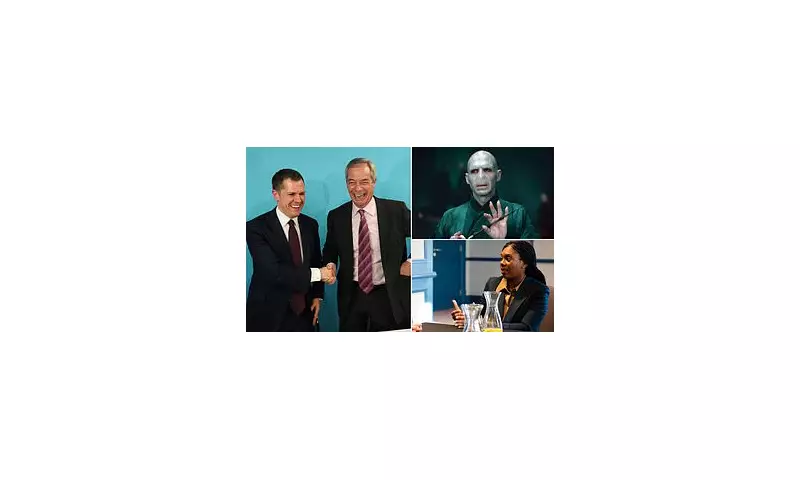
The political landscape was rocked by high drama as former Conservative minister Robert Jenrick dramatically defected to Reform UK, only to be swiftly sacked by Tory leader Kemi Badenoch after evidence of his plot was uncovered. The move has sparked a fierce war of words, with senior Conservative figure Michael Gove warning that Nigel Farage's party now risks being seen as the "Slytherin House" of British politics – a haven for power-hungry intriguers.
The Defection Plot and Swift Sack
Robert Jenrick's planned move to Reform UK was pre-empted in a stunning fashion by Conservative leader Kemi Badenoch. Acting on what she called "clear irrefutable evidence," Badenoch summarily sacked Jenrick from the frontbench and the party itself before he could formally announce his defection. The evidence, reportedly provided by a mole within Jenrick's own team, included a draft defection speech and a detailed media strategy.
Jenrick, the former shadow justice secretary, was officially welcomed by Nigel Farage at a press conference just hours after his expulsion. Farage ironically thanked Badenoch for her decisive action, suggesting it had pushed a wavering Jenrick firmly into Reform's arms. Jenrick has stated he will not trigger a by-election in his Newark constituency, claiming his views are already well-known to his constituents.

Gove's 'Slytherin' Warning and Leadership Critique
In a pointed intervention, former Cabinet minister and close Badenoch ally Michael Gove drew a vivid parallel to the Harry Potter series. He suggested that with the defections of Jenrick and Nadhim Zahawi earlier in the week, Reform UK is in danger of being perceived not as a fresh political force, but as "Slytherin House" – the Hogwarts house synonymous with duplicity and a hunger for power, famously home to the villain Lord Voldemort.
"They look rather more like the home of those who are the intriguers," Gove told BBC Radio 4's Today programme. He argued that Jenrick's reputation had been severely damaged, as he was "caught mid-plot" and was not in control of the narrative. Gove contrasted this with Badenoch's "strong" action, which he said sent a message of strength to the country.
Gove also highlighted a growing internal tension within Reform, pointing out that energetic figures like London mayoral candidate Laila Cunningham and businessman Zia Yusuf have insisted the party must be a "fresh force," not merely a refuge for ex-Tories. He speculated that Jenrick's arrival might ignite a succession battle alongside Farage's presumed heir, Zia Yusuf.
Conservative Reaction and Unity Claims
The Conservative response has been one of public unity and condemnation of Jenrick. New shadow justice secretary Nick Timothy insisted the party was "united" under Badenoch's leadership, a sentiment he claimed was shared by colleagues in Parliament who were impressed by her decisiveness. He personally vowed to "die a member of the Conservative Party."
Tory MP Mark Francois delivered a damning personal verdict, stating he felt "desperately let down" and that Jenrick's actions were an "ego trip." Badenoch, campaigning in Scotland, doubled down, stating Jenrick was now "Nigel Farage's problem" and that "it is not a blow to lose someone who lies to his colleagues."
Despite this public front, significant private dismay persists among some MPs, and the party remains braced for the possibility of further defections. The episode has, however, appeared to bolster Badenoch's authority in the short term, with allies confident she has stemmed the immediate flow.