Government Left Powerless After Palestine Action Ban Ruled Unlawful
The government finds itself in a deeply compromised position following a High Court ruling that declared the proscription of Palestine Action as a terrorist organisation unlawful. This decision has left ministers facing accusations of tyranny while simultaneously rendering them practically powerless to control the group's activities, which have included property damage and actions that Jewish communities describe as threatening.
A Humiliating Failure for the Government
Whatever arguments might be made about the merits of attempting to outlaw Palestine Action, the government's approach has proven to be a humiliating failure on multiple fronts. The High Court determined that the ban was "disproportionate" and violated human rights legislation, creating what legal experts describe as the worst possible outcome for ministers.
The situation is further complicated by the fact that two separate juries have refused to convict Palestine Action activists in high-profile cases, despite what prosecutors described as overwhelming and unchallenged evidence of wrongdoing. This has created what observers characterize as a legal and political mess with no clear resolution in sight.

Home Secretary's Response and Police Inaction
Home Secretary Shabana Mahmood expressed disappointment with the judges' decision, though legal analysts note she should not have been surprised given the legal precedents involved. While the government plans to appeal the ruling, maintaining the ban temporarily, many consider it effectively a dead letter in practical terms.
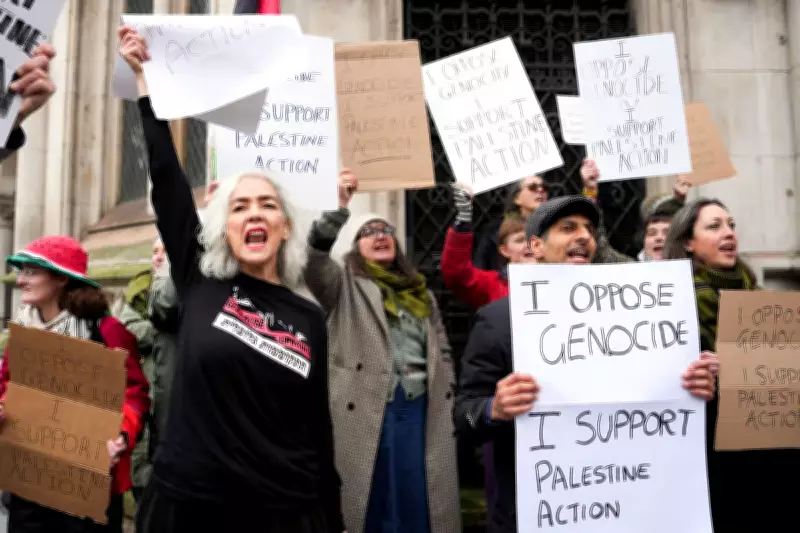
The Metropolitan Police demonstrated this reality when they declined to arrest protesters outside the High Court who openly displayed placards supporting Palestine Action. Police officials cited the "unusual" situation created by the court ruling as justification for their inaction, though legal experts question whether this constitutes a lawful reason to fail to uphold existing legislation.
Legitimate Concerns and Dangerous Rhetoric
When former Home Secretary Yvette Cooper presented the case for proscription to Parliament last June, she raised reasonable concerns about Palestine Action's activities. The Board of Deputies of British Jews has warned that the group has repeatedly targeted buildings hosting Jewish communal institutions and Jewish-owned businesses, creating fear and disruption that extends far beyond immediate protest sites.
We live in a troubling period where legitimate criticism of Israeli military actions in Gaza has too frequently devolved into blaming British Jews for these actions—a classic antisemitic trope, whether conscious or unconscious. Following attacks on Jewish communities in Manchester, Bondi Beach, and elsewhere, all those protesting Palestinian suffering must be exceptionally clear about the peaceful nature and intent of their cause.
The Limits of Acceptable Protest
Neither the government nor the British public should accept the destruction of vital defence equipment as an acceptable expression of free speech. As Cooper correctly noted, "direct action" does not equate to vandalism in pursuit of political objectives. Palestine Action does not possess the right to destroy key national infrastructure and defence firms that provide services to Ukraine, NATO allies, and UK defence capabilities.
The consequences extend beyond property damage. Last year, a Palestine Action activist was allegedly responsible for breaking a police officer's spine with a sledgehammer during a raid on an Israel-based defence firm's factory. The jury failed to reach a verdict in that case, and a retrial remains pending.
Democratic Protections and Proportional Responses
Britain remains a democracy with ancient rights to protest protected by common law, human rights conventions, and the safeguard against bad law guaranteed by jury trials. There exist better ways for Palestine Action to advance its arguments than through violence, as demonstrated during the general election when numerous so-called Gaza independents were elected to Parliament.

If Palestine Action moves beyond peaceful, noisy protest and begins employing intimidation and violence, its members should be restrained through proportionate action by authorities, just as with any other group. The government's fundamental error was selecting the wrong measure to maintain peace regarding Palestine Action.
The Terrorism Designation Problem
Despite the violence sometimes deployed by its activists, it was always absurd to categorize Palestine Action as a terrorist organisation, placing them alongside groups like Islamic State or the Provisional IRA. This designation resulted in retired individuals and wheelchair users—obviously not terrorists in any accepted sense—being manhandled by police for holding cardboard signs.
The law descended into farce when confronted with banners proclaiming loyalty to "Plasticine Action", dragging legal proceedings into disrepute. Existing laws and powers already address demonstrations and direct action, including legislation covering incitement to racial or religious hatred, disorder, criminal damage, and grievous bodily harm.
A Path Forward
If Palestine Action represents a more sinister organisation than it appears, as ministers have claimed, yet still doesn't clearly qualify as terrorist, the government should frame new legislation accordingly and justify it to Parliament and the public. Currently, the government has rendered itself practically powerless to address Palestine Action while simultaneously infringing on common protest rights—a classic lose-lose scenario.
Even if the ban is upheld on appeal, juries may still choose to ignore it, along with other relevant laws, and free Palestine Action protesters. Home Secretary Mahmood will need to reconsider what should replace this unenforceable ban, developing a more nuanced approach that protects both public safety and fundamental democratic freedoms.