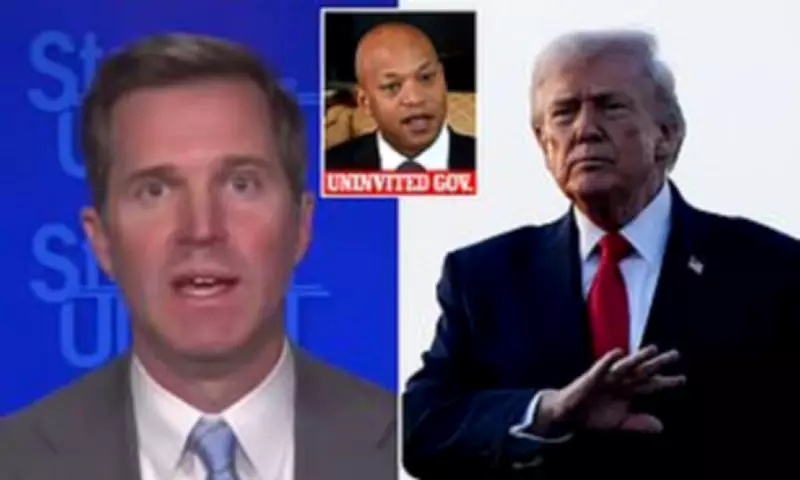
Democratic Governor Boycotts Trump's White House Dinner in Protest Over Exclusion of Black Governor
Kentucky Governor Andy Beshear, a Democrat considered a potential future presidential candidate, has announced he will boycott President Donald Trump's upcoming White House dinner. This decision comes in response to the exclusion of Maryland Governor Wes Moore, who is currently the only black governor in the United States, from the invitation list for the 2026 National Governors Association event.
Controversial Guest List Sparks Bipartisan Backlash
The traditionally bipartisan gathering, scheduled for February 20, has become mired in controversy after Trump's administration extended invitations to all Democratic governors except two notable exceptions: Colorado Governor Jared Polis and Maryland Governor Wes Moore. Governor Moore holds the distinction of being both the first black governor in Maryland's history and the only currently serving black governor nationwide.
In a revealing post on his Truth Social platform, President Trump addressed circulating rumors that he planned to invite only Republican governors to the event. While confirming that Democratic governors would indeed receive invitations, Trump explicitly stated that Polis and Moore were excluded because he deemed them "not worthy of being there."

Beshear Takes a Stand Against Perceived Discrimination
Governor Beshear, who discussed the situation with CNN's Jake Tapper on Sunday morning, declared he would stand in solidarity with Governor Moore by refusing to attend the White House dinner. "Nearly everything Trump touches, he destroys," Beshear remarked during an appearance on MSNBC's "PoliticsNation" with Al Sharpton on Saturday. The 48-year-old governor suggested that racial prejudice might have influenced Trump's decision to exclude Moore from the guest list.
"He has taken an annual bipartisan tradition, and he's turned it into his own 12-year-old birthday party, where he's going to invite some people and not invite others," Beshear criticized. "And the idea that he wouldn't invite Wes Moore, who is our nation's only black governor, in the same set of days that he put out that video of the Obamas the way he did, just speaks volumes."
Trump's Controversial Social Media Activity
Beshear referenced a particularly inflammatory meme that Trump reposted earlier this month, which depicted the faces of former President Barack Obama and former First Lady Michelle Obama superimposed on ape bodies. Such imagery carries deeply racist historical connotations and prompted widespread bipartisan condemnation before Trump eventually deleted the post.
"Wes Moore is a friend of mine," Beshear affirmed. "I certainly ain't going if he's not invited." The Kentucky governor further characterized Trump's behavior as demonstrating that his "pettiness knows no bounds."
Moore Responds with Dignity and Defiance
Governor Moore, upon learning of his exclusion from the White House dinner, responded with measured dignity. "Well I can't speak to the president's heart, I can speak to his actions," Moore told CBS News. "And I do want to be clear to the president, respectfully, you do not determine my worthiness. God determines my worthiness. The people of Maryland determine my worthiness. They are who I answer to, not him."
The Maryland governor emphasized his governing philosophy: "I have been very clear with the people of my state that I will work with anyone, but I will bow down to no one. And I think the president has a problem with that." Moore added that if the meeting was intended to devolve into "name-calling," he was content to skip the event entirely.
Trump's Justification for the Exclusion
In his extensive Truth Social post, President Trump provided specific reasons for excluding Governor Moore, referring to him as "the foul mouthed Governor of Maryland, who fraudulently stated that he received Military medals, A LIE, is doing a terrible job on the rebuilding of the Francis Scott Key Bridge, and has allowed Baltimore to continue to be a Crime Disaster."

Trump similarly criticized Colorado Governor Jared Polis for allegedly placing a "73-year-old cancer stricken woman" in solitary confinement and "attempting to fight Democrat Voter Fraud." Despite these exclusions, Trump noted that he had extended invitations to other Democratic governors with whom he has publicly feuded, including Illinois Governor JB Pritzker, whom he called a "SLOB," and California Governor Gavin Newsom, described as "horrendous."
The president concluded his social media statement with: "I look forward to seeing the Republican Governors, and some of the Democrats Governors who were worthy of being invited, but most of whom won't show up."
Broader Implications for Political Discourse
This incident highlights the deepening divisions within American politics and raises questions about the preservation of bipartisan traditions. The National Governors Association dinner has historically served as an opportunity for state executives from both parties to engage in constructive dialogue with the sitting president, regardless of political differences.
Governor Beshear's boycott represents a significant protest against what he perceives as discriminatory exclusion, while Governor Moore's response underscores a commitment to maintaining dignity in the face of personal attacks. The controversy has drawn attention to issues of racial representation in American governance and the tone of political discourse at the highest levels of government.
Representatives for Governors Moore and Beshear, as well as President Trump's team, have been contacted for further comment regarding this developing political dispute.