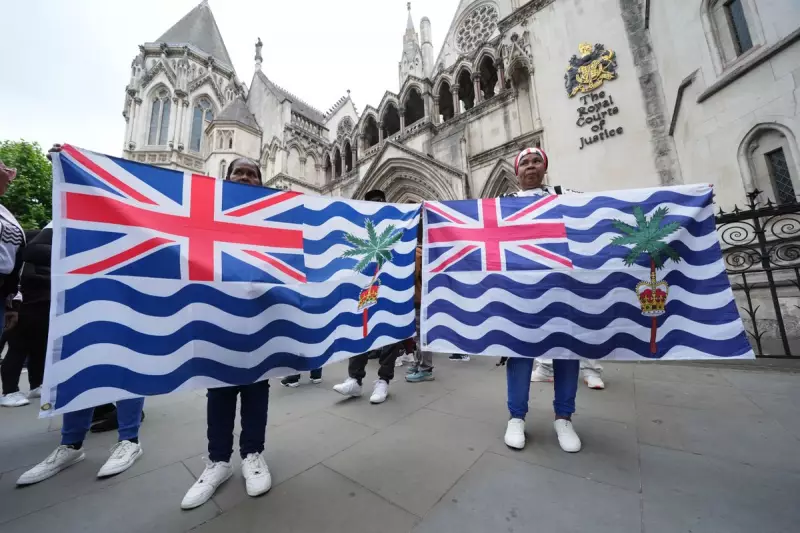
Labour MPs Stage Rebellion Over Chagos Islands Sovereignty Transfer
The government has faced a significant backbench rebellion in the House of Commons concerning the controversial deal to transfer sovereignty of the Chagos Islands to Mauritius. Labour MPs have urged ministers to pause the agreement following unexpected criticism from former US President Donald Trump, creating fresh parliamentary turmoil over this strategically sensitive issue.
Trump's Intervention Sparks Parliamentary Revolt
The political drama unfolded after Donald Trump took to his Truth Social platform to criticise the UK's approach, stating the British government was proceeding with the sovereignty transfer for "no reason whatsoever." This intervention from across the Atlantic has complicated the legislative process, with the Diego Garcia Military Base and British Indian Ocean Territory Bill currently caught in parliamentary wrangling between the Lords and Commons.
Backbencher Graham Stringer, representing Blackley and Middleton South, led the charge for a pause during Tuesday's debate. "I have heard the Foreign Office minister in this chamber, a number of times, say the United States supported this deal," Stringer told MPs. "The President of the United States clearly doesn't support it anymore."
Cost Concerns and Defence Implications
The rebellion centred on several key amendments proposed by peers, with Labour MPs expressing deep concerns about:
- Financial transparency regarding the treaty's costs
- Defence implications for UK interests in the Indian Ocean
- Protection mechanisms should military use of Diego Garcia become impossible
Stringer emphasised the financial burden, stating: "We're going to pay for something that we didn't used to have to pay for, it will have consequences for our ability in the Indian Ocean to look after our defence interests, and we don't know how much it will cost."
Referendum Proposal and Discrimination Concerns
The Labour backbencher also raised significant human rights issues, arguing that the indigenous Chagossian people are being discriminated against in the current process. Stringer advocated for a referendum on sovereignty, stating: "The only solution to the central issue of this problem is not a survey that the House of Lords are doing in good faith. It is to have a referendum."
However, Speaker Sir Lindsay Hoyle ruled such a referendum amendment out of order because it would impose a charge on public revenue, which the Lords cannot propose under parliamentary rules.
Voting Patterns and Government Response
The rebellion saw Labour MPs Graham Stringer, Peter Lamb (Crawley), and Bell Ribeiro-Addy (Clapham and Brixton Hill) voting against the government on multiple amendments:
- An amendment to stop payments to Mauritius if military use of Diego Garcia became impossible was rejected 344 to 182
- A requirement to publish treaty costs was defeated 347 to 185
- A proposal for expenditure publication within the first financial year failed 347 to 184
Foreign Office minister Stephen Doughty remained defiant, stating: "We won't pause in defending our national security interests and those of our allies. We will do the right thing to keep our national security and the operations of this base working as they have done for many decades."
International Pressure and Legal Complexities
The government maintains the deal is necessary following international court rulings favouring Mauritian sovereignty claims, which ministers argue threatened the future of the strategically vital Diego Garcia facility. Doughty attempted to reassure MPs about American support, noting: "The United States and President Trump welcomed this deal in the spring... We will, of course, have discussions with the administration in the coming days to remind them of the strength of this deal."
Conservative former minister Simon Hoare highlighted the diplomatic challenge, suggesting President Trump had "dropped a depth charge" on support for the legislation and questioning what Parliament should interpret as America's true position.
The rebellion underscores the complex intersection of international diplomacy, defence strategy, and post-colonial sovereignty disputes that continues to challenge UK foreign policy in the Indian Ocean region.