Michigan Senate Hopefuls Demand Democratic Spine in Shutdown Showdown
Three Democratic candidates vying for Michigan's Senate seat have issued a unified call to their party's leadership in Washington: show some backbone in the looming government shutdown fight. The race, set against the backdrop of one of America's most politically competitive states, has become an ideological proxy battle for the Democratic Party's future direction.
A Purple State Battle With National Implications
This contest could ultimately determine control of the Senate chamber and whether Donald Trump can continue advancing his agenda through Congress. At a United Auto Workers candidate forum in Washington, D.C., the candidates demonstrated remarkable alignment on one critical issue: refusing to fund the Department of Homeland Security without substantial reforms to Immigration and Customs Enforcement.
Despite policy differences between state senator Mallory McMorrow, congresswoman Haley Stevens, and progressive candidate Abdul El-Sayed, all three share a similar stance toward the impending funding deadline. Their unified position represents a significant challenge to Democratic leadership as the party attempts to protect its numbers in this crucial battleground state.
Challenging the Status Quo
As the DHS shutdown deadline rapidly approaches, Democratic senators on Capitol Hill took notice that all three of their party's Michigan Senate candidates are vowing to disrupt the established order. This call for change, once largely confined to the Bernie Sanders wing of the Democratic Party, has now become mainstream among these contenders.
Notably, none of the three candidates—including Stevens, who reportedly enjoys favor from the Democratic Senatorial Campaign Committee—are willing to publicly endorse Chuck Schumer for another term as Senate Democratic leader. McMorrow, endorsed by Senators Chris Murphy and Martin Heinrich, has explicitly called for Schumer to step down from his leadership position.
The Immigration Enforcement Debate
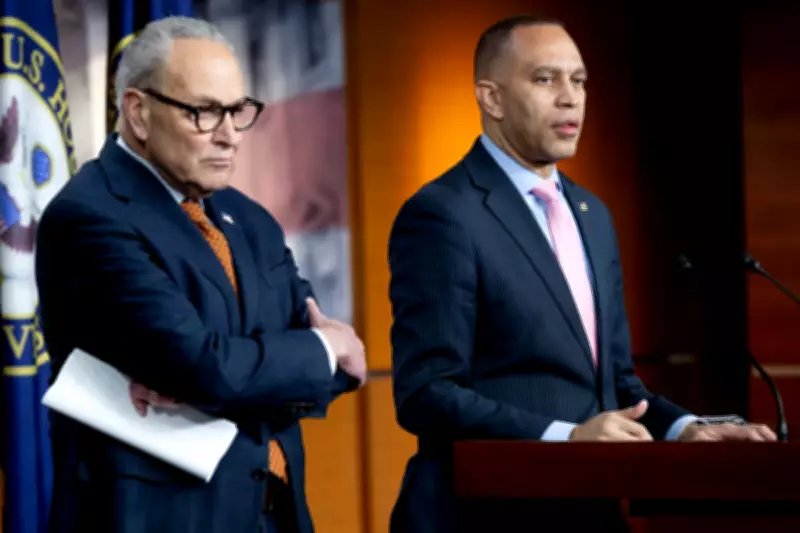
Democratic leaders including Schumer and House Minority Leader Hakeem Jeffries have proposed ten reforms they want codified into legislation to fund ICE and DHS for the remainder of the calendar year. However, both McMorrow and El-Sayed told The Independent that these requests fall short of what's necessary.
El-Sayed, the Sanders-backed candidate, supports abolishing ICE altogether, calling it a paramilitary force. He argues that Trump's deployment of immigration enforcement resources to Minneapolis represents more than just immigration policy enforcement—it's a test of using armed forces on American streets to exert control ahead of potential election subversion attempts.
"This is about normalizing the use of paramilitary force on our streets," El-Sayed stated. "Why? Because you want to do it in a moment where it actually has impact, and that looks like the 2026 election."
Leverage and Negotiation Strategy
McMorrow largely concurred with this assessment, telling The Independent: "You need to hold firm. We cannot fund this agency with a penny more until it is overhauled from the ground up." She specifically called for removing ICE from streets immediately, ending roving patrols, preventing warrantless home entries, and stopping operations near schools and childcare centers.
The state senator rejected arguments that the minority party lacks sufficient leverage to force Republican concessions, asserting that Democrats actually hold the "upper hand" in negotiations. "Demand a full overhaul of this agency," she urged. "Use the budget to examine spending. Is this the amount of money this agency really needs, or can it be allocated somewhere else?"
A Shift in Political Calculus
What seemed like an improbable political maneuver just weeks ago has gained substantial traction following the shocking fatal shootings of Minneapolis residents Alex Pretti and Renee Good by ICE and Border Patrol agents earlier this year. These incidents have dramatically altered the political landscape, erasing the malaise that settled over Trump's Washington adversaries after last fall's record-long government shutdown ended.
Stevens, while not immediately responding to The Independent's request for comment, previously stated on social media that "not one penny more" should go to ICE. This position aligns her with her competitors despite their different ideological backgrounds, demonstrating how immigration enforcement has become a unifying issue among Michigan's Democratic Senate hopefuls.
As Congress remains embroiled in the funding battle pushed forward by a two-week continuing resolution, the Michigan candidates' unified stance represents both a challenge to party leadership and a reflection of growing Democratic base demands for more assertive opposition to Trump administration policies they view as threatening both immigrant communities and democratic institutions.