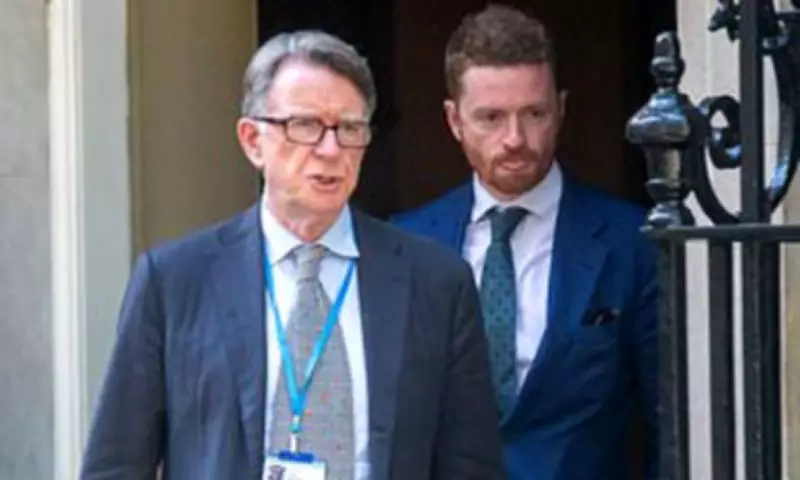
When questioned about whether Morgan McSweeney had done more than any other individual to eliminate the hard-Left faction from the current Labour Party, Peter Mandelson hesitated briefly before delivering his response. 'I would have to affirm that statement. I hold him in exceptionally high regard,' Mandelson stated. This revealing conversation occurred in December 2024, shortly after Downing Street officially announced Mandelson's appointment as the next ambassador to Washington, a decision that faced significant opposition from security services and numerous Cabinet ministers.
The Architect of Mandelson's Ambassadorship
Mandelson had substantial reasons to shower praise upon McSweeney, fully aware that he owed his prestigious diplomatic position to him. McSweeney was the pivotal figure who convinced an initially hesitant Sir Keir Starmer to grant Mandelson the most coveted role in the British diplomatic service, despite Mandelson's extensively documented connections to the disgraced financier Jeffrey Epstein. This controversial appointment served as the ultimate demonstration of the immense authority wielded by McSweeney, a 48-year-old who has become the most influential unelected official in Britain, a man whom even senior Cabinet ministers fear to challenge.
From Irish Roots to Political Mastery
Described as both tough and cunning, McSweeney arrived in Britain as a 17-year-old from his hometown of Macroom in County Cork, Ireland, and he still retains a gentle Irish accent. His political lineage traces back to his grandfather, Michael McSweeney, who served in the Irish Republican Army during the Irish War of Independence from 1919 to 1921, earning a medal for his service. McSweeney proved to be a restless soul, dropping out of the London School of Economics and briefly working on construction sites, where he quickly realized he was unsuited for such physically demanding labor.

He subsequently enrolled at Middlesex University to study politics, abandoned his studies, traveled to California, and then relocated to Israel, where he worked in a factory operated by Czech Jews and developed a strong work ethic. Upon returning to London, he joined the Labour Party, inspired by the peace process in Northern Ireland brokered by Tony Blair's government. In 2001, he began working at Labour's London Millbank headquarters as an intern during the general election campaign buildup.
The Political Apprenticeship
His breakthrough moment occurred when the receptionist accidentally dropped a vase on her foot. McSweeney stepped into her position, marking the 24-year-old's first interaction with Peter Mandelson, whom he greeted daily as the Labour strategist entered the building as a key architect of Blair's second election victory. Mandelson claims to have no memory of the office junior with the Irish accent from that period. Nevertheless, McSweeney deliberately modeled his own political career on the spin doctor, widely regarded as a master strategist and backroom operator.
After the election, he immersed himself in local politics in Lambeth, south London, where he met his wife, Imogen Walker, an actress who served as a local councillor. The borough, once a Labour stronghold, had fallen to the Conservatives and Liberal Democrats following the disastrous leadership of Red Ted Knight from the Militant Tendency. With the assistance of local councillor Steve Reed, now the Housing Secretary, McSweeney successfully restored Labour control over the borough by 2006.
Mastering Electoral Strategy
He learned to campaign street by street, house by house, mastering the art of winning elections even during periods when Labour performed poorly nationally. He achieved this by identifying what voters genuinely desired, rather than what the Left believed they should want. McSweeney applied these skills in Barking and Dagenham, combating the far-Right British National Party, which had secured ten seats on the local council.
His talents soon attracted attention. He worked for the Labour group at the Local Government Association, but his major opportunity emerged with the election of Marxist sympathizer Jeremy Corbyn as Labour leader in 2015. A new pressure group, Labour Together, was established to privately work toward returning the Labour Party to moderate control. Future Chancellor Rachel Reeves was a significant supporter, as was Peter Mandelson.

The Sunday Supper Club Conspiracy
McSweeney and Mandelson became members of a clandestine group known as the Sunday Supper Club, which convened at the Kennington residence of Mandelson's friend Lord Liddle, who had worked in Downing Street during Blair's first term. Over dinners, they meticulously plotted the downfall of the Corbyn project.
So where does Keir Starmer fit into this narrative? In 2019, while publicly campaigning to make Corbyn Britain's prime minister, Starmer secretly spent Monday mornings with trusted aides planning for life after the next election, which he anticipated Labour would lose decisively. This covert group met secretly at the home of Jenny Chapman, then a Labour MP. One morning, to the astonishment of Starmer's close-knit circle of advisors, the Irishman appeared.
Forging the Starmer Alliance
Starmer's associates were instinctively wary. However, Starmer himself was persuaded by the softly spoken McSweeney, who ultimately managed his leadership campaign, securing a comfortable victory. Starmer attributed his success to McSweeney and appointed him as his chief of staff. Yet, the initial two years of Starmer's leadership in Opposition proved disastrous. Following Labour's loss in the Hartlepool by-election in 2021, Starmer dismissed McSweeney from his chief of staff role, reassigning him to oversee campaigning efforts.
This repositioning enabled McSweeney to direct the general election campaign, delivering Labour its most substantial landslide victory since Blair in 2001. Starmer once again credited McSweeney with this triumph. With Mandelson remaining deeply involved, McSweeney orchestrated the composition of the first Starmer Cabinet and effectively became the all-powerful, unofficial deputy prime minister, exercising far greater influence than the nominal deputy, Angela Rayner.
Consolidating Unprecedented Power
Even Chancellor Rachel Reeves deferred to him. Behind the scenes at Number 10, the phrase 'What does Morgan think?' became dominant. He swiftly outmaneuvered former senior civil servant Sue Gray, who survived merely three months as chief of staff, and assumed her position. McSweeney ensured a rapid promotion for his wife, Imogen Walker, who was elected as the Labour MP for Hamilton and Clyde Valley in the last election. She was appointed parliamentary private secretary to the Chancellor, providing McSweeney with his own eyes and ears within the Treasury.
Mandelson spoke at party fundraisers for Walker's campaign, underscoring the powerful personal bond between the two men. Encouraged by Mandelson, McSweeney purged Corbyn supporters, excluded their followers from parliamentary selections, and revised the party's rulebook to guarantee the hard-Left would be barred from any future leadership contests. It was McSweeney who mandated the singing of the national anthem at the Labour Party conference and the embracing of the Union flag.
The Ultimate Political Gamble
Significantly, McSweeney, who typically avoids publicity, was photographed seated near Starmer during his meeting with Donald Trump at the White House in February of the previous year. He was beaming with satisfaction, having successfully persuaded Starmer to appoint Mandelson as ambassador—a decision that would ultimately prove to be a catastrophic miscalculation. This appointment, against substantial opposition, symbolized the zenith of McSweeney's extraordinary influence, cementing his status as the unelected powerhouse steering the Labour government from the shadows.