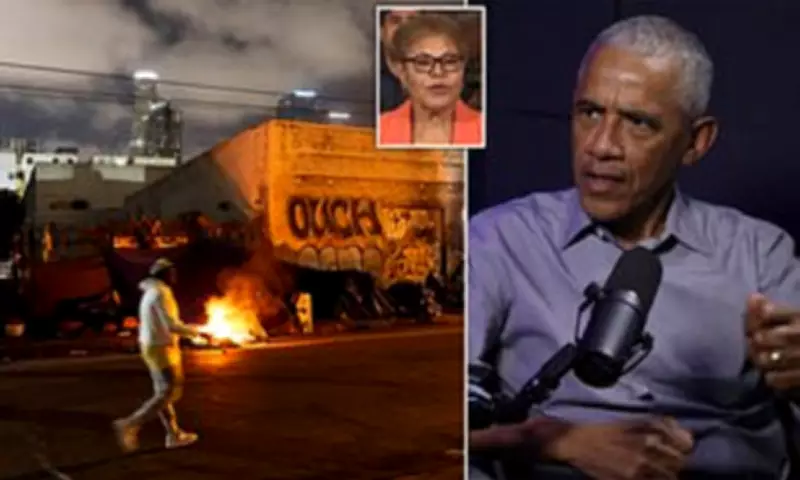
Barack Obama Condemns Los Angeles' Homelessness Epidemic and Urban Decline
Former President Barack Obama has become the latest prominent figure to criticise liberal Los Angeles for its shocking homelessness epidemic, as the city continues to face a noticeable decline. In a wide-ranging interview with podcaster Brian Tyler Cohen, Obama argued that Democrat politicians often take a lax approach to the issue, neglecting accountability and practical solutions.
Obama's Critique of Political Strategy
Obama specifically called out Mayor Karen Bass and other city leaders for employing what he described as 'a losing political strategy' to navigate the homelessness crisis. He emphasised that the average person does not want to navigate around tent cities in downtown areas, highlighting the need for policies that balance compassion with practicality.
'We're not going to be able to generate support for it if we simply say, 'You know what, it's not their fault and so they should be able to do whatever they want,'' Obama stated. He urged Democrats to find effective ways to address the problem without exacerbating issues for the broader community.

Moral and Ethical Dimensions
Obama expressed deep concern over the homelessness situation, describing it as morally and ethically atrocious for such a wealthy country to have people living on the streets. 'I think it is morally — ethically speaking — it is an atrocity that in a country this wealthy, we have people just on the streets,' he said. He insisted on policies that recognise the full humanity of unhoused individuals and provide them with necessary resources.
He clarified that caring for homeless people does not mean ignoring practical realities. 'That doesn't mean that we care less about those folks. It means if we really care about them, then we got to try to figure out how do we gain majority support and be practical in terms of what we can get through at this moment in time and build on those victories,' Obama explained.
Statistical Context and Local Perspectives
According to the Los Angeles Homeless Services Authority, homelessness has decreased slightly in recent years, with a four percent drop to 72,308 people on the streets in LA County and a 3.4 percent reduction to 43,699 in the city itself. However, these figures contrast sharply with local experiences of decline.
Real estate agent and longtime Angeleno Makan Mostafavi told The Daily Mail that Los Angeles is 'officially dead,' citing unresolved homelessness, crime, and economic pressures as key factors. '[Now], when you do go out, everyone around you is so stressed out from rent bills, just stressed of everyday life, with everything that's going on - the homeless, the crime, the high taxes, the just terrible road conditions,' Mostafavi said.
Impact on Nightlife and Local Businesses
Mostafavi, who has lived in LA since the 1980s, linked the city's crime, homelessness, and drug problems to a dying nightlife scene. He noted that residents now hide valuables like jewelry and Rolex watches to avoid theft, with robbers even using tools to unlock Cartier bracelets. Crime statistics show 1,393 armed robberies in 2025, down from 1,856 in 2024, but overall violent crimes remain high at 60,400 in the county last year.
'It's a broken system,' Mostafavi asserted. 'If they [the government] can take care of the crime and homelessness and help improve the economy, there's no way [nightlife] would not improve. It would definitely improve.'
Closures of Historic Establishments
The city's decline is reflected in the closure of historic venues. Cole's French Dip, credited with creating the iconic sandwich, is on the brink of closure due to economic pressures, despite temporary reprieves from customer support. Le Petit Four restaurant shut after 40 years, unable to cope with rising costs like the minimum wage increase from $10 in 2016 to $17.87 currently.

Other notable closures include the Mayan concert hall, open since 1927, and Sunset Boulevard hotspot LAVO, which shuttered on New Year's Eve. Restaurants like Rosaline and The Den have also closed, with The Den operating for 16 years before shutting down. OpenTable data indicates a five percent drop in restaurant patronage between January and August 2025.
'It has been a difficult run for LA restaurants,' Resy owner Pablo Rivero told The Hollywood Reporter. 'Even in the best of times, these businesses operate on tight margins - any disruption can shake the foundation, and LA has had a wave of them.'
Ultimately, Obama and local observers agree that Los Angeles' homelessness problem has become untenable, threatening the city's vitality and demanding more accountable, practical solutions from political leaders.