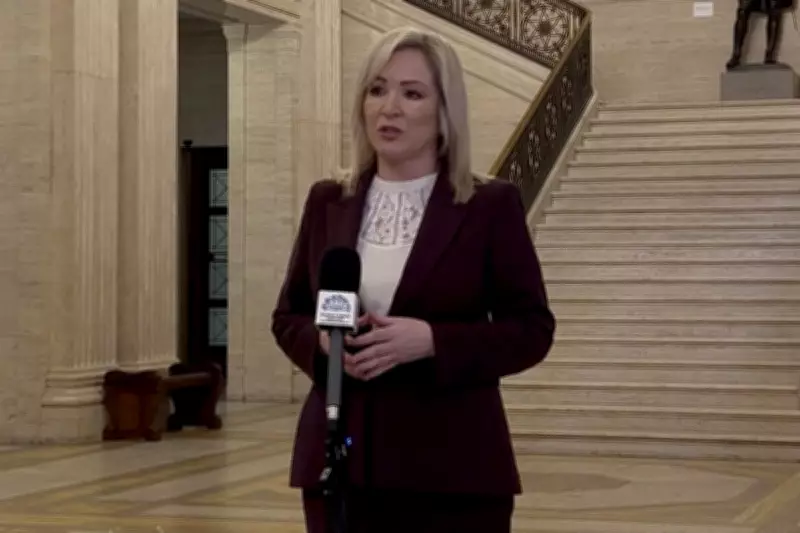
Northern Ireland's First Minister Michelle O'Neill has faced intense questioning in the Stormont Assembly over her government's engagement with China while simultaneously boycotting traditional St Patrick's Day events at the White House with US President Donald Trump.
White House Boycott Confirmed
The controversy emerged after Ms O'Neill confirmed she would not attend next month's St Patrick's Day celebrations at the White House, citing the ongoing situation in Gaza as her primary reason. This decision marks the second consecutive year the Sinn Féin vice president has declined the invitation, repeating the stance she took in March 2025.
Political Divisions Over Attendance
During Assembly questions for her department, Opposition leader Matthew O'Toole welcomed the First Minister's position and confirmed that SDLP leader Claire Hanna would also abstain from attending the Washington events. This follows last year's pattern where the SDLP and Alliance Party similarly stayed away, while DUP ministers including Deputy First Minister Emma Little-Pengelly participated in the traditional diplomatic engagements.

China Engagement Questioned
The questioning took a sharper turn when Ulster Unionist Party leader Jon Burrows challenged what he called an "at odds" approach between Ms O'Neill's humanitarian-based boycott of the White House and her party colleague Economy Minister Caoimhe Archibald's official visit to China last year.
"You're still prepared to have the Economy Minister go to China, a regime that drips in blood, that crushes dissent, that is a humanitarian abuser, that oppresses Christians – you're happy to have a member of your party shake the bloody hand of Beijing, but give false reasons why you won't attend the White House?" Mr Burrows pressed during the heated exchange.
First Minister's Defence
Ms O'Neill responded by emphasizing that her administration consistently raises human rights concerns with Chinese officials. "We've spoken quite often in this house in relation to our engagement with both Chinese officials here, or indeed, whenever the Economy Minister recently visited China," she stated. "We make it very clear about their human rights abuses, we always underline that in all of our visits."
The First Minister elaborated that both she and the deputy First Minister have consistently recorded their concerns about China's human rights record during official meetings. However, Mr Burrows dismissed this as a "non-answer" and continued to press on what he perceived as contradictory positions.
Gaza Conflict Central to Decision
Ms O'Neill clarified that her White House boycott stems specifically from the conflict in Gaza, which she described as "unique to our generation." She emphasized: "There is a genocide, something that is unique to our generation and I think it's important that you stand on the right side of humanity on that issue."
The First Minister criticized what she sees as the United States' failure in the region, stating: "I'm taking a stand in terms of the role of the United States, in particular, in terms of the international community, the fact that they have turned the other way, that they have failed."
Distinct Approaches Defended
Ms O'Neill defended maintaining different approaches to Washington and Beijing, explaining that trade relationships with China require continued engagement where human rights concerns can be raised directly. "I take a distinct approach to what we do in relation to Washington and what we do in relation to China in terms of trade and relationships," she said, expressing confidence that Economy Minister Archibald is "more than capable of raising all those human rights concerns that we all share."
The First Minister concluded by encouraging greater international community action toward a two-state solution in the Middle East, while maintaining her position that her administration's engagement with China serves different diplomatic purposes than the symbolic boycott of White House events during what she considers a humanitarian crisis requiring clear moral positioning.