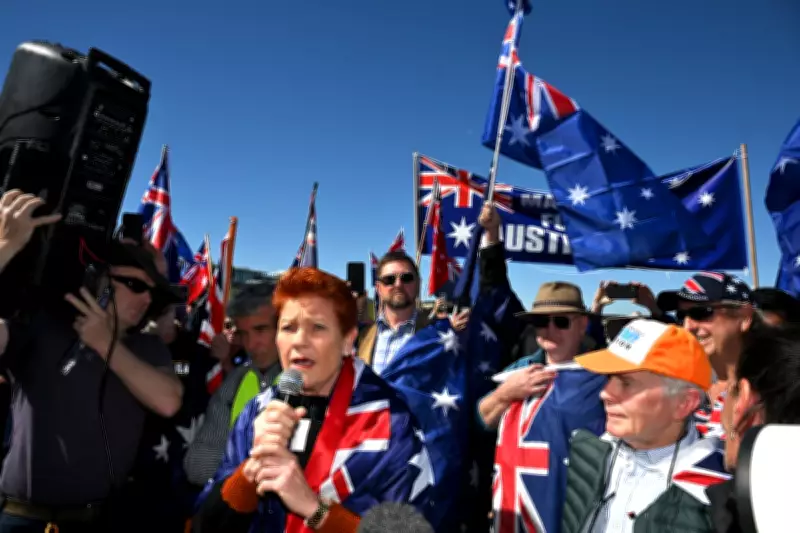
Pauline Hanson's Racist Rhetoric Cast a Shadow Over My Childhood. Here We Are Again
As a first-generation immigrant, it is utterly gut-wrenching to witness Australians falling for One Nation's anti-immigration rhetoric three decades after Pauline Hanson's initial rise to notoriety. I have long maintained a cynical outlook on politics, particularly regarding Australian attitudes toward racism and immigration. Historically, immigration has served as the go-to scapegoat for right-wing politicians seeking to deflect from substantive policy failures—whether it's soaring house prices, high unemployment rates, or growing economic inequality. The narrative that foreigners are stealing jobs, homes, and resources from "Aussie families" is so predictable it borders on tedium.
A Dismaying Poll Surge for One Nation
However, I must confess that even my hardened black heart was dismayed upon seeing recent polls indicating a significant rise in popularity for One Nation. While I understand that poll outcomes are influenced by complex factors, it is profoundly disheartening to observe Australians succumbing to the same divisive rhetoric thirty years after I believed we had moved beyond Pauline Hanson for good. One Nation may be experiencing a surge in the polls, but historical patterns suggest it may struggle to achieve mainstream acceptance, as noted by analysts like Tom McIlroy.
Childhood Memories in Country New South Wales
Growing up in the mid-1990s in rural New South Wales after arriving in Australia in 1992, Hanson's ascent to political infamy remains a core memory from my childhood. It marked the first time I consciously realized that my family and I were not universally welcome in this country, with a segment of the community harboring animosity solely based on our visible cultural differences. Even as a child, I recognized that the only discernible distinction between my family—my father an engineer, my mother managing a small takeaway store, and my siblings and I attending public schools—and my friends' families was our skin color. In all other meaningful aspects, our lives were remarkably similar: my parents worked diligently, paid taxes, and we aspired to build careers and families while investing in our local community.

My parents were acutely aware of the impact of Hanson's racist rhetoric at the time. They attempted to mitigate its effects through humor, often playing the Pauline Pantsdown parody in the car, with us children gleefully shouting "Please Explain!" from the backseat. When Hanson failed to secure election in 1998, I optimistically believed that era of toxic anti-immigration discourse was behind us. Yet, here we are today, with polls recording One Nation's popularity soaring and high-profile figures like Barnaby Joyce aligning with their ranks, thereby amplifying their dangerous message.
Social Media Insights and Misguided Blame
This week, I spent time exploring social media to understand why individuals might perceive One Nation as a viable solution to the challenges confronting Australia's middle and working classes. These issues predominantly revolve around income and resource scarcity, stemming from an unequal economic system that exacerbates the gap between the highest and lowest earners, rather than immigration. The overwhelming sentiment I encountered was twofold: "there are too many foreigners here, taking our jobs and houses" and "they don't want to assimilate." The first assertion strikes me as bemusing, given that immigrating to Australia is notoriously difficult, involving significant costs and stringent criteria across the three main immigration streams. I have witnessed numerous family and community members attempt and fail to navigate this arduous process over the years.

The second claim is utterly exhausting, as it perpetuates the myth of a monolithic Australian culture—a construct that has been profoundly shaped by multicultural influences and, critically, built upon the violent genocide and dispossession of Aboriginal and Torres Strait Islander peoples. As someone who has assimilated so extensively that my Australian identity sometimes creates a barrier with my Indian heritage, I can attest that no degree of assimilation can counteract racism rooted in something as superficial as skin color. This raises a poignant question: have we suddenly transformed into a nation of gullible xenophobes overnight, as humorously pondered by First Dog on the Moon?
Parental Efforts and Future Hopes
During my childhood, my parents endeavored to counterbalance the racism propagated by figures like Pauline Hanson by highlighting the many individuals in our community who embraced multiculturalism as a cornerstone of Australian culture. However, when I contemplate fostering a similar sense of balance for my own son, I feel a profound sense of deflation. Must I spend the next thirty years grappling with the same tired, repetitive racism I thought we had conquered when Hanson was initially defeated? Alternatively, will the broader nation finally awaken to the realization that fixating on immigration and culture wars serves as a clever distraction from the genuine inequalities we all face? These disparities have little to do with skin color or arrival dates and everything to do with a system that thrives on oppressing many to secure the prosperity of a privileged few.
Zoya Patel is a writer and editor based in Canberra, offering a personal perspective on the resurgence of One Nation and its implications for Australian society.