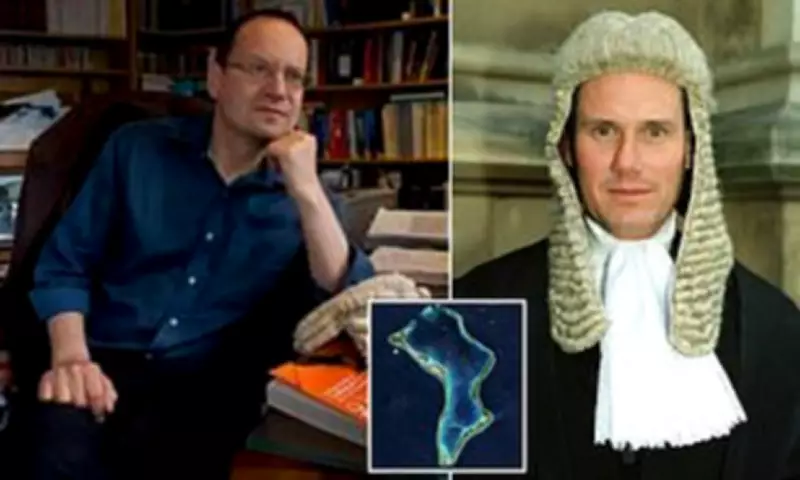
Philippe Sands' Lucrative Role in Chagos Sovereignty Transfer
The costly and highly symbolic legal battle that culminated in Britain's surrender of the Chagos Islands is inextricably linked to the earnest, reassuring visage of human rights lawyer Philippe Sands. It was a beaming Sands, captured in sunglasses, who stood by as the Mauritian flag was provocatively raised over the Indian Ocean territory in 2022. A year later, he spoke with palpable satisfaction about the joy of defeating his own nation in an international court, remarking that the victory "humiliated them – [in other words Britain] – completely."
Substantial Financial Rewards and Civilian Honors
That humiliation, as revealed by yesterday's Daily Mail, has proven exceptionally lucrative for the 65-year-old barrister, who ranks among the most prominent – if not always the most celebrated – legal minds of his generation. His former position as chief legal counsel to Mauritius has granted him a share of an £8 million compensation pot. Even within the affluent realm of international jurisprudence, this represents a considerable financial windfall. "Nice work if you can get it," one fellow lawyer wryly observed.
Sands also received Mauritian citizenship, hardly a hardship, and was showered with civilian honors. He played a pivotal role in securing the contentious agreement that will see Britain relinquish sovereignty of the Chagos archipelago while simultaneously leasing the strategically vital Diego Garcia military base for 99 years at an eye-watering cost of £35 billion.

Political Consternation and Accusations of Mercenary Behavior
The decision has provoked significant consternation, particularly due to China's growing influence in Mauritian affairs. While Sands has championed the payment of billions to Mauritius – funds that must come from Britain's already strained defence budget – as a personal crusade, friends indicate he has been "surprised" by the uproar surrounding his own financial gain, as if it were a trivial distraction.
As he loftily informed a House of Lords committee investigating the sovereignty transfer: "I was remunerated, as I am for almost all my cases. It was not done pro bono." Perish the thought. Liberating Britain from what he terms its "last colony" appears to have been an equally motivating factor.
Ideological Alignment with Key Political Figures
Professor Sands – who also holds an academic post at University College London – has built his reputation as a devotee of a doctrine that subordinates Britain's national interests to a vision of a borderless world governed by international jurists. He enjoys a position within a troika of legal elites at the pinnacle of human rights law, alongside Lord Hermer, the Attorney General, and Prime Minister Sir Keir Starmer.
Sands volunteered for Starmer's campaign during the Labour leadership contest and describes him as a "great friend… generous, humorous and empathetic." All three men share a similar ideological background and spent time at Matrix Chambers, the influential firm of predominantly left-wing civil liberties barristers known for its high-minded political correctness.
Scathing Criticism from Political Opponents
Despite his undoubted brilliance, Sands remains a divisive figure. Upon news of his Chagos payment, Labour MP Graham Stringer branded him a "mercenary," accusing him of "pretending to care about rights." Stringer asserted: "Philippe Sands is making a fortune representing the interests of a foreign country. Sands, the Prime Minister and the Attorney General all believe that international courts, dominated by judges from China, are more important than our own democracy."
Shadow Foreign Secretary Dame Priti Patel was equally blunt: "Like Starmer and everyone else associated with the Chagos scandal, I believe that Sands is happy to sell out our country. Labour and their Lefty lawyer friends cannot be trusted."

Contentious Sovereignty Decision and Chagossian Perspectives
These interventions underscore the highly contentious nature of the sovereignty handover. A source close to the negotiations, who disparagingly refers to Sands as "Starmer's legal buddy," notes: "Decolonialisation has been used as a justification for this move. Certainly, not all Chagossians wish their homeland to remain in British hands, but a majority appear to. They possess the right to British citizenship, and recent months have witnessed a surge in Chagossian arrivals to the UK."
The source adds: "The Chagossian people are not Mauritian. They have a distinct history, faith, and culture. For them, Mauritius is just as much a colonial power as the UK."
International Reactions and Personal Background
International reactions have been mixed. Donald Trump initially called the decision an "act of great stupidity," then suggested it was "the best" deal Starmer could secure, perhaps damning with faint praise. Yet, hours after the US State Department officially endorsed the agreement, the former president declared Starmer was making an "extraordinary mistake."
Sands, seemingly indifferent to such critiques, was effusively described by Counsel magazine as "a man for all seasons" propelled "from obscurity to public intellectual." His Who's Who entry intriguingly omits his education at fee-paying University College School in Hampstead, possibly due to left-wing sensitivities about elite institutions.
Legal Career and Personal Convictions
Born into a middle-class family – he lost 80 relatives in the Holocaust – Sands credits a politics teacher who took his 15-year-old class to a Yorkshire coalmine as inspiring his justice crusade. He gained prominence by challenging Tony Blair's legal justification for the Iraq War and has frequently criticized Conservatives, particularly Boris Johnson for his support of Donald Trump.
For Sands, the consequences of the invasions of Iraq and Afghanistan remain paramount. As he wrote in the Daily Mail: "Early decisions following 9/11 – to wage a 'war on terror', use Guantanamo as a permanent detention site, employ torture, invade Iraq – have left legacies that will haunt us for years."
Literary Connections and Legal Strategy
Sands, a prize-winning author for his book East West Street on genocide, befriended spy novelist John le Carré in his local pub. They shared skepticism about the Iraq War, and le Carré asked Sands to review his manuscripts. "There was always in every Le Carré novel an appalling lawyer, and my job was to check the awfulness," Sands recalled. In return, the author taught him plotting techniques applicable in court: "You want judges to come to the conclusion you like but leave them feeling they've cracked it."
Whether similar closure will be achieved regarding the Chagos transfer remains uncertain. It may endure as an act of political and strategic vandalism, remembered long after this government's tenure concludes.