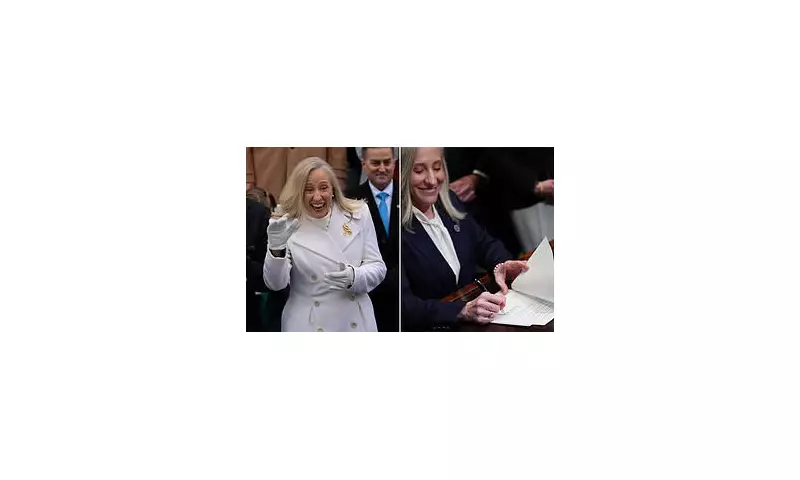
Virginia's New Governor Sparks Conservative Fury With Progressive First-Day Actions
Democrat Abigail Spanberger, Virginia's newly inaugurated governor, is confronting intense conservative criticism after implementing what opponents describe as far-left policies during her initial days in office. This backlash comes despite Spanberger having positioned herself as a moderate throughout her campaign trail.
A Victory Followed By Controversial Decrees
Spanberger, a former Congresswoman and CIA operative, secured a decisive victory over sitting Lieutenant Governor Winsome Earle-Sears, providing a significant momentum boost for Democratic prospects. However, her transition from candidate to governor has been marked by immediate controversy.
Among her first-week executive orders that have alarmed conservative observers is a directive reducing Virginia's cooperation with federal Immigration and Customs Enforcement authorities. Spanberger had explicitly campaigned on this particular policy change.

Additionally, she signed an order prohibiting discrimination in employment across the state, with the stated aim to "foster a culture of inclusion, diversity, and mutual respect for all Virginians."
Conservative Voices Raise Alarms
The reaction from conservative commentators and organizations has been swift and severe. Assistant Attorney General Harmeet K. Dhillon, currently investigating anti-ICE protesters in Minnesota, offered a particularly vivid comparison, writing: "She's like a Bond villain."
The Lepanto Institute, a conservative Catholic organization, drew literary parallels, stating: "A long winter without Christmas has come to Virginia," likening Spanberger to the White Witch from C.S. Lewis's Narnia series.
Ben Domenech, Editor of The Spectator at Large, added a more contemporary critique: "It's like the CIA built the perfect Karen in a lab."
A Legislative Agenda Awaits
Conservative journalist Greg Price highlighted the broader legislative program awaiting the governor's approval, describing it as resembling a liberal wish list. Proposed measures include:
- Implementing sales taxes on digital services from companies like Amazon and Uber Eats
- Creating several new tax brackets
- Banning gas-powered leaf blowers
- Expanding ranked-choice voting systems
- Eliminating Columbus Day as a state holiday
Democratic legislators in Virginia's statehouse have pledged to collaborate closely with Spanberger to advance what they term a bullish agenda. This includes redrawing the state's congressional district maps ahead of the approaching midterm elections.
Historical Context and Political Significance
Spanberger's victory carries substantial historical and political weight. She becomes Virginia's first female governor, succeeding Republican Glenn Youngkin. Her win, alongside Mikie Sherrill's in New Jersey, has been interpreted as a positive indicator for Democrats in increasingly competitive states.
Virginia's off-year gubernatorial elections frequently serve as national political bellwethers. Spanberger's comfortable margin over Earle-Sears suggests Democrats may be better positioned as the country approaches next year's midterm elections, which will significantly influence the trajectory of the final years of the current presidential administration.
The campaign revealed notable divisions within Republican ranks. Neither the president nor Vice President JD Vance campaigned in Virginia or held fundraisers for Earle-Sears, whose candidacy reportedly generated little enthusiasm within White House circles.
Democratic Support and Fundraising Success
In contrast, Spanberger received robust support from prominent Democratic figures. Former President Barack Obama rallied with her in Norfolk, while former President Bill Clinton and former Secretary of State Hillary Clinton headlined a major fundraiser.
This event, hosted by former Virginia Governor Terry McAuliffe at his residence, achieved record-breaking success, pulling in $2.2 million from over 350 donors. Political analysts described it as the largest gubernatorial fundraiser in Virginia's history.

Governor Defends Her Approach
Spanberger has defended her early actions through social media statements, asserting that her executive orders "respond to the moment." She outlined her administration's philosophy, stating: "We're setting the tone for what Virginians can expect over the next four years: pragmatic leadership focused on lowering costs, growing our economy, and making sure that every parent knows that their child is set up for success."
Her campaign focused heavily on protecting Virginia's economy from what she characterized as aggressive federal tactics, addressing concerns about civil service changes, rising goods costs, and impacts on the state's healthcare system.
Continued Criticism and Historical Patterns
Criticism persists from various quarters. Stephanie Lundquist-Arora, a Fairfax County mother and chapter leader of the Independent Women's Network, told media outlets: "It's a shame that Virginia's first female governor is one who's so disingenuous. She has duped Virginians. She ran on affordability, but supports costly environmental regulations, as well as the Democrat-approved expensive cars and meals taxes. She's a leftist in moderate's clothing."
The political landscape reveals challenging historical patterns for Republicans. The last time a Republican candidate won the Virginia governor's race while a Republican occupied the White House was in 1973, during Richard Nixon's presidency.
As Governor Spanberger's administration begins, the stark contrast between her moderate campaign rhetoric and progressive initial actions ensures that Virginia remains a focal point of national political attention and debate.