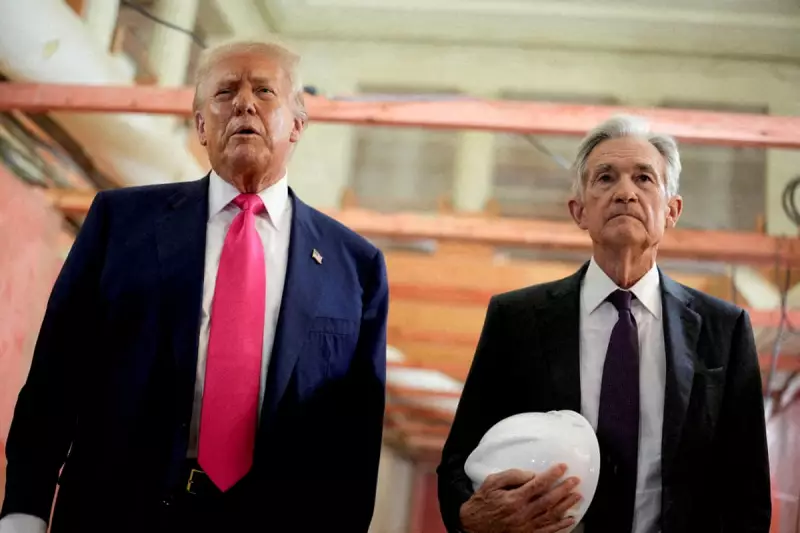
In a striking confrontation at the heart of US governance, former President Donald Trump's aggressive tactics against the Federal Reserve have collided with the judicial scrutiny of the Supreme Court. A photograph from July last year captures Trump alongside Fed Chair Jerome Powell at the central bank's Washington headquarters, a visual reminder of the ongoing tension. Now, the court's conservative majority, typically eager to expand presidential authority, appears to be drawing a line when it comes to the independence of the US central bank.
Trump's Unprecedented Assault on Federal Reserve Independence
Donald Trump has employed his characteristic blend of persuasion, bullying, and threats in a bid to pressure the Federal Reserve into lowering interest rates. He has labelled Chair Jerome Powell as "stupid" and openly threatened to dismiss him for not enacting rate cuts swiftly enough. More recently, the Justice Department initiated a criminal investigation into Powell concerning testimony about renovations at the Fed's headquarters. Despite these efforts, the Fed has maintained its stance, refusing to yield to political pressure.
Tactically, this assault mirrors Trump's broader overhaul of the federal government, where persistent pushing has often secured his objectives. However, the Federal Reserve may represent a unique obstacle. During oral arguments, Supreme Court justices expressed resounding scepticism regarding Trump's firing of Fed Governor Lisa Cook in August. He alleged she committed mortgage fraud by listing multiple properties as her primary home, accusations first aired on social media without a formal investigation or hearing.

Legal Complexities and Due Process Concerns
The haphazard nature of Cook's dismissal raises critical legal questions. Were her due-process rights violated due to the lack of a hearing? Even if the mortgage allegations hold truth—her lawyers claim it was an "inadvertent mistake"—does pre-appointment conduct justify removal from the Fed? Additionally, should lower courts have adjudicated this before Supreme Court review? These issues underscore the delicate balance between executive power and institutional safeguards.
The Federal Reserve, designed as a quasi-private, independent agency shielded from politics, adds another layer of complexity. By law, Fed officials can only be fired "for cause," though the statute lacks specificity. This structure is intended to insulate monetary policy from short-term political whims, ensuring decisions based on economic data rather than electoral fortunes.
Supreme Court's Divergent Approach to Executive Power
While the court has generally been lenient towards Trump's executive actions—such as allowing firings at the National Labor Relations Board and aggressive immigration enforcement—the Fed case reveals a potential exception. Conservative justices, who often advocate for the "unitary executive" theory granting presidents broad removal powers, seem hesitant here. In prior rulings, the court even referenced the Fed's unique historical status, hinting at resistance to political interference.
Legal experts like Michael Dorf of Cornell University warn that this selective stance could be misleading. "The Supreme Court is making war on independent agencies at the worst possible moment," Dorf notes, highlighting risks when a president seeks to centralise power. Yet, in Cook's case, justices like Amy Coney Barrett and Brett Kavanaugh voiced economic concerns, citing amicus briefs that warn her firing could trigger a recession.
Economic Implications and Global Repercussions
The core of Fed power lies in interest rate setting, which influences borrowing costs, inflation, and employment. Trump's desire for lower rates aims for short-term economic boosts but risks long-term price instability. Interfering with Fed independence could precipitate economic shocks, a fear echoed by justices questioning the "real-world" consequences. Kavanaugh pointedly asked about precedents that might lead to mass removals under future administrations, underscoring the stakes for institutional stability.

Lev Menand of Columbia Law School observes, "Large business interests don't want to see the Federal Reserve's capacity degraded. They don't want to see the Federal Reserve politicised." This economic rationale may explain why the court, while dismantling other agencies' independence, treats the Fed as a special case.
Broader Context and Future Outlook
This case unfolds against a backdrop where the Supreme Court has largely upheld Trump's executive authority, from immigration tactics to blocking nationwide injunctions. A ruling against Trump in Cook's case, expected by June, might garner praise for judicial restraint but, as Dorf cautions, could mask broader permissiveness. "You stand up to him at the most extreme edge of what he does, [but] you're still allowing him to do all sorts of things," he remarks.
Ultimately, the Supreme Court's deliberation on Lisa Cook's firing probes a fundamental question: how much presidential power over the Federal Reserve will be tolerated? As an unstoppable force meets an immovable object, the outcome could reshape not only US economic policy but also the global financial landscape, testing the resilience of democratic checks and balances in an era of heightened political polarisation.