Tarique Rahman's Dramatic Political Resurrection
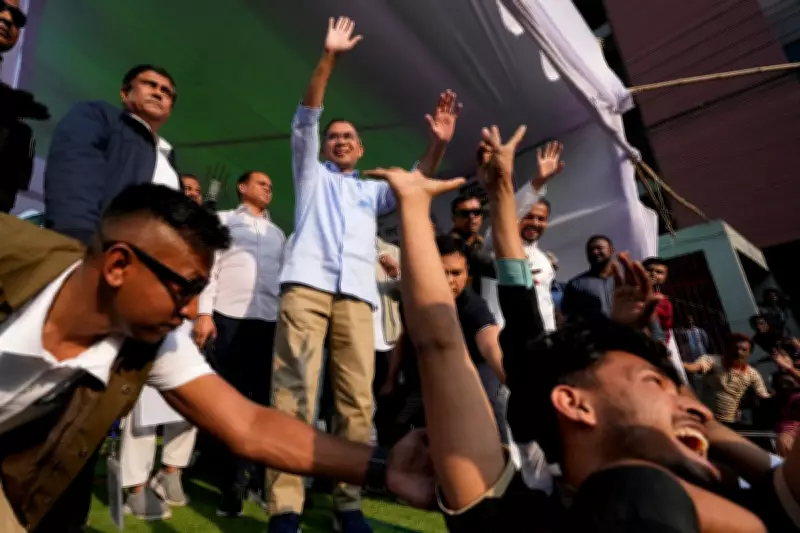
After spending seventeen years in self-imposed exile, Tarique Rahman now stands on the brink of becoming Bangladesh's next prime minister. This remarkable political turnaround follows his Bangladesh Nationalist Party's apparent victory in Thursday's national election, according to widespread local media reports. The election results signal a profound shift in the political landscape of this South Asian nation, home to over 170 million people.
A Nation in Turmoil Welcomes Back Its Prodigal Son
The 60-year-old political scion returned from London in December to a country grappling with multiple crises. Within days of his arrival, his mother, former Prime Minister Khaleda Zia, succumbed to a long illness. Rahman then faced a formidable electoral challenge from a rising religious conservative party that had gained momentum following the 2024 student-led uprising which toppled his mother's longtime rival, former Prime Minister Sheikh Hasina.
Yet Rahman's most significant challenges may still lie ahead. The path from the 2024 uprising to Thursday's election has been marked by profound turmoil. Bangladesh has contended with widespread unrest following a student leader's death, a worrying resurgence of Islamist groups, the erosion of rule of law, attacks on Hindu minorities and the press, alongside a struggling economy.

"Rahman has said all the right things, pledging to eliminate corruption and bring the country together. That all sounds well and good. But the BNP has a poor track record from when it was last in power — there was repression and corruption," observed Michael Kugelman, a Senior Fellow for South Asia at the Atlantic Council.
Scion of a Powerful Political Dynasty
Rahman represents a key figure in Bangladesh's influential Zia political dynasty. His mother served two five-year terms as prime minister, most recently from 2001 to 2006. His father, Ziaur Rahman, rose through military ranks to become Bangladesh's sixth president before his assassination in 1981. Rahman is married to Zubaida Rahman, a physician and daughter of a former Bangladesh Navy chief.
His Bangladesh Nationalist Party, alongside Hasina's now-banned Awami League party, has dominated the nation's political landscape for decades. In recent years, the BNP boycotted several elections, including the 2024 vote, citing allegations of widespread electoral fraud.
A Controversial Past and Image Transformation
Rahman's political career has been shadowed by controversy. Targeted by multiple criminal cases under Hasina's government, he spent those seventeen years in self-imposed exile in London. In 2018, he received a life sentence in connection with a 2004 grenade attack on Hasina that killed at least twenty-four people. Hasina narrowly survived the assault.
Rahman has consistently denied involvement in the attack and denounced the verdict as politically motivated, a position echoed by his party. He originally left Bangladesh in 2008, officially for medical treatment, after enduring torture while in custody during the military-backed administration that governed from 2006 to 2008.
Though he never held formal office in his mother's governments, Rahman wielded substantial influence within the BNP, serving as acting chairman, senior vice chairman, and senior joint secretary. A leaked set of U.S. diplomatic cables once described him as "phenomenally corrupt."
Following the collapse of Hasina's government, the charges and convictions against Rahman were dropped, clearing his path for return from exile. In the election run-up, he actively sought to reshape his public image, promising job creation, financial aid for impoverished families, greater freedom of speech, stronger law enforcement, and an end to systemic corruption.
His campaign strategically positioned him as a defender of democracy in a country long shaped by entrenched political parties, military interventions, and persistent allegations of vote rigging. After Hasina's ouster, Nobel Peace Prize laureate Muhammad Yunus, serving as the country's interim leader, met with Rahman in London—an event that apparently facilitated his eventual return.

Navigating Political Rivalries and Public Expectations
Despite his electoral success, Rahman's rise is expected to rankle many Bangladeshis, particularly those who participated in the 2024 uprising and hoped to see their country liberated from dynastic politics and the old political guard they blame for the nation's persistent problems.
The Atlantic Council's Kugelman highlighted that a crucial test for Rahman will be how he treats Hasina's Awami League party, which has been accused of cracking down on the BNP in the past through arrests of senior leaders and party workers. Rahman's own mother was arrested and imprisoned during Hasina's government.
Hasina has been living in exile in India since August 2024, and a special tribunal in Dhaka sentenced her to death last year over crimes against humanity related to her crackdown that killed protesters during the uprising that ultimately ousted her. She denies all charges. Meanwhile, her party was barred from participating in the election, and thousands of its members remain in hiding due to fears of persecution.
"If Rahman leans on retribution, it shows the old politics haven't disappeared," cautioned Kugelman. "But a focus on unity would be an encouraging sign."
As Bangladesh stands at this political crossroads, the world watches to see whether Tarique Rahman can transcend his controversial past and his party's checkered history to unite a fractured nation and deliver on his promises of reform and reconciliation.