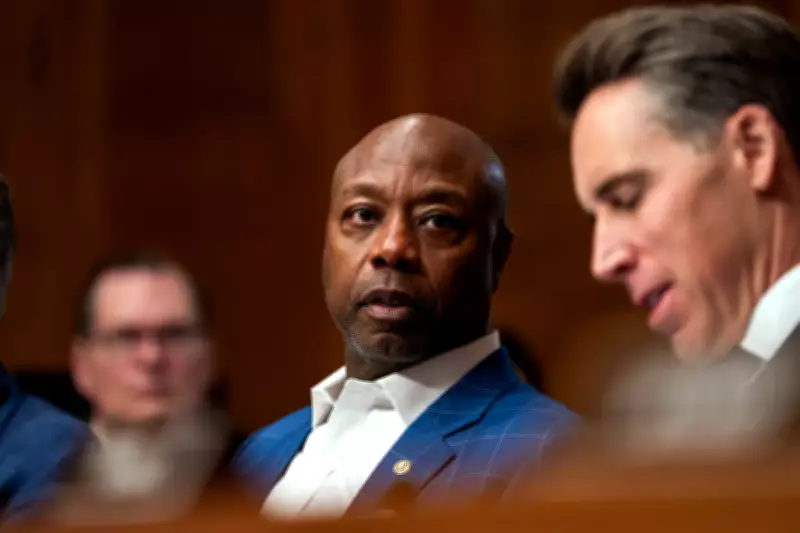
After five days of maintaining a conspicuous silence following his public denunciation of a racist video posted by Donald Trump's Truth Social account, Senator Tim Scott has broken his radio silence with a series of new social media posts. The South Carolina senator, who chairs the National Republican Senatorial Committee, ignited a rapid and fierce backlash from within his own party after he described the offensive video as "the most racist thing I've seen out of this White House" and expressed hope it was a fabrication.
Scott's Controversial Comments and Republican Backlash
In his most recent activity on the platform X, Senator Scott shifted his focus to remarks previously made by Democrat State Representative Gene Wu, the minority leader of the Texas House of Representatives. Scott accused Wu of "recycling the ideology behind slavery, ethnic cleansing, and history's greatest atrocities," adding a sarcastic "Congrats" to his post. He accompanied this with a resurfaced video clip showing Wu in an interview calling for greater unity among America's diverse ethnic communities.
Wu is heard stating: "The day the Latino, African American, Asian and other communities realise they share the same oppressor, is the day we start winning. We are the majority in this country now. We have the ability to take over this country and do what is needed for everyone." Scott's decision to highlight these comments has further inflamed tensions within Republican circles, particularly among those loyal to former President Trump.
Support for Susan Collins Fuels Further Division
Following that contentious post, Senator Scott published a message of support for fellow Republican Susan Collins, who is seeking re-election as a U.S. senator from Maine. He described Collins as "a battle-tested leader whose fierce independence has led to historic wins for Maine." This endorsement has significantly heightened tensions among Trump loyalists, given the longstanding friction between Collins and the former president.
Collins recently sided with a small group of Republicans supporting a procedural measure to curb Trump's authority to deploy the military in Venezuela without congressional approval. This move prompted Trump to declare that the group "should never be elected again." Additionally, Collins voted to convict Trump in the impeachment trial following the January 6th, 2021 attack on the U.S. Capitol, further cementing the rift between them.
Trump's Racist Video and the White House Response
The controversy stems from a video posted on Trump's Truth Social account last Friday, which depicted the faces of former President Barack Obama and former First Lady Michelle Obama superimposed onto the bodies of apes. Senator Scott's immediate and forceful condemnation of this video as racist triggered widespread criticism and exposed deep divisions within the Republican Party.
It later emerged that, following Scott's public remarks urging Trump to remove the offensive video, the former president phoned the South Carolina senator. During that call, Trump reportedly claimed that the post had been made in error by a staff member and assured Scott that it would be taken down. This private conversation contrasted sharply with the initial public defense offered by the White House.
White House Initially Defends Controversial Post
White House Press Secretary Karoline Leavitt initially defended the post, describing the image as part of an "internet meme video" parodying The Lion King. She urged reporters to "stop the fake outrage and report on something today that actually matters to the American public." However, this stance was later walked back by a White House official, who stated that a staffer had "erroneously made the post," attempting to downplay the incident as a mistake rather than an intentional act.
Attacks from Trump Loyalists Intensify
Senator Scott's perceived disloyalty to Trump has been underscored by numerous attacks from those close to the former president. Far-right political activist Laura Loomer, a hardline Trump supporter, posted on Saturday questioning why Scott had not deleted his critical tweet, accusing him of "deliberately trying to sabotage President Trump." These attacks highlight the ongoing struggle within the Republican Party between traditional conservatives and the Trump-aligned faction, with Scott's actions placing him squarely in the crosshairs of this internal conflict.
The entire episode underscores the volatile nature of contemporary American politics, where a single social media post can ignite fierce partisan battles and expose fundamental rifts within political parties. As the 2026 political landscape continues to evolve, figures like Tim Scott find themselves navigating treacherous waters between principle and party loyalty.