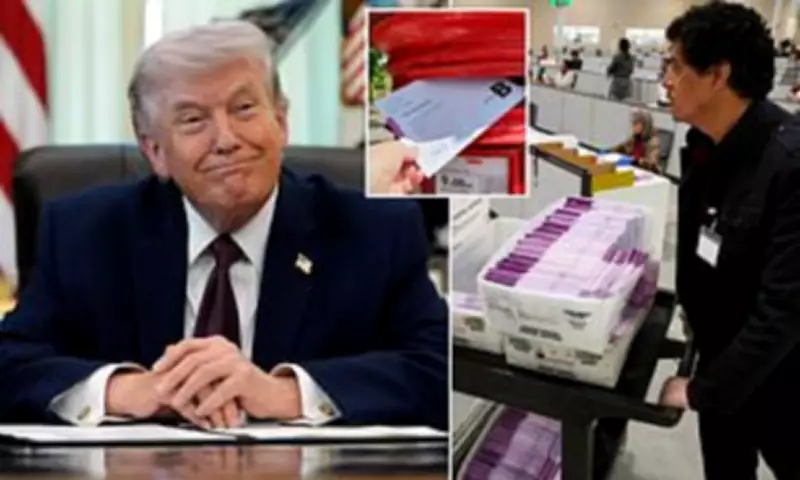
President Donald Trump has enacted a new executive order aimed at tightening regulations on mail-in voting across the United States, a move he claims will combat widespread electoral cheating. The order was signed during an Oval Office ceremony on Tuesday, where Trump asserted that "the cheating on mail-in voting is legendary" and expressed confidence that these measures would significantly improve election processes.
Contradiction in Personal Voting Practice
Despite his vocal criticism of mail-in ballots, Trump recently utilized a postal ballot to vote in a Florida special election last week. This election was ultimately won by a Democrat in the district encompassing his Mar-a-Lago estate. When questioned about this apparent inconsistency, Trump dismissed it, stating that as President, he has "a lot of different things" to manage, implying his personal use does not undermine his broader policy stance.
Key Provisions of the Executive Order
The executive order mandates several significant changes to mail-in voting procedures. Firstly, it requires the administration to compile comprehensive lists of eligible voters in each state, ensuring that absentee ballots are distributed exclusively to individuals on approved mail-in voter rolls. Additionally, ballots must now be issued in newly designed secure envelopes featuring unique barcodes for enhanced tracking capabilities.

States that fail to adhere to these new standards risk losing federal funding, a provision intended to enforce compliance. Trump emphasized that these steps are crucial for "stopping the massive cheating that's gone on," and he hinted at future reforms, including potential voter ID requirements and proof of citizenship checks, which he described as "another subject for another time."
Historical Context and Political Reactions
Trump has consistently denounced mail-in ballots as a mechanism for fraud, often attributing his 2020 election loss to Joe Biden to this voting method. During the ceremony, he reiterated his disputed claim of having won that election, stating, "I won three times, convincingly." This executive order builds upon previous actions by his administration, such as directing federal agencies to assist states in verifying voters' citizenship status and attempting to prohibit the counting of mail-in ballots received after Election Day.
However, the order has faced immediate criticism from legal experts and political opponents. Lexi Kennard, a senior political media strategist at the Brennan Center for Justice at NYU Law, argued that "the president does not have the authority to rewrite election rules," highlighting potential constitutional overreach. Democrats have long contended that non-citizens are already barred from voting, though the Department of Justice has prosecuted cases involving illegal immigrants casting ballots in federal elections.
Broader Implications for Election Integrity
The debate over mail-in voting has intensified in recent years, with proponents arguing it enhances accessibility and opponents raising fraud concerns. Trump's executive order adds a new layer to this contentious issue, potentially affecting millions of voters in upcoming elections. As the administration moves forward with implementation, ongoing legal challenges and political discourse are expected to shape the future of electoral practices in the United States.