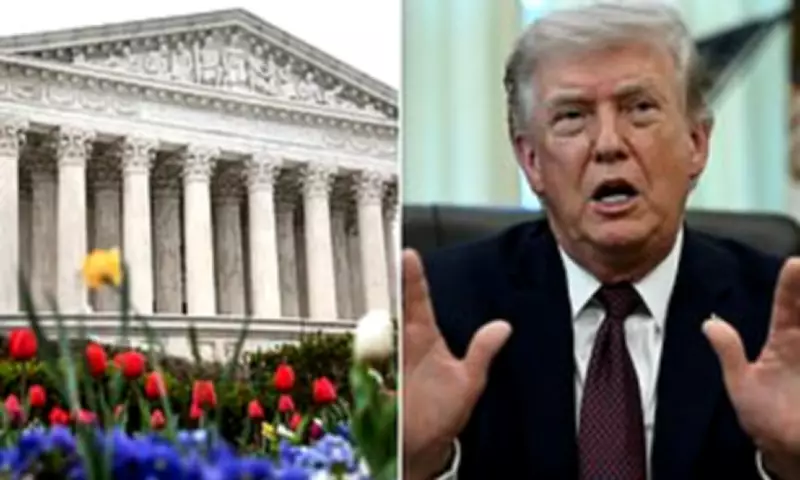
President Donald Trump has declared his intention to undertake an unprecedented journey to the Supreme Court to witness oral arguments firsthand as he seeks to dismantle birthright citizenship in the United States. Speaking from the Oval Office on Tuesday, the President confirmed he would make the trip across town to the high court for Wednesday's proceedings, a decision that legal experts warn could provoke significant constitutional concerns regarding the separation of powers.
Trump's Determination and Historical Context
When questioned by a reporter about the case, Trump asserted, 'And I'm going.' He explained his attendance by stating, 'because I have listened to this argument for so long.' The President elaborated on his stance, arguing, 'This is not about Chinese billionaires who are billionaires from other countries who all of a sudden have 75 children, or 59 children in one case, or 10 children, becoming American citizens. This was about slaves.'
Birthright citizenship, established by the 14th Amendment ratified in 1868 to guarantee citizenship to recently freed slaves, has historically applied to every individual born within U.S. territories. As a cornerstone of his hardline immigration agenda, Trump signed an executive order on Inauguration Day 2025 aimed at ending this practice. However, lower courts have consistently ruled that this executive order is unconstitutional, setting the stage for the Supreme Court's review.

Supreme Court Schedule and Past Precedents
The Supreme Court is scheduled to hear oral arguments on the birthright citizenship case at 10:30 a.m. ET on Wednesday. This visit marks a rare instance, as presidents have historically avoided attending oral arguments to maintain the judiciary's independence, typically only appearing for ceremonial occasions. Trump noted, 'I went once before, the opening of the Supreme Court in the last administration,' referring to a visit during his first term.
In October, Trump had previously indicated he would attend Supreme Court arguments related to his tariff case but ultimately withdrew. That case did not favour him, despite the Court's 6-3 conservative majority. Justices struck down Trump's authority to impose broad tariffs, a policy he had pursued since the start of his second term. Chief Justice John Roberts, appointed by President George W. Bush, along with Trump appointees Justices Neil Gorsuch and Amy Coney Barrett, joined the three liberal justices in the February decision, which Trump labelled a 'disgrace.'
Trump's Criticism of the Judiciary
When asked about his current views on the justices, Trump responded, 'I love a few of them,' but added, 'I don't like some others.' He specifically complained about justices appointed by Democratic Presidents Barack Obama and Joe Biden, stating, 'I don't care how good your case is, you can have the greatest case ever. They're going to rule against you. They always do. And it's not supposed to be that way.'
In contrast, Trump remarked that justices appointed by Republicans 'tend to be very different.' He continued, 'They want to show how honorable they are. So a man can appoint them and they can rule against them. We're so proud we ruled against Trump. We're so proud. We're above it.' The President concluded, 'And there are those that say that's wonderful, and there are those who say that's so stupid.'
The Supreme Court is designed to function as a separate but equal branch of government, a principle that underscores why presidential attendance at oral arguments is traditionally avoided. Trump's planned visit challenges this norm, highlighting the ongoing tensions between the executive and judicial branches over immigration policy and constitutional interpretation.