Trump's State of the Union Address: A Show of Confidence Amid Democratic Boycott
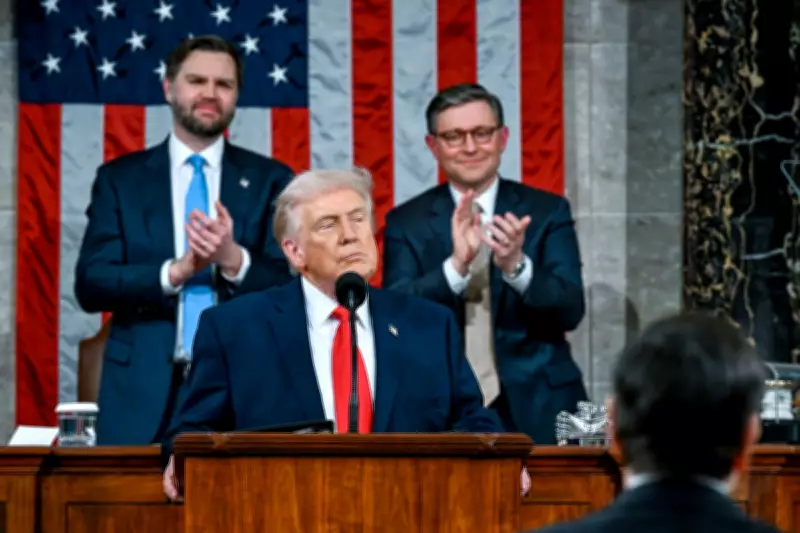
President Donald Trump transformed his State of the Union address into a theatrical spectacle, complete with surprise guests like the U.S. Men's National Hockey team and a boisterous Republican crowd chanting "U.S.A." at every opportunity. The event, held on Wednesday 25 February 2026, served as the starting gun for the 2026 midterm elections, where Trump aimed to rally support for his party's congressional majorities. In a bold declaration, Trump proclaimed, "Our nation is back, bigger, better, richer and stronger than ever before," linking his presidency to America's 250th anniversary and promising a "golden age."
Polling Reveals Widespread Voter Skepticism
Despite Trump's optimistic rhetoric, polling data indicates that many Americans remain unconvinced. A YouGov survey showed that 60 percent of Americans approve of the Supreme Court's decision to strike down Trump's tariff policy, while a CNN poll found that 61 percent of voters believe his policies will move the country in the wrong direction. Additionally, 68 percent of Americans reportedly feel Trump has not paid enough attention to the nation's most pressing problems. An ABC News/Washington Post/Ipsos poll further highlighted disapproval, with 65 percent disapproving of Trump's handling of inflation, 64 percent on tariffs, and 57 percent on the economy.
When confronted with these unfavorable numbers, U.S. Trade Representative Jamieson Greer dismissed the polls as biased, stating, "I mean, some of them are like, opt-in polls where people who hate the president anyway want to go and make their point." He emphasized Trump's support among union members and pointed to economic indicators like rising GDP and wages outpacing inflation. However, this approach mirrors the failed strategy of Joe Biden and Democrats, who similarly painted a rosy economic picture while voters grappled with high costs, ultimately leading to Trump's return to the White House and Republican Senate gains.

Immigration and Border Security Turn into Political Liabilities
Perhaps more alarmingly for Trump and Republicans, the same polling shows Trump underwater on immigration at 58 percent and border security at 50 percent. This marks a stunning reversal, as many voters, including Hispanic communities in Southwestern states, previously supported Trump due to perceptions that the Biden administration had lost control of the border. Now, voters associate Trump's draconian measures with incidents like Immigration and Customs Enforcement killing Renee Good and Customs and Border Protection killing Alex Pretti in Minneapolis, rather than with safety and security.
During his address, Trump attempted to shift the narrative by referring to Somali-Americans as "pirates who ransacked Minnesota," a line criticized as racist and likely inspired by Stephen Miller. He argued that "importing these cultures through unrestricted immigration and open borders brings those problems right here to the U.S.A." Yet, Americans are not buying this rhetoric, emboldening Democrats like Rep. Rashida Tlaib of Michigan and Ilhan Omar of Minnesota to publicly accuse Trump of "killing Americans."
Democratic Boycott and Its Consequences
Much of the Democratic Party chose to boycott the State of the Union, likely to avoid lending legitimacy to Trump's words. However, this move allowed Trump's claims to go unchallenged and may have reinforced voter perceptions that Democrats lack solutions or appear weak. In contrast, those who attended, such as Rep. Lauren Underwood of Illinois—who flipped a Trump district in 2018—initially stayed but left when Trump lied about healthcare, stating, "I had kind of envisioned I'd give it like three 'USA, USA chants' and a handful of lies, and I'd be out."
Other Democrats offered sharp rebuttals. Abigail Spanberger, who won the Virginia governorship after a congressional victory in 2018, delivered a well-received response, while Sen. Alex Padilla provided the Spanish rebuttal, highlighting his protest against Homeland Security Secretary Kristi Noem's crackdown in Los Angeles. Despite these efforts, the boycott meant Trump heard more cheers than jeers, potentially insulating him from the dissatisfaction many Americans feel.

Political Implications and Future Challenges
The eager-to-please Speaker Mike Johnson's reluctance to oppose Trump may further harm the president's political standing. When Trump asserted that "congressional action will not be necessary" to continue his tariffs, Johnson merely noted, "it's in the statute." This dynamic has lulled Trump into a false sense of security, preventing him from recognizing the real threats to his political project. As Eric Garcia observes from his perch in the House of Representatives, too many Democrats ceded the argument by bailing on the State of the Union, missing an opportunity to create a meaningful contrast as they did during the 2018 Blue wave.
Ultimately, Trump's boastful address underscores a growing disconnect between his portrayal of America and voter realities. With midterm elections looming, both parties must navigate this complex landscape, where polling doubts and strategic missteps could shape the political future.