The Dangerous Pattern of Presidential Falsehoods
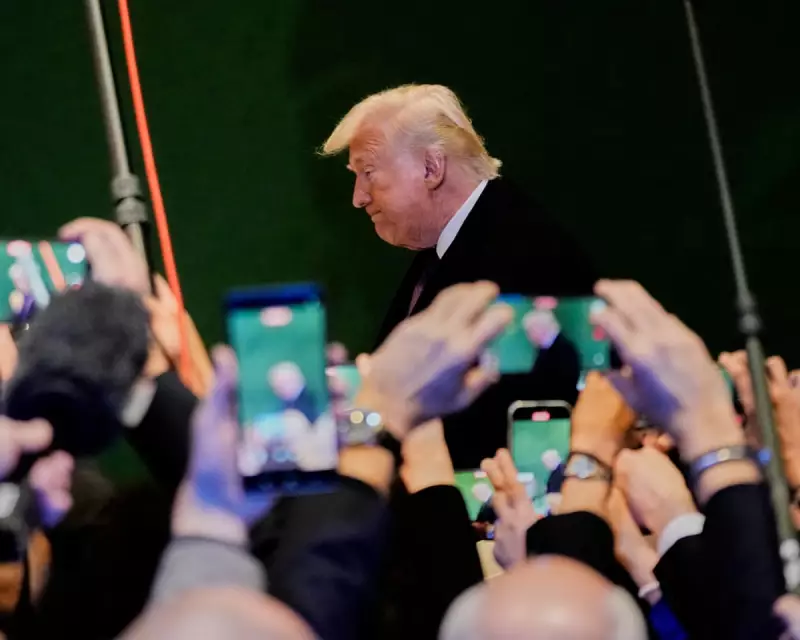
In contemporary political discourse, a troubling phenomenon has emerged with increasing clarity during Donald Trump's return to office. The former president appears to operate under a guiding principle that challenges fundamental reality: essentially asking supporters to choose between his version of events and the evidence of their own senses. This approach represents more than mere political rhetoric—it constitutes a systematic assault on truth with potentially dangerous consequences for democratic institutions and public trust.
The Renee Nicole Good Case: A Disturbing Example
A particularly egregious recent illustration involves the tragic death of Renee Nicole Good in Minneapolis. Within hours of the incident, Trump took to his Truth Social platform to disseminate a version of events that bore little resemblance to documented reality. The 37-year-old mother of three was characterized as belonging to "a Radical Left Movement of Violence and Hate" who had "viciously run over" an ICE officer. Trump further claimed the officer was fortunate to be alive and recovering in hospital.
These assertions stood in stark contrast to video evidence showing ICE agent Jonathan Ross walking away unharmed after shooting Good three times. The discrepancy between Trump's narrative and verifiable facts didn't stop administration officials from amplifying the false version. Homeland Security Secretary Kristi Noem quickly labeled Good a rioter and domestic terrorist, while Vice President JD Vance denounced her as a "deranged leftist." This coordinated response suggests a troubling pattern where false narratives become official positions.

Economic Misrepresentations: Denying What Consumers Experience
The assault on observable reality extends to economic matters where Trump has made increasingly bold claims that contradict everyday experience. Despite current inflation running at 2.7%—only slightly below the rate when Biden left office—Trump has repeatedly asserted there is "no inflation" and that "every price is down." For ordinary consumers, particularly those navigating grocery aisles, these claims ring hollow against actual price increases.
Government data reveals that while some food prices have decreased, overall food costs rose by 3.1% over the past year. Specific categories show even more dramatic increases: coffee prices jumped 19.8%, beef and veal 16.4%, and sugar 6.9%. The December 2023 monthly increase of 0.7% represented the largest single-month food price surge in over three years. Beyond groceries, hardware prices increased 5.4%, furniture and bedding 3.6%, and electricity costs rose 6.7% despite campaign promises to halve electricity prices within twelve months.
Gasoline and Healthcare: More Fantastical Claims
Fuel prices provide another area where Trump's statements diverge from observable reality. During a recent primetime address, he claimed gasoline had fallen to $1.99 "in much of the country." Yet data shows more than 70 million Americans live in states where average prices exceed $3 per gallon, with the national average hovering above $2.80. The discrepancy between claim and reality couldn't be more apparent to drivers across the nation.
Healthcare presents perhaps the most mathematically absurd assertions, with Trump variously claiming to have reduced prescription drug prices by percentages ranging from 500% to an astonishing 3,000%. These figures demonstrate either a fundamental misunderstanding of percentage calculations or a deliberate attempt to overwhelm with numerical absurdity. As any sixth-grade mathematics student understands, a 100% price reduction means an item becomes free—making claims of 500% or 3,000% reductions mathematically impossible.
A Pattern of Reality Denial
Trump's falsehoods extend across numerous policy areas with consistent disregard for verifiable facts. He has preposterously asserted that Ukraine started its war with Russia, claimed Portland, Oregon was "burning to the ground" (the city remains standing), insisted Barack Obama founded the terrorist organization IS, and blamed Capitol police for instigating January 6 violence. This pattern suggests a strategic approach rather than occasional misstatements.

Several explanations emerge for this persistent reality denial. Trump often appears to lack basic factual understanding, having grown accustomed to operating within a bubble where subordinates rarely challenge his assertions. The lies clearly serve to energize his base while infuriating political opponents—a dynamic his supporters celebrate as "owning the libs." More strategically, Trump seems convinced that "alternative facts" represent effective political strategy, particularly when amplified by sympathetic media outlets.
The Big Lie Strategy and Its Historical Parallels
Trump's approach bears disturbing resemblance to the "big lie" strategy employed by authoritarian movements throughout history, most notably by the Nazis during the 1930s. This technique involves repeating falsehoods so frequently and confidently that some portion of the population eventually accepts them as truth. The strategy has proven effective in certain contexts, as demonstrated by the millions who continue to believe Trump actually won the 2020 election despite overwhelming evidence to the contrary.
Political theorist Hannah Arendt identified this phenomenon in her 1951 work The Origins of Totalitarianism, noting that the ideal subject for totalitarian rule isn't the convinced ideologue, but rather "people for whom the distinction between fact and fiction (and the distinction between true and false) no longer exists." This erosion of shared reality creates fertile ground for demagoguery.
Consequences and Dangers
The implications extend beyond political discourse to tangible consequences in governance and law enforcement. The administration's vigorous defense of ICE agent Jonathan Ross—despite contradictory evidence—sends a dangerous message to law enforcement personnel that they may act with impunity, confident that political leadership will defend even unjustified actions with false narratives. This creates conditions where accountability mechanisms break down and institutional norms erode.
In a political environment where truth becomes negotiable and reality subjective, demagogues who confidently assert falsehoods gain advantage over truth-tellers constrained by factual accuracy. The resulting "upside-down world" where people cannot distinguish truth from lies represents perhaps the greatest danger to democratic governance. When prominent politicians flood public discourse with demonstrable falsehoods, they don't merely mislead—they actively undermine the shared reality upon which democratic deliberation depends.