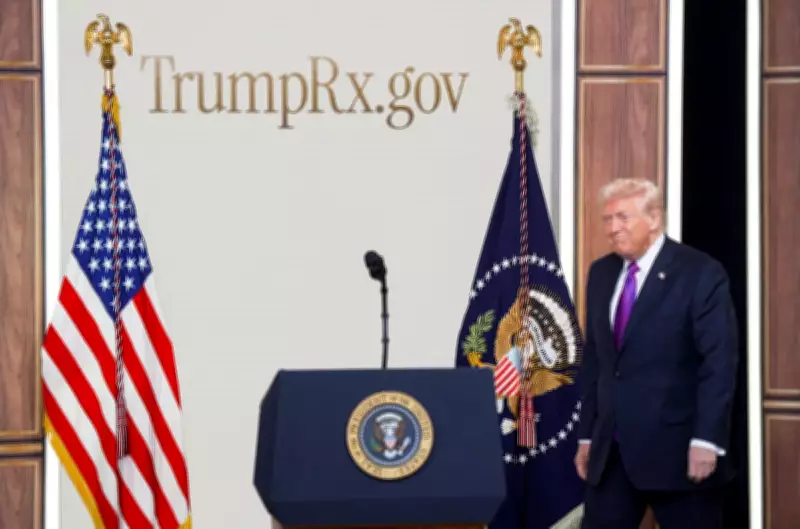
Trump's Unprecedented Branding Spree: From TrumpRx to Battleships
In a bold move that underscores his unyielding focus on self-promotion, former President Donald Trump unveiled the TrumpRx prescription drug discount website at the White House on 5 February 2026. This initiative, however, is just one facet of a broader and relentless campaign to imprint his name and visage across American institutions and symbols at an unprecedented rate.
A Historical Context of Presidential Naming
The United States has a long-standing tradition of honouring its presidents by naming significant landmarks and edifices after them. For instance, Washington DC boasts the Ronald Reagan National Airport, while New York City is served by the John F. Kennedy International Airport. Other notable examples include the Hoover Dam, the Theodore Roosevelt Building, Franklin D. Roosevelt Island, the Lincoln Memorial, and the state of Washington itself, named after George Washington.
Yet, Donald Trump appears determined to surpass all his predecessors in this regard. Less than eighteen months into his second term, his name, face, and signature have been aggressively affixed to government buildings, institutions, and even currency, marking a branding expansion that shows no signs of abating.

Recent Additions to the Trump Portfolio
The launch of TrumpRx, a website where Americans can purchase prescription medications, occurred just last month. As of February 2026, the site listed only 43 drugs, with more than half available as cheaper generics elsewhere, raising questions about its practical utility.
Shortly before this, the White House and the US Navy announced the creation of a new "Trump class" of battleships, touted by Trump as the largest ever constructed. A Pentagon press release noted, however, that battleships had not been used in combat for 35 years, suggesting the project may be more about vanity than military necessity.
Other notable rebrandings include the renaming of the US Institute of Peace to the "Donald J Trump United States Institute of Peace" in December 2025, with a White House spokesperson citing it as a reminder of strong leadership for global stability—ironically, weeks later, Trump initiated a war on Iran.
In a controversial move, Trump handpicked a new board at the John F. Kennedy Center for the Performing Arts in February 2025, installing himself as chair. By December, the board voted to rename it the "Donald J Trump and John F. Kennedy Memorial Center for the Performing Arts," with signage altered the very next day in a mismatched font, now subject to legal challenges.
Political and Public Reactions
The Republican Party has largely acquiesced to Trump's naming odyssey, with some members even encouraging it. Proposals have included carving Trump's face into Mount Rushmore and naming an airport after him. According to Steven Levitsky, a political scientist at Harvard University, Trump is "unconstrained" by his cabinet, advisers, or party, as Republican politicians seek to please him by endorsing such branding efforts.
Giant banners depicting Trump have been hung from government buildings in Washington DC, including the Department of Justice and the Department of Labor, in a style reminiscent of Soviet-era propaganda. Kim L Scheppele, a professor at Princeton University, notes that such displays are rare in democracies and more typical of autocratic regimes, where leaders use imagery to assert power while in office.
Traditionally, presidents wait until after leaving office or posthumously for such honours, bestowed by successors. Trump, however, shows little embarrassment in pursuing these endeavours actively. Examples include his conditional offer to fund a New York infrastructure project only if Penn Station and Dulles International Airport were renamed after him, and the approval of a 24-karat gold coin featuring his image by his handpicked arts commission.
Additionally, Trump's signature is set to appear on US paper currency later this year, described by Treasury Secretary Scott Bessent as a way to recognise historic achievements. A White House spokesperson, Davis Ingle, defended these actions, stating that while Trump is focused on saving the country, it is natural for patriots to want to recognise his accomplishments.

Public Backlash and Controversies
Despite administration claims, there are signs that the American public does not share Trump's enthusiasm for his own image. The National Park Service faced outrage in 2026 when it announced that its annual pass would feature Trump's face with a spectral George Washington behind him, leading to a cottage industry of stickers to cover it up. This forced the government to update its policies, warning that alterations may void the pass.
This branding spree raises profound questions about narcissism, democratic norms, and the legacy of a president seemingly obsessed with self-aggrandisement. As Trump continues to affix his name to everything from drug sites to battleships, the debate over his motivations and the implications for American democracy intensifies, highlighting a unique chapter in US political history.