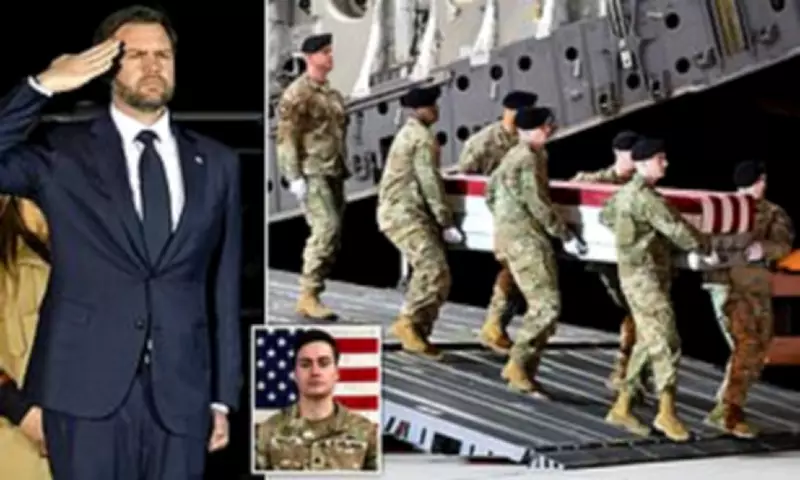
Vice President Vance Leads Dignitary Ceremony for Fallen Soldier
Vice President JD Vance presided over the solemn dignified transfer ceremony for the seventh American service member to perish in the ongoing conflict with Iran. The event unfolded at Dover Air Force Base in Delaware, where Vance paid respects to Army Sgt. Benjamin N. Pennington, aged 26, from Glendale, Kentucky. Pennington lost his life during an assault on the Prince Sultan Air Base in Saudi Arabia, marking another tragic milestone in the escalating hostilities.
Trump's Candid Admission on Vance's Stance
Earlier on Monday, President Donald Trump openly acknowledged that Vice President Vance held a divergent philosophical perspective at the inception of the Iran war. In remarks to reporters, Trump stated, 'We get along very well on this. He was, I would say, philosophically a little bit different than me. I think he was maybe less enthusiastic about going, but he was quite enthusiastic.' Trump swiftly clarified his position, asserting, 'But I thought it was something we had to do. I didn't feel we had a choice.' This revelation underscores the nuanced dynamics within the administration's highest echelons regarding military engagement.
A Somber Duty at Dover Air Force Base
The dignified transfer, regarded as one of the most poignant responsibilities for any commander in chief, saw Vance joined by Fox News host Pete Hegseth and senior military officials. Together, they rendered salutes as the transfer case, draped in the American flag, was ceremoniously transported from a military aircraft to a waiting vehicle. Reflecting on the gravity of such moments, Vance shared, 'I want to just start on a slightly somber note here, because on a personal level, I was honored to be able to participate in the dignified transfer of six American soldiers who were killed overseas in this conflict with Iran. And I had never done that before.' He extended prayers for the 'seventh soul' lost and for the families of all fallen heroes.
Honoring Sgt. Benjamin Pennington's Service
Sgt. Benjamin Pennington was assigned to the 1st Space Battalion, 1st Space Brigade of the U.S. Army Space and Missile Defense Command, based at Fort Carson, Colorado. His unit specialized in critical missions including missile warning, GPS operations, and long-haul satellite communications. Pennington enlisted as a unit supply specialist and was assigned to the Space and Missile Command on June 10, 2025. His distinguished service earned him numerous awards, such as:
- Army Commendation Medal
- Army Achievement Medal
- Army Good Conduct Medal
- National Defense Service Medal
- Global War on Terrorism Service Medal
- Army Service Ribbon
Vance's Cautious Approach and Influence
Vice President Vance, a veteran of the Iraq War, has historically advocated against prolonged foreign military engagements, a stance informed by his Marine Corps experience. In a 2023 op-ed, he articulated that Trump's optimal foreign policy centered on 'not starting any wars.' Notably, Vance has maintained a lower public profile since the Iran conflict commenced, with his social media activity diminishing and his terminology favoring 'conflict' or 'operation' over 'war.' Despite this, a recent Daily Mail/JL Partners poll identified Vance as Trump's most influential advisor, with 19% of respondents affirming his pivotal role within the inner circle.
Administration's Unified Front and Strategic Objectives
In a Fox News interview earlier this month, Vance emphasized that President Trump is committed to avoiding a protracted conflict reminiscent of Iraq or Afghanistan. He asserted, 'There's just no way that Donald Trump is going to allow this country to get into a multi-year conflict with no clear end in sight and no clear objective.' Vance outlined the administration's defined goal: preventing Iran from acquiring nuclear weapons and ensuring it renounces future nuclear capabilities. Trump reinforced this stance on social media, warning, 'If Iran does anything that stops the flow of Oil within the Strait of Hormuz, they will be hit by the United States of America TWENTY TIMES HARDER than they have been hit thus far.'
Military Assessments and Future Projections
During a press conference, President Trump provided a stark assessment of Iran's military capabilities, noting the country 'has no air force,' and suffers from degraded radar, telecommunications, and anti-aircraft systems. He reported that Iran's drone capacity has dwindled to 25% and is anticipated to reach zero, with most missiles destroyed. When queried about the conflict's conclusion, Trump offered a vague timeline, stating only 'soon,' while Iran's Revolutionary Guard countered, 'We are the ones who will determine the end of the war.' This exchange highlights the ongoing volatility and uncertain resolution of the hostilities.