White House Submits Detailed $400 Million Trump Ballroom Plans Amid Growing Controversy
The White House has officially submitted the most comprehensive and detailed architectural plans to date for former President Donald Trump's lavish $400 million ballroom project. These extensive blueprints, formally titled the "East Wing Modernization Project," were delivered to the National Capital Planning Commission by the architectural firm Shalom Baranes Associates.
Presidential Enthusiasm Meets Architectural Scrutiny
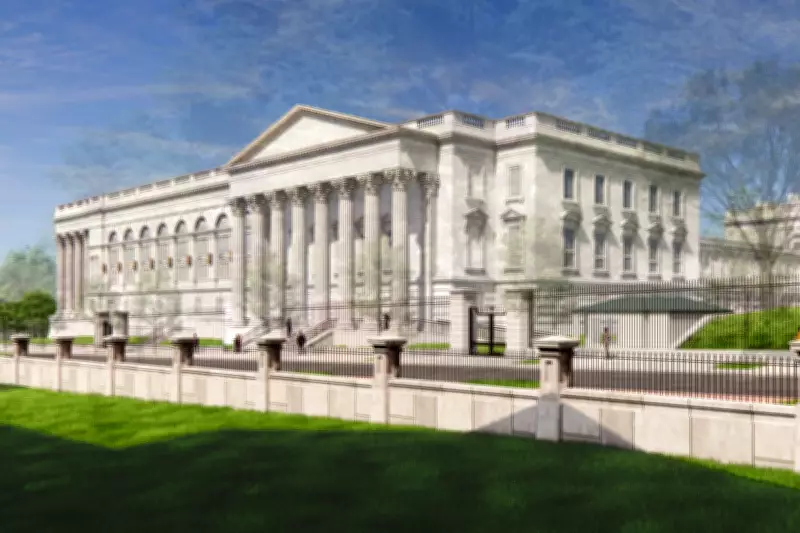
"When completed, it will be the finest Ballroom ever built anywhere in the World, one that has been sought by Presidents for over 150 years – and now they are getting THE BEST!" Trump declared enthusiastically on his Truth Social platform this Tuesday. The former president shared two detailed renderings of the proposed structure, emphasizing that "because of its unprecedented structural, safety, and security features, it will also be used for future Presidential Inaugurations."
The comprehensive submission to the National Capital Planning Commission, which oversees significant federal construction projects in the Washington D.C. region, includes multiple images from various angles and precise dimensions for the massive 90,000 square-foot building. The architectural firm provided these detailed renderings as part of their formal planning documentation.

Design Modifications and Preservation Concerns
The newly submitted plans reveal several important design modifications from earlier versions. Notably, a large triangular pediment that was previously included above the ballroom's southern portico has now been removed from the current design. However, a similar pediment on the eastern side remains part of the architectural plan.
Despite this significant design change, the overall height of the building is expected to remain precisely the same as the White House itself – a specific priority that Trump has emphasized throughout the planning process. This height consistency has become a central point of contention among architectural experts and historical preservationists.
Bruce Redman Becker, a Biden-appointed architect who was removed from the Commission of Fine Arts by Trump last year, expressed serious concerns to The Washington Post. Becker described the designs as "a poorly proportioned pseudo-neoclassical structure that is completely out of scale with the White House." He further criticized the plans for allegedly failing to comply with guidelines developed by the National Park Service, which require new additions to historic buildings to maintain compatibility with the original structure.
"The design team clearly ignored these guidelines, and should be asked to revise and resubmit plans that follow the guidelines," Becker told The Post, highlighting the tension between modern construction ambitions and historical preservation standards.
Legal Challenges and Public Response
The East Wing demolition that preceded this ballroom project prompted significant public outcry when Trump proceeded with it in mid-to-late October of last year. Critics noted that the demolition moved forward without independent reviews taking place and without congressional approval being granted.
The National Trust for Historic Preservation has since filed a lawsuit seeking to halt construction of the controversial ballroom project entirely. This legal action represents a significant challenge to the project's progression and reflects broader concerns about preserving the historical integrity of the White House complex.
Despite these mounting legal and architectural challenges, Trump remains characteristically optimistic about the project's progress. In his Tuesday social media post, he added confidently: "Two views of the Great Ballroom being built on the site of our wonderful White House – It is on budget, and ahead of schedule!"
The Independent has reached out to both the White House and Shalom Baranes Associates for comment regarding the alleged non-compliance with National Park Service guidelines, though responses have not yet been made public. The architectural controversy continues to develop as preservationists, architects, and political observers closely monitor the project's progression through regulatory channels.