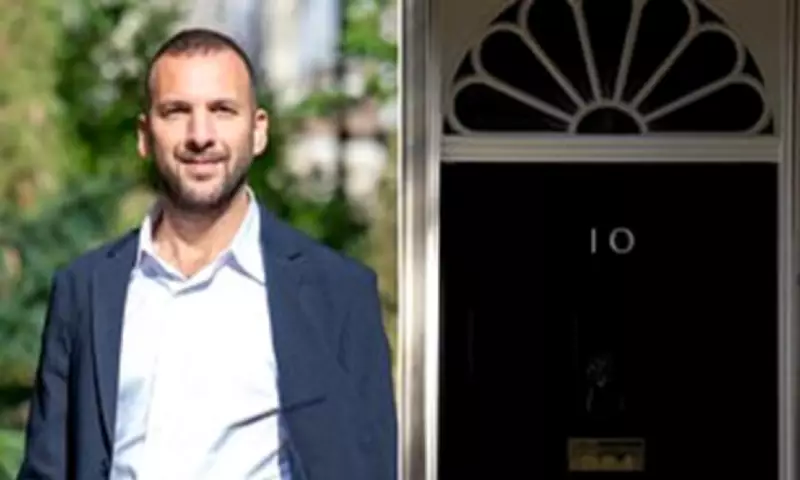
There was a hint of drizzle in the air on that cold April morning as the Prime Minister cycled down Greta Thunberg Way, formerly Whitehall. He cast an anxious glance at the grey clouds overhead, then turned to his partner Richie, who was cycling alongside him.
'It's a pity we couldn't have had a repeat performance of last year's weather,' Zack Polanski said, thinking back to that golden moment exactly 12 months earlier when he had first entered No 10 under blazing sunshine and bright blue skies. Richie, a physiotherapist who had lived with Zack in Hackney, east London, long before there was any prospect of him reaching the political summit, gave a nod, then signalled that he was about to turn into Al Gore Passage, the road known as Downing Street before the Greens embarked on the renaming drive.
Having dismounted and passed through the security gates, the two men parked their bikes in the unfeasibly large, under-used cycle rack near the door of No 10 that had been repainted green on day one of Polanski's tenure. The cycle rack had been a source of huge controversy, not only because it was a gift to 'the people of Britain' from the Duke and Duchess of Sussex but also because the conservation watchdog English Heritage objected strongly to its prominent location in such a historic setting. Polanski, whose slogan 'Be kind' had been at the centre of his party's successful election campaign, decided to teach the quango a lesson by removing its chief executive and putting her in charge of a rewilding project at Dungeness.

In contrast to the jubilant scenes that had greeted him a year earlier, there was no cheering crowd in Al Gore Passage that morning, just a smattering of disgruntled journalists, photographers and film crews. The cause of their discontent was yet another power cut, a form of disruption that was now happening only too frequently after Polanski's government imposed a comprehensive ban on the use of fossil fuels. Nor could these angry professionals be mollified by the distribution of vegan snacks made by earnest No 10 interns. Their hostility only evaporated once the electricity supply was restored by cranking up an ancient generator in the basement, ironically powered by diesel.
By the time this elderly machine had coughed into life, Richie had disappeared behind the green door, leaving his partner alone to deliver his speech on the first anniversary of his government. As usual during major set-piece appearances, he wore the Palestinian black and white scarf, known as the keffiyeh, while both the podium and the dark brick wall above the entrance to No 10 were draped in Palestinian flags.
Administering the revolution
Administering the revolution was proving a draining experience, however, and there were dark lines under his eyes. Take the decision to impose a ban on domestic flights, a move which had provoked fury in the travel industry. He was used to such opposition and refused to back down but the episode had taken its toll on him nonetheless. That said, he privately admitted that, as a former actor, part of him relished the drama of confrontation, as when his government pushed through plans to turn Westminster Abbey into an inter-faith centre. He had also enjoyed the open-mouthed horror exhibited by the Prince and Princess of Wales when he suggested that, in the interests of equality and social justice, they should move from Norfolk to a semi in Wolverhampton.
But the moment had arrived for him to address an issue that was close to his heart, with a speech whose central theme was the progress he had made in creating a new greener, fairer Britain by isolating the Right. In opposition, he had caused outrage by ruminating over how to build a society without these objectionable dissidents. Then, he had been deliberately vague about the practical steps that he would take to create a bigot-free utopia but now he was turning that goal into a reality.

The Environmental Truth Commission
One of the first actions of his Government had been to establish an 'Environmental Truth Commission', under the former Green Party leader Caroline Lucas, to promote eco-awareness, diversity and 'correct thinking'. It would also have a brief to challenge what the Greens called 'misinformation'. In his first anniversary speech, he boasted that the commission had been an enormous success in tackling the 'forces of reaction and enemies of the people'. Armed with sweeping powers, it had conducted hearings all over the country at which recalcitrant individuals and unenlightened companies confessed to their past eco-sins and failure to embrace diversity. In the same manner, oil and gas companies and electricity generators and distributors were interrogated by truth commissioners, their openness, he found, often lubricated by threats of nationalisation.
The commission was doing other invaluable work, such as monitoring all teaching materials and library books for any deviation from the new progressive orthodoxy. Meanwhile, under its new director general, the TV presenter and animal rights activist Chris Packham, the BBC has become the biggest cheerleader for the Greens' truth commission, with its fact-checking operation, BBC Verify, now acting as quasi state censor.
Soft on crime, hard on thought
When it came to violent crime and offences such as burglary and theft, Polanski advocated a softly-softly approach based on the classic, hand-wringing belief that criminals were really victims of society and were in need of support rather than punishment. In fact, his party did not consider drug possession or illegal immigration to be crimes at all. 'We will welcome all new migrants as potential citizens,' the Greens' last manifesto had stated, adding that 'the Green Party wants to see a world without borders'.
But all that softness disappeared when it came to handling environmental and social thought crimes. Looking into the cameras, Polanski said he was happy to embrace the paradox that Britain was becoming more tolerant by showing zero tolerance of the far-Right. Unesco had urged in 2025 that 'climate change denial' should be made an international crime. Polanski's Greens adopted this proposal for British domestic consumption, thereby creating a significant number of political prisoners, a category that had never existed before in peacetime. He recalled with relish the incarceration of 'king of the petrolheads' Jeremy Clarkson.
Trumpeting the dramatic widening of the definition of 'hate speech', he declared that misogyny, transphobia and 'queerphobia' would all enter this category, with offenders liable for long jail sentences. His regime had even introduced the concept of 'hate books' and the success of Suicide Of A Nation – a work which forensically demolished the case for mass immigration – had made its author, the academic and Reform UK candidate Professor Matt Goodwin, a prime target for the new witchfinder-generals and he was now behind bars.
A totalitarian atmosphere
The totalitarian atmosphere Polanski's administration created meant that criticism of his regime was muted. Some commentators said that the climate of censorship echoed the McCarthyism era in the 1950s. Others claimed that Polanski took his inspiration from the Soviet bloc in the 1970s. But most were too afraid to speak out.
What made the scale of the authoritarian powers adopted by the Prime Minister so astonishing was the shallow basis of his parliamentary ascendancy. The Greens had won only 24 per cent of the overall vote at the General Election but, thanks to the vagaries of the first past the post system – which was not designed for multiparty democracy – they emerged as the biggest party and were able to cobble together a majority with the support of radical Asian independents, a few Labour mavericks and Jeremy Corbyn.
The price for the backing of Islamists was the acceptance of sharia courts, as well as the effective adoption of a new Islamic blasphemy law and the further isolation of the Jewish community. It was support for Israel rather than anti-Semitism that became the more serious offence within the Green movement, highlighted by the slogan 'Zionism equals racism'. Despite his Manchester Jewish background, Polanski was as obsessed with Palestine as the rest of his party, refusing to take anti-Semitism seriously and even questioning the reality of the threat to the Jewish population.
Not that he could claim to be unaware of the rising tensions. During one canvassing exercise in his constituency, the street had been shaken by a massive explosion and he had heard the sound of distant gunfire and the wail of police sirens. But Polanski had been remarkably unfazed, for sectarian violence had become commonplace in Britain's cities as the police found their authority rapidly diminishing in the face of speculation that the Government was going to abolish the constabularies and replace them with local citizen militias under a network of committees of public safety.
Failures glossed over
He did not mention any of this in his first anniversary speech, just as he glossed over the grisly failings of his government. His decision to impose a swingeing 'carbon tax' on diesel had put hundreds of farmers, who relied on the fuel to power their tractors, out of business, with the result that the price of household staples such as bread and vegetables had spiralled and empty supermarket shelves became a common sight across the country.
Polanski's much vaunted wealth tax – levied at 1 per cent on people with assets worth more than £10 million and 2 per cent on wealth over £1 billion – had been a predictable disaster, causing a vast exodus of investors. Just as wrong-headed had been his revival of Lord Justice Leveson-style curbs on the Press, accompanied by the creation of a state regulator and limits on media ownership. For the first time since the end of the 17th century, Britain could no longer be said to have a free Press.
Unfettered immigration following the abolition of border controls cranked up the pressure on the housing stock and sent welfare bills spiralling out of control. Ironically, for all their talk about protecting the environment, Polanski's government made Britain a dirtier, more squalid, crime-ridden place, an outcome that exposed its supposed obsession with green issues as nothing more than virtue-signalling.
Phase two: indoctrination and propaganda
But Zack was a man on a mission. The first 12 months had been only phase one of his programme. Phase two was about to begin, strengthening the focus on indoctrination and propaganda. This would feature the introduction of study camps for young people and re-education centres for independent-minded adults. Civic culture would be brought more into line with the new values, epitomised by the replacement of the statue of Winston Churchill in Parliament Square by a sculpture of the Greenpeace vessel Rainbow Warrior.
Phase two will see the Right further isolated by the Greens' adoption of the Chinese social credit system, whereby independent-minded citizens are punished for their reluctance to embrace the state. Penalties would include such measures as low credit ratings, the withdrawal of benefits or poor job references.
Two days after he had given the anniversary speech, Polanski presided over the laying of the foundation stone of the first re-education centre. Nigel Farage was expected to be one of its first guests.
This may sound like an unlikely fantasy or, more appropriately, nightmare but it could happen if the British people don't come to recognise the authoritarianism behind Polanski's genial mask. His Green Party is a movement in thrall to doctrinaire radicals who have no respect for British traditions or freedoms. What was once a band of well-meaning, sometimes eccentric campaigners, who were genuinely devoted to the future of the planet, has morphed into a cadre of ruthless Marxists, bent on winning control at all costs, as evidenced by their ugly alliance with militant Islam. That coalition of opportunism is how they won the Gorton and Denton by-election, a constituency in Greater Manchester with a large Muslim minority. In their obsession with gaining power, what the Green Party and the Islamists have in common is a contempt for Western civilisation. And if the electorate falls into the trap of voting them in, we will all live to regret it.