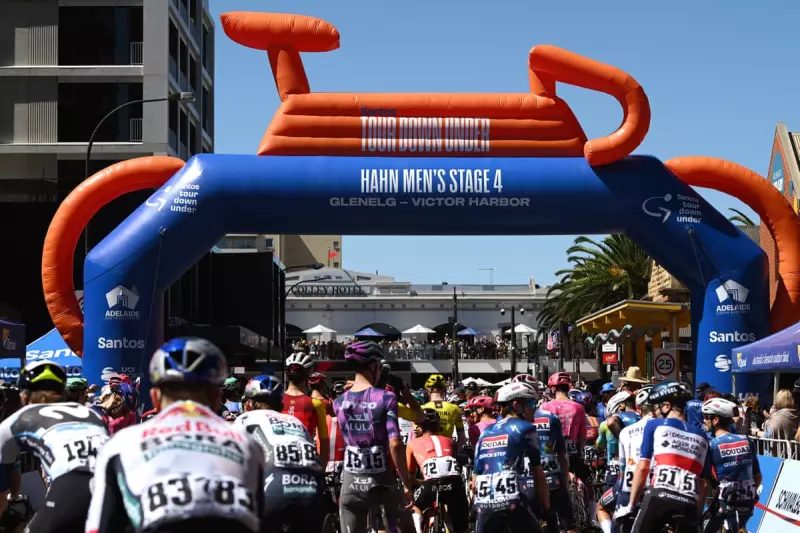
As the peloton lined up for the 25th Santos Tour Down Under in Glenelg, South Australia, a pressing contradiction overshadowed the start of Australia's premier cycling event. Riders are increasingly vocal in their call for fossil fuel sponsorship to be outlawed, even as they prepare to race in the extreme heat that climate change is making more frequent and severe.
The Gruelling Reality of Racing in a Heating Climate
For elite cyclists like Australian Olympian Maeve Plouffe, preparing for races like the Tour Down Under has become a brutal science. Plouffe recalls training in Paris for the Olympics, where an "easy" acclimatisation ride ended with her fainting from heat sickness. "Racing in extreme heat is like playing chicken with your environment," she says, describing a sensation where "your whole body is encapsulated in heat" and performance deteriorates rapidly with no relief.
This preparation is now standard. At the South Australian Sports Institute, riders endure up to three weekly sessions in a heated glass chamber for a month before the race. Temperatures are cranked to between 36C and 40C for an hour at a time, simulating the punishing conditions they will face on the road.

An 'Embarrassing' Partnership Under Scrutiny
This reality is forcing an uncomfortable reckoning with the race's long-term sponsor, the Australian oil and gas company Santos. The company has held naming rights to the Tour Down Under since 2010 and renewed its contract until 2028 just last January. However, riders are now openly questioning the alignment of a sport uniquely vulnerable to climate change with a major fossil fuel producer.
"I think it will just resonate better for a lot of people involved if there was an option to have a different sponsor of the event," says Plouffe, who holds degrees in law and marine biology. National road champion Brodie Chapman is more direct: "It's certainly time that the Tour Down Under looks for a new sponsor to more align with the values of the modern world."
Former national champion Cyrus Monk labels the situation "embarrassing" and challenges the assumption that finding a new sponsor would be difficult. "Obviously the dream would be similar to the [Belgian] Renewi Tour, where the sponsor is a renewable energy company," he notes. The financial details of the Santos deal and government contributions remain undisclosed.
Sportswashing and a Failure of Imagination
Matt Rendell, a former Tour de France commentator now with the Badvertising campaign, argues cycling has become "an unexpected locus of this rearguard propaganda activity by the fossil fuel industry." He explains that the sport's cheap costs and green imagery make it an attractive vehicle for companies like Santos to associate themselves with environmentalism and peak human performance.
Rendell calls the belief that no alternative sponsor exists a "failure to imagine things otherwise." He points out that as long as a contract with a fossil fuel firm is locked in, race organisers are not actively seeking other partners. The Tour Down Under, held in a region where cycling directly confronts extreme weather, represents a particular flashpoint in a global battle also seen in Europe with the Tour de France's ties to Total and Ineos.
In response to the criticism, a Tour Down Under spokesperson praised Santos as a "valued naming rights partner" without whom delivering a world-class race would be impossible. They cited Santos's support in growing the event, including establishing a women's WorldTour race with equal prize money. The spokesperson also echoed Santos's and South Australian Premier Peter Malinauskas's argument that Santos's natural gas and its Moomba carbon capture project support the state's renewable energy transition.
However, this defence is undercut by analysis showing the Moomba project captures just 4.6% of Santos's total corporate emissions, and the recent approval of its highly controversial Barossa gas project. As riders continue to push their limits in ever-hotter conditions, the pressure to sever the sport's ties to the fuels exacerbating that heat is only set to intensify.