Manchester United's Teenage Prodigy Chido Obi Navigates Unexpected Development Path
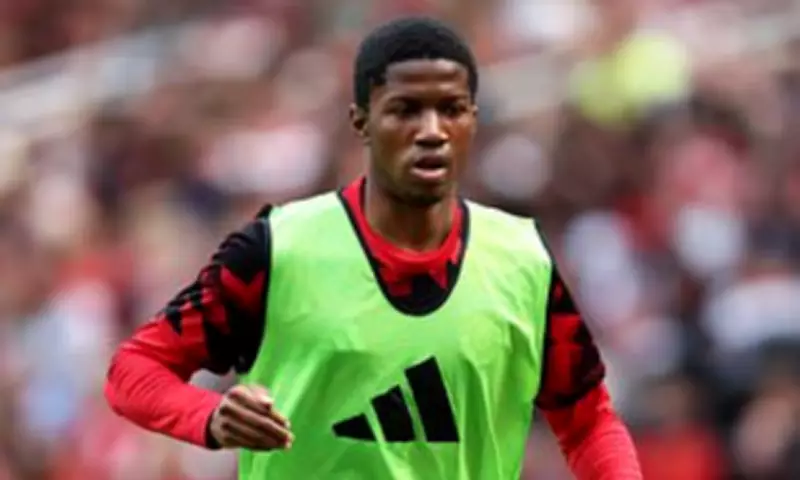
For a young footballer whose career trajectory had followed an exceptionally steep upward curve, the current campaign has delivered a significant reality check for Chido Obi. The teenager—remarkably still only 18 years old—arrived at Manchester United from Arsenal in 2024, convinced that a clearer pathway to first-team football awaited him. The financial terms of the move also presented a compelling proposition for the promising striker.
Early Breakthrough and Record-Breaking Debut
Obi announced his arrival emphatically, scoring a hat-trick on his first start for United's Under-18s against Nottingham Forest. Merely a couple of months later, he earned his senior debut, coming on as a substitute during an away fixture at Tottenham Hotspur. His breakthrough continued when he started a Premier League match away at Brentford at the tender age of 17 years and 156 days, becoming the youngest player ever to start a league game for Manchester United. By the season's end, he had accumulated eight senior appearances.
Under the mentorship of first-team players Joshua Zirkzee and Patrick Dorgu, most youngsters in Obi's position would have felt they had truly arrived at the pinnacle of the game. However, the coaching staff at Manchester United held a contrasting perspective.

Staff Concerns and a Strategic Pivot
Certain members of the United hierarchy expressed reservations about Obi's conduct off the pitch on several occasions. Furthermore, there was a prevailing belief that the gap between youth and senior football was disproportionately vast for such a young striker, especially while the first team itself was undergoing considerable instability and transition.
Consequently, rather than allowing him to continue finding his feet in the high-pressure environment of the senior squad, the club decided this season would focus on taking a deliberate step back. The strategy involved developing his skills away from the intense spotlight, with no immediate first-team involvement planned.
Coaching Perspective and Player Response
'I do think that has been a good thing for him on the whole,' explained Under-21s boss Adam Lawrence, speaking publicly for the first time since his return to the club. 'Naturally, with any player when you've had that first team exposure and then you spend a bit of time around the first team when you then have that bit where you're not around it as often, naturally that's going to have an impact on your short term, the way you see things or that bit of disappointment or frustration.'
'But I think credit to Chido. What he's obviously done over this period is he's gone, “this is the situation that I'm in. This is what I'm working towards to help take my game to the next level and then I'm going to go after it.” So that is the bit between now and the end of the season that he needs to continue to focus on. But I think he deserves some credit in terms of approaching it in that way and going after those things because, yes, you've seen players go the other way.'
High Hopes and Areas for Improvement
Manchester United staff maintain exceptionally high expectations for Obi, a player who garnered national headlines after scoring ten goals in a single match against Liverpool back in 2023. Privately, however, they have emphasized that significant developmental work remains. The club believes that skipping crucial formative years could ultimately prove detrimental to realizing his full potential at Old Trafford.
Last season, observers noted that Obi frequently displayed insufficient willingness to lead the pressing game from the front. In numerous academy matches attended by reporters, coaches including Lawrence, Travis Binnion, and current Under-18s manager Darren Fletcher were often heard demanding greater intensity from the young striker.

Noticeable Progress and Restored Confidence
In recent months, a marked improvement in Obi's effort and on-pitch intelligence has validated the club's tough-love approach. The teenager has responded impressively, netting 15 goals so far this season. His performance in a crucial Under-18s away victory over Manchester City, which significantly shifted the title race momentum in United's favour, became a major talking point among coaches, especially as it was witnessed by first-team manager Michael Carrick.
For the Under-21s, Obi scored all four goals in a commanding 4-1 win against Leicester City. Through consistently delivering high-level performances, he has successfully reintegrated into the first-team's considerations, recently rejoining their training group over the past fortnight.
The Philosophy of Development and Personalised Coaching
'When a coach is tough on players or they spend more time with them, it means that they really, really believe in the player, even when it can be challenging,' Lawrence elaborated. 'It's a bit like, you know, with your child. There’s times where you're going to be really supportive and you need to put your arm around them and there's other times where you need to give them a nudge and they need to stand on their own two feet.'
'I think the difficulty about coaching and managing people is that everybody's different. So you might have your blanket principles around how you manage the group and expectancies and behaviours, etcetera. But then there'll be individuals that respond differently in different ways that you then have to find a way and a connection.'
'I think the brilliant thing that Chido has got is, between Travis, Darren Fletcher, Colin Little, all the coaches working with him, he’s got a group of people that really believe in his potential and are working really hard to help him fulfil that. Listen, we're pushing Chido, we're challenging Chido. We want him to go up levels and keep improving… He’s definitely in a good place at the moment.'
Future Prospects and Club Strategy
For Obi, whose first-team involvement this season has been limited to an unused substitute appearance against Wolves, the opportunity to secure a remarkable quadruple remains alive. He could potentially win the Under-18 Premier League, the FA Youth Cup, the Premier League International Cup, and Premier League 2. This prospect was a key factor in the club's decision to reject all loan offers during the January transfer window.
United's hierarchy remains confident that their bespoke Individual Player Performance Plan (IPPP), combined with the available silverware and the stability of remaining at the Carrington training complex, represents the optimal long-term strategy for Obi's development.
Positive Mentality and Ongoing Development
'I like him because he's really open and honest when he speaks to us,' Lawrence added, revealing that feedback from Travis Binnion—now part of Carrick's first-team staff—has been extremely positive regarding Obi's evolving mentality. 'I think he's making good progress and he's training and playing with a smile on his face, which is massive.'
The philosophy echoed by staff members like Ruben Amorim, who previously spoke about combating entitlement in academy systems, appears particularly relevant to Obi's situation. 'Sometimes strong words are not bad words,' Amorim noted. 'Sometimes difficult moments are not a bad thing for the kids. We don't need to be always with accolades in everything, in every situation. We are not helping…'
This perspective underscores why Manchester United's initially unpopular decision to temporarily hold Obi back has proven beneficial. The player has demonstrably developed—and continues to improve—into a more complete footballer than the one who made his senior debut at Tottenham. That earlier version, in terms of physical readiness, technical ability, and mental fortitude, was not prepared to make a substantive impact on the first team. The version now being nurtured by Carrick and his coaching staff is in a markedly stronger position, proving that challenging periods can indeed foster significant growth.