England's Youth Football Crisis: Talented U19s Miss Euros Despite Stunning Portugal Win
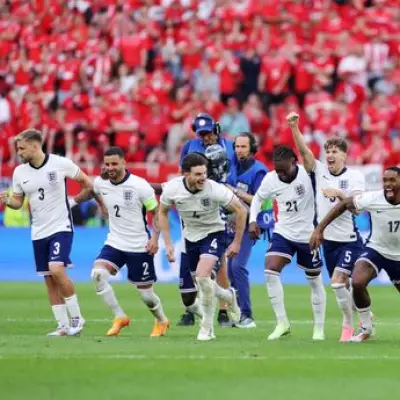
In a breathtaking display of attacking football, England's Under-19 team ran roughshod over Portugal on their home turf, securing a resounding 6-0 victory. Arsenal's rising star Max Dowman orchestrated this symphony of dominance with a goal and two assists, showcasing the immense talent within the Young Lions squad. Yet, this emphatic triumph was bittersweet, as it failed to secure qualification for the Under-19 European Championships, raising urgent questions about systemic failures in England's youth development pathway.
The Qualification Conundrum: How Did England Fall Short?
The finals, scheduled for North Wales this summer, will feature Croatia, Denmark, Germany, Italy, Serbia, Spain, Ukraine, and hosts Wales. England's absence is particularly puzzling given the squad's composition. Players like Max Dowman (Arsenal), Rio Ngumoha (Liverpool), Divine Mukasa (Manchester City, now on loan at Leicester), Jesse Derry, and Shim Mheuka (both Chelsea) have all broken into their respective first teams to varying degrees, with many viewed across Europe as potential superstars. Despite this, they will miss out on a crucial tournament opportunity.
The qualification process for youth Euros involves three phases: a qualifying round, an elite round, and the final tournament. Under coach Will Antwi, England started strongly, winning all three matches in the initial phase without conceding a single goal. As a Pot One team in the elite round, they were drawn against Portugal (Pot 2), Poland (Pot 3), and Serbia (Pot 4). England continued their defensive solidity with two more clean sheets, defeating Poland 1-0 and Portugal 6-0 in that stunning performance.

However, a 2-0 defeat to Serbia, bolstered by senior-capped players like Mihajlo Cvetković (Anderlecht) and Andrija Maksimović (RB Leipzig), proved costly. With five wins from six games and five clean sheets, England still fell short, joining Czechia as the only Pot One team to miss the finals.
A Pattern of Underachievement in Youth Tournaments
The surprise, perhaps, lies in the fact that people are surprised at all. England has a long history of bungling campaigns at younger age groups. Since winning the Under-19 Euros in 2022, they have reached the finals only once in four years. Looking further back, since their 1993 triumph, they have lifted the trophy just twice.
Recent years illustrate this trend vividly. In 2023, despite winning all three qualifying group matches and topping their group, England failed to qualify. That squad included now-senior internationals Kobbie Mainoo, Adam Wharton, and Lewis Hall, yet they finished second behind Iceland in the elite round hosted on home soil. In 2024, England did not even progress to the elite round, trailing Austria and Montenegro in their group. In 2025, they made the finals but exited in the group stage after losses to the Netherlands and Germany.
This issue extends beyond the Under-19s. England's Under-17s have also missed out on qualifying for their Euros twice since 2022, with only one quarter-final appearance since hosting the semi-finals in 2017. At the Under-17 World Cup, FIFA's premier competition for that age group, England failed to qualify in 2019 and 2026, and suffered early exits to Uzbekistan (2023) and Austria (2025) since winning in 2017. The Under-20 World Cup record is even bleaker, with 13 failures to qualify out of 25 tournaments since 1977, alongside six first-round exits, and only the 2017 victory as a highlight.
The 2017 Golden Generation and Current Concerns
2017 stands as a golden year for the Football Association, with England winning the Under-20 World Cup, Under-19 Euros, and Under-17 World Cup. That era featured talents like Phil Foden, Morgan Gibbs-White, Marc Guehi, Mason Mount, Dominic Calvert-Lewin, and Callum Hudson-Odoi in full flight, fueling optimism for future dominance. Yet, this success has not been sustained.

There is no divine right to reach tournament latter stages, and entitlement may have placed the cart before the horse too often. Now, despite praise for the player pathway producing generational talents such as Dowman and Ngumoha, it is time for the FA to conduct a thorough internal review. The recurring failure of high-quality teams to qualify demands scrutiny into coaching, selection, and tournament preparation strategies.
As Serbia's impressive young core, including AFC Bournemouth's Veljko Milosavljević, demonstrates, other nations are capitalizing on their youth investments. England must address why their age groups outside the Under-21s consistently fall short, lest they waste the potential of stars like Max Dowman and his peers.