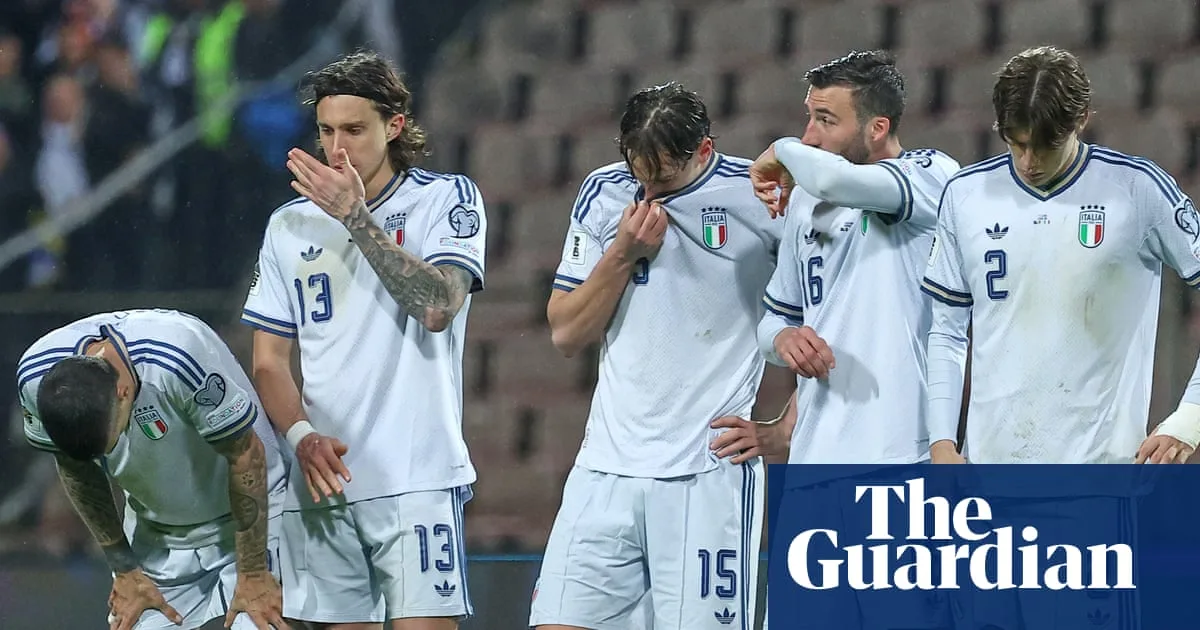
Italy's World Cup Absence Continues: A Third Consecutive Failure After Bosnia Defeat
Italy have missed out on the World Cup for the third successive time following their defeat against Bosnia and Herzegovina. This latest setback no longer feels like a catastrophic event but rather a recurring disappointment, echoing a pattern of decline that has plagued Italian football for years.
A History of Headlines Reflecting Decline
The decline of Italy's footballing expectations is starkly illustrated by the headlines that have greeted their qualification failures. In November 2017, after losing a playoff against Sweden, La Gazzetta dello Sport described it as "The End" and an "Apocalypse". By 2022, following defeat by North Macedonia, Il Corriere dello Sport portrayed a nation sinking "Into Hell". Now, in the wake of the Bosnia and Herzegovina loss, both newspapers led with a simpler, perhaps sadder, "Tutti A Casa" – Everybody Go Home. Italians have long understood that the 2018 failure was not an aberration but part of a trend, with the team also failing to reach the knockout stages in 2010 and 2014.
Missed Opportunities for Reform
After the 2010 disappointment, there was recognition of a need for change. In August 2010, Arrigo Sacchi was appointed coordinator of national youth teams, and Roberto Baggio became president of the Italian Football Federation's technical sector. Sacchi pushed for investment in academies and a shift towards fun and instinct in youth development. Baggio, with about 50 collaborators, produced a 900-page document titled "Renewing the future", proposing an overhaul of talent pathways, including standardised coaching methods and a digital database for player progress. However, Baggio resigned in January 2013, lamenting that the project had been "literally dead" for a year, while Sacchi stepped down in 2014 due to stress. Despite some changes, such as Italy winning the European Under-19 Championship in 2023 and the under-17s in 2024, modernisation has been slow and incomplete.
Broader Issues in Italian Football
The senior national team's decline parallels worsening results for Serie A clubs in European competitions, partly due to lagging commercial revenues. A key factor is that most Italian teams play in outdated, communally owned stadiums. While progress is evident – Milan and Inter agreed to buy San Siro last year, and Fiorentina secured a leasehold for renovations – these developments have been slow, with other projects stalling. On the pitch, Italian football faces challenges; for example, Atalanta were thrashed by Bayern Munich this season. Yet, Inter reached the Champions League final in two of the past three years, and players like Nicolò Barella and Gianluigi Donnarumma show the talent pool remains strong enough for qualification expectations.
Management and Accountability Questions
Portraying Italy's failure as inevitable due to falling standards overlooks avoidable mistakes. Questions arise about managerial decisions: was Gennaro Gattuso, with a mixed record in club management, the right choice after Luciano Spalletti's sacking last June? Should Spalletti have been replaced sooner after underwhelming Euro 2024 performances? After the 2018 failure, federation president Carlo Tavecchio resigned, but his successor, Gabriele Gravina, did not step down after the 2022 defeat and has asked Gattuso to continue pending board discussions. Change for change's sake is not a solution, but repeating the same approaches yields no different results.
Conclusion: A Sad Song on Repeat
Italy's latest World Cup failure underscores a systemic issue where past reform proposals, like Baggio's in 2011, were never fully implemented. The current approach is clearly not working, and while the talent exists, mismanagement and slow adaptation hinder progress. Perhaps the saddest aspect is that this no longer feels like The End but rather the same sad song playing on repeat, with no clear resolution in sight.