Kosovo's Football Dream: From War-Torn Nation to World Cup Hopefuls
The Balkan nation of Kosovo stands on the precipice of footballing history. A victory against Turkey on Tuesday evening would secure their first-ever World Cup finals appearance, capping an extraordinary journey from post-war obscurity to international recognition.
Humble Beginnings and Emotional Foundations
"We didn't even know each other," recalls Samir Ujkani, thinking back to March 2014 when a makeshift Kosovo squad convened for their first official match against Haiti. The goalkeeper was a rarity - a player with Serie A experience at Palermo and 20 caps for Albania who was willing to bet on what has become one of international football's great success stories.
"I can say without doubt that I didn't know 50% of the guys' names at first," Ujkani admits. "It was really difficult but, in our hearts, we always pushed to get better and believe in each other."

Kosovo could barely have imagined their current position. Just twelve years ago, Ujkani and his teammates slogged through a sodden goalless draw against one of the few nations prepared to visit. Back then, the ultimate goal was recognition by Uefa and Fifa - further global validation for a state that had declared independence in 2008.
Overcoming Historical Obstacles
This is a country where public matches were banned by Serbian authorities in the 1990s after the breakup of Yugoslavia. Football became the most luxurious of afterthoughts as a brutal, appalling war wrought unimaginable trauma at the end of that decade. When Kosovo rose and stood alone, sport became more important than ever in its capacity to project a fresh, serious, accomplished face to the world.
"It gets emotional thinking about the conditions we faced," Ujkani says. Kosovo would often train on a rutted pitch at the crumbling Kek stadium outside Pristina, directly beneath the belching Obiliq power plants that have been listed among the most polluting in Europe. On other occasions they would make a three-hour round trip to Mitrovica, where the Haiti game took place, for a single session. "We didn't care, we did it all and nobody complained. And I'm so proud of what the team are achieving now."
The Diplomatic Breakthrough
Eroll Salihu, the former Football Federation of Kosovo general secretary, recalls the immense pressure surrounding that first match. "If anything went wrong against Haiti I was afraid somebody would misuse it and say Kosovo wasn't able to organise a proper match," he says.
Salihu forged an extraordinary diplomatic double act with the then FFK president, Fadil Vokrri, that, via years of exhaustive politicking, earned Kosovo its place at the table. Uefa and Fifa accepted them in May 2016. Salihu remembers the moment, the previous September, when he and Vokrri realised Uefa's executive committee had the required number of votes to forward their application for final approval at congress.
"Fadil had goosebumps," he says. "He said to me: 'Eroll, it's happening.' And then he began to cry. I'd never seen him cry, but then I started too."
The beloved Vokrri, a brilliant striker for FC Prishtina and Partizan Belgrade, died in 2018. Kosovo will walk out on Tuesday in front of almost 14,000 fans in the bowl-like, renovated stadium named in his memory.
Building a Competitive Team
It seemed victory enough when, four months after being admitted to football's governing bodies, Kosovo played their first World Cup qualifier against Finland in Turku. There were more tears in the team hotel when, hours before kick-off, Fifa confirmed that players who had previously represented other countries or not held Kosovan nationality would be allowed to represent them competitively.
"I couldn't sleep beforehand because I was so stressed," says Ujkani, who was among them. Ujkani would captain the side and finish his international career with 36 Kosovo caps. He is now on the FFK executive committee, his goalkeeping jersey replaced by suit and pin badge.

The team's transformation has been remarkable under German manager Franco Foda, appointed in 2024. "He gave us this push," Ujkani says. "He's a real commander and put us on the correct, straight way with good tactics. The team became connected. We always had talent but for a long time we could not progress under the regime. It was a tough thing for our people. Now we have quality and team spirit."
Current Success and Historical Significance
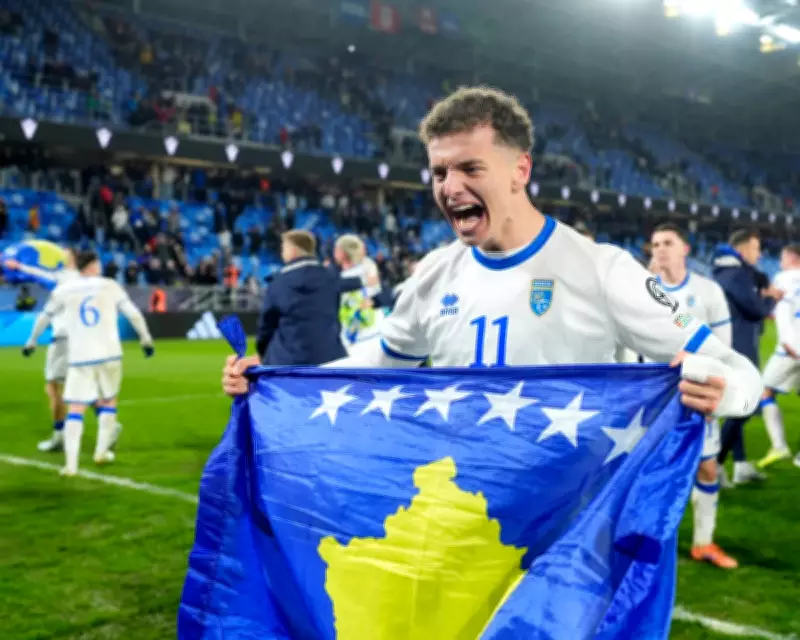
The grizzled, gladiatorial visage of Foda's team is Vedat Muriqi, the Mallorca centre-forward and captain in Amir Rrahmani's injury-enforced absence. Kosovo had flickered promisingly for years before finishing runners-up in a tough Group B, beating Sweden twice, winning in Slovenia and drawing at home with Switzerland.
They were outsiders for their playoff semi-final in Slovakia but won a helter-skelter game 4-3. Turkey know they have a battle coming. In players such as Juventus's Edon Zhegrova and the Hoffenheim forward Fisnik Asllani, a country of 1.6 million has bred plenty of match-winners, both homegrown and among its diaspora.
Those with long memories will also find meaning in the visit of Turkey, who came two months after the Haiti game and won 6-1. Established countries had hardly been queueing round the block to face them but Fatih Terim brought a strong side. "We don't forget it," Salihu says. "Terim said that, even if there were no hotel rooms, they would stay in people's houses if it meant playing the match." Ujkani agrees: "We'll always be grateful to them."
The appreciation is genuine. But so is the hunger, this time around, for a stunning win that would cause shockwaves around the world. "This isn't only for the players, the coaches or the federation," Ujkani says. "It's for everyone from Kosovo, and everyone who fought for us to be in the place we are now. It's like a dream come true."