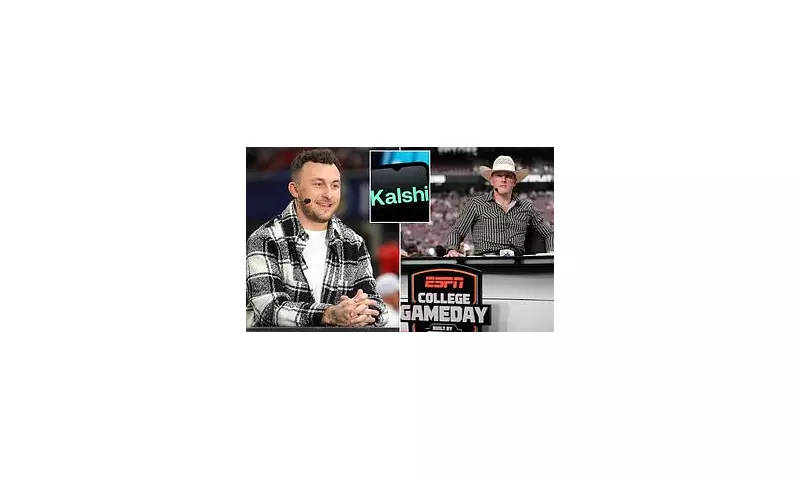
The sporting world was left puzzled when former Heisman Trophy winner Johnny Manziel failed to appear as the guest picker on ESPN's flagship college football show, College GameDay. The no-show, which occurred on December 21 in College Station, Texas, has since evolved into a notable promotional opportunity for both the controversial ex-quarterback and the emerging prediction-market platform, Kalshi.
The Mysterious Absence and Immediate Fallout
Manziel, the former Texas A&M and Cleveland Browns star, was scheduled to appear on the programme ahead of his alma mater's playoff clash with the Miami Hurricanes. Moments before broadcast, however, host Rece Davis revealed that former Texas A&M basketball player Alex Caruso would be stepping in instead.
The sudden switch baffled fans, particularly as Manziel had been photographed at the Kaseya Center in Miami just the night before, attending the high-profile boxing match between Jake Paul and Anthony Joshua. Social media quickly filled with speculation regarding his whereabouts.
Some theorised that the athlete's well-documented struggles with alcohol had resurfaced, while others suspected a feud with ESPN or with College GameDay co-host Pat McAfee. Manziel later claimed he was battling an illness, but the incident had already captured significant public attention.
From Controversy to Commercial Opportunity
Rather than letting the story fade, Manziel and Kalshi seized the moment. On Wednesday, following the initial incident, Manziel released a statement directly addressing the speculation and steering his followers towards the prediction market.
'FOR IMMEDIATE RELEASE,' the December 30 statement began, posted on X the following day. 'I'm good with ESPN. I'm good with McAfee,' Manziel wrote, dismissing rumours of a rift. He then pivoted to promotion: 'If you want to keep guessing, you can now do it officially. Thanks to Kalshi, you can trade on whether I'll be back on College GameDay in 2026.'
The platform promptly launched a market allowing users to bet on the likelihood of Manziel returning to the ESPN set by 2026. Initially priced at just a 34% chance, the figure spiked to over 50% following Manziel's direct endorsement on social media.
Public Reaction and The Rise of Prediction Markets
The public response to Manziel's promotional tactic was largely critical. One social media user pleaded, 'Get this dude a publicist for the love of god,' while another quipped, 'Good thing Kalshi didn't exist when you played... I would've lost my kid's college fund.' A third simply called it 'the most Johnny Manziel thing I've ever read.'
The episode highlights the growing profile of platforms like Kalshi and its competitor Polymarket. These prediction markets operate as exchanges where users can trade on the outcome of future events, from sports and politics to gas prices and pop culture. They function similarly to sportsbooks, with prices fluctuating like odds, but they operate under a different regulatory framework.
Crucially, these platforms consider themselves 'exchanges' rather than traditional sportsbooks. This places them under the federal oversight of the U.S. Commodity Futures Trading Commission (CFTC), rather than state-level gambling regulators. This approach, which Nevada state senator Dina Titus has labelled a 'backdoor way' to legalising sports gambling, allows them to operate more widely across the United States while facing fewer taxes and restrictions.
The industry gained significant attention during the 2024 U.S. Presidential race for accurately forecasting Donald Trump's victory over Kamala Harris based on user wagers. It has since faced cease-and-desist orders in several states as it continues to handle hundreds of millions in bets on events ranging from March Madness to the Masters.