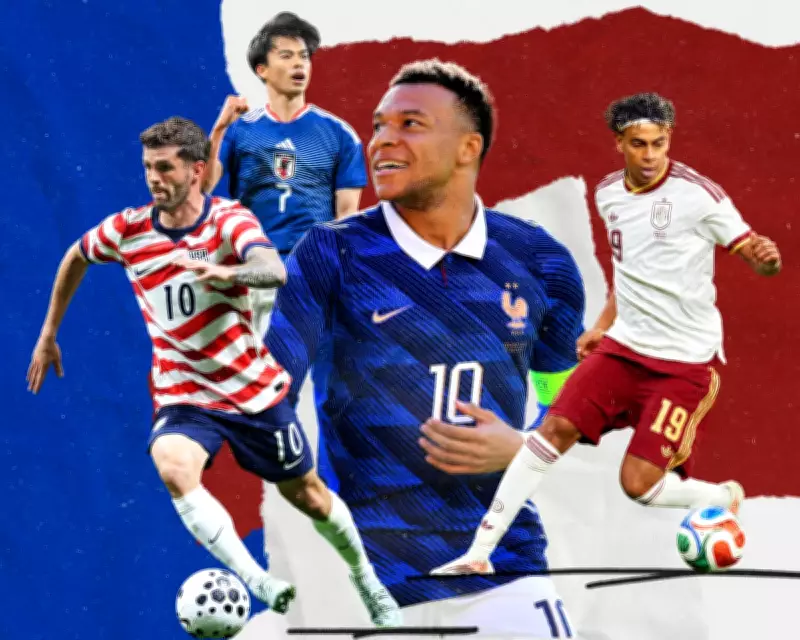
World Cup 2026 Power Rankings: France Lead the Way with Senegal and Japan in Top 10
From Algeria to Uzbekistan, our global network of writers and contributors has assessed the state of all 48 nations that have qualified for the 2026 World Cup. The rankings reveal France as the frontrunners, with African champions Senegal and Asian contenders Japan making significant strides into the elite top 10.
1) France
Kylian Mbappé issued an ominous warning this week, stating, "There's more talent and potential than in 2022," after France secured a 2-1 victory over Brazil despite having Dayot Upamecano sent off after 55 minutes. His confidence appears well-founded. For their second match of this international window, against Colombia, manager Didier Deschamps changed the entire starting XI yet still fielded a formidable attack featuring Marcus Thuram, Désiré Doué, Rayan Cherki, and Maghnes Akliouche. Doué scored twice in a comfortable 3-1 win. Deschamps remarked, "I'm well aware that there are some very good players that I won't be bringing because, in my opinion, there are even better ones."
2) Spain
The European champions had to adjust their plans after the Finalissima against Argentina, scheduled for Qatar, was cancelled due to the war in the Middle East. Instead, they played friendlies against Serbia, winning 3-0 in Villarreal, and Egypt, drawing 0-0 in Barcelona. The latter match was overshadowed by chants from Spain fans that police are investigating for Islamophobia and xenophobia. Lamine Yamal responded, "To those who sing these things: using a religion as a form of mockery on a pitch shows you up as ignorant and racist." On the pitch, Luis de la Fuente's team were surprisingly toothless against Egypt despite 25 attempts, while Mikel Oyarzabal scored two excellent goals against Serbia.

3) Argentina
The world champions experienced a slightly surreal international window, beginning with a narrow 2-1 win over Mauritania. Coach Lionel Scaloni was unimpressed, noting, "We didn't play and the important lesson here is to make sure it does not happen again." For the second game at La Bombonera, Lionel Messi returned, and Argentina's form improved dramatically, beating the Gambia 5-0 with the Inter Miami forward scoring one goal and providing an assist. However, debutant Joaquín Panichelli of Strasbourg suffered a serious knee injury, casting a shadow over the otherwise positive mood.
4) Brazil
Brazil were overpowered by France 2-1 but recovered to beat Croatia 3-1. Manager Carlo Ancelotti indicated he has his 26-player squad and starting XI in mind for the World Cup, but injuries to key players like Alisson, Gabriel, Alex Sandro, Bruno Guimarães, and Raphinha disrupted his plans. Luiz Henrique benefited from Raphinha's absence, showing he can be a game-changer, while Endrick made a promising cameo against Croatia. Despite Casemiro and Vinícius Jr not being at their best, these matches provided a valuable test of Brazil's depth.
5) Portugal
Portugal's matches against Mexico and the USA tested fans' ability to stay awake, not only due to the late kick-off times but also because of lethargic performances. Nevertheless, Portugal avoided defeat, drawing 0-0 with Mexico in the reopening of the Azteca Stadium and beating the USA 2-0 in Atlanta with goals from Francisco Trincão and João Félix. In the absence of Cristiano Ronaldo, Bernardo Silva, Rúben Dias, Diogo Costa, and Rafael Leão, Bruno Fernandes was the team's main reference. Samu Costa and 33-year-old Toluca striker Paulinho auditioned for World Cup places, but coach Roberto Martínez likely had his squad decisions settled before this window.
6) Senegal
Manager Pape Thiaw declared, "If I had any doubts about our ability to win the World Cup, I wouldn't be here," after a 3-1 friendly win over the Gambia. This confidence has not drawn ridicule, marking perhaps the first time an African side can realistically target winning the World Cup before it begins. Senegal's belief is rooted in a steady pipeline of talent from elite domestic academies like Generation Foot and Diambars. Thiaw's priority will be maintaining unity and fitness, with the memory of Sadio Mané missing the last World Cup serving as a reminder of how fragile ambitions can be.

7) Belgium
The Red Devils traveled to North America, securing a 5-2 victory against the USA and a 1-1 draw with Mexico. While scoring five goals without Romelu Lukaku was positive, with Benfica's Dodi Lukébakio stepping up, Belgium still need their star striker. Concerns remain over conceding from set pieces, an issue that must be addressed before the tournament. Kevin De Bruyne showed irritation in the buildup against Mexico, indicating his high motivation levels.
8) Japan
Japan's UK tour could not have gone better, starting with a comfortable 1-0 win over Scotland in Glasgow and followed by a historic 1-0 victory over England, making them the first Asian team to beat the Three Lions. Despite missing stars like Wataru Endo, Takumi Minamino, Takefusa Kubo, and Takehiro Tomiyasu, Japan proved to be a well-coached dark horse. Coach Hajime Moriyasu said, "I'm happy that we were able to win, but we still have a long way to go. We have to be even stronger."
9) Germany
Germany, once renowned for its powerful strikers, are still searching for a successor to Thomas Müller, Jürgen Klinsmann, and Miroslav Klose. Deniz Undav scored the winner in a 2-1 victory against Ghana, but coach Julian Nagelsmann indicated he is unlikely to start at the World Cup. The real problem lies in defence, with Nico Schlotterbeck looking shaky. Positives included Florian Wirtz's standout performance in a 4-3 win over Switzerland and 18-year-old Lennart Karl impressing with his dribbling skills.
10) Morocco
On paper, Morocco are African champions, but on the pitch, certainty is harder to find. Walid Regragui stepped down as head coach last month, only for CAF to overturn the 2025 Afcon result weeks later. His successor, Mohamed Ouahbi, has shown early promise, with March friendlies against Ecuador and Paraguay easing concerns about continuity. Ouahbi's Atlas Lions appear more ambitious, moving away from Regragui's pragmatic approach. The lingering question is which style is better suited for World Cup success.
The remaining nations, from Croatia to Curaçao, have shown varying levels of preparedness, with key takeaways including tactical experiments, injury concerns, and rising stars. As the 2026 World Cup approaches, these rankings highlight the dynamic landscape of international football, with traditional powerhouses facing stiff competition from emerging forces.