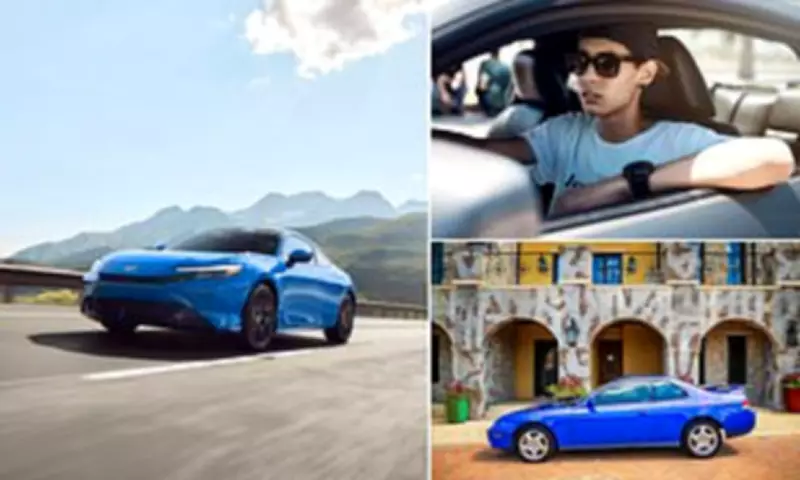
Honda Prelude's Controversial Comeback Divides Automotive Enthusiasts
The iconic Honda Prelude, a top-selling sports car throughout the 1980s and 1990s, has made a dramatic return to American roads after a quarter-century absence. Honda launched the reborn two-door model in the United States late last year, marking a significant moment for automotive nostalgia. However, the long-awaited comeback arrives with a substantial catch that has already alienated many of the car's original enthusiasts.
Radical Transmission Overhaul Sparks Criticism
Unlike its celebrated predecessors, the new 2026 Prelude model completely abandons traditional transmission systems. The vehicle features neither a manual stick shift nor a conventional automatic gearbox. Instead, drivers interact with a series of buttons on the center console to select drive modes, supplemented by steering-wheel paddles that trigger simulated gear changes.
The car's computer system generates artificial engine revs and exhaust sounds through integrated speakers, creating the auditory illusion of gear shifting despite the hybrid powertrain operating without actual gear changes. This fundamental design choice has become the central focus of automotive reviews and social media debates since the model's launch.

Media Reviews Highlight Artificial Experience
The Wall Street Journal emerged as one of the harshest critics, noting that the Prelude "doesn't even have a transmission, per se" and describing the gear changes and engine noise as "completely artificial." Their review characterized the driving experience as "virtualized nostalgia," suggesting Honda has recreated the sensation of a sports car without the mechanical authenticity that defined the original.
While acknowledging the Prelude's solid build quality and handling capabilities—including suspension and brake components borrowed from the Civic Type R—the Journal emphasized the vehicle lacks the raw, mechanical connection that made earlier generations cult favorites.
Car and Driver adopted a more forgiving yet skeptical stance, suggesting the paddle-controlled simulated shifts do enhance driver involvement but cannot replace the satisfaction derived from a genuine manual gearbox. The Drive similarly noted that the simulated shifting adds engagement while ultimately reinforcing that the Prelude prioritizes hybrid efficiency over pure sports coupe characteristics.
From Cult Classic to Modern Hybrid
First introduced in 1978, the Prelude achieved cult classic status during the 1980s and 1990s through its sharp styling, responsive engines, and accessible sports-car appeal. Competing alongside Japanese rivals like the Toyota Celica, Supra, and Nissan Skyline, the Prelude delivered driving excitement without the fuel consumption and maintenance costs associated with American muscle cars.
Sales gradually declined through the late 1990s, leading Honda to discontinue the model in 2001 after five generations. The 2026 revival maintains familiar exterior styling but represents a dramatic technological departure, replacing traditional gasoline engines with a hybrid system combining a 2.0-liter four-cylinder engine with a compact battery pack, producing approximately 200 horsepower.
Pricing and Market Context
Priced just above $40,000, the new Prelude positions itself firmly within the modern sports coupe segment. The controversy surrounding the vehicle centers not on its hybrid configuration but specifically on the elimination of conventional gear selection mechanisms.
Honda's Prelude revival follows another nostalgic automotive move from the manufacturer, who announced in August last year the return of the Acura RSX to US dealerships after a 19-year hiatus—this time reimagined as a Tesla Model Y-inspired electric crossover vehicle.
The Prelude's return represents a significant test case for how automakers can balance technological advancement with preserving the authentic driving experiences that created legendary automotive reputations.