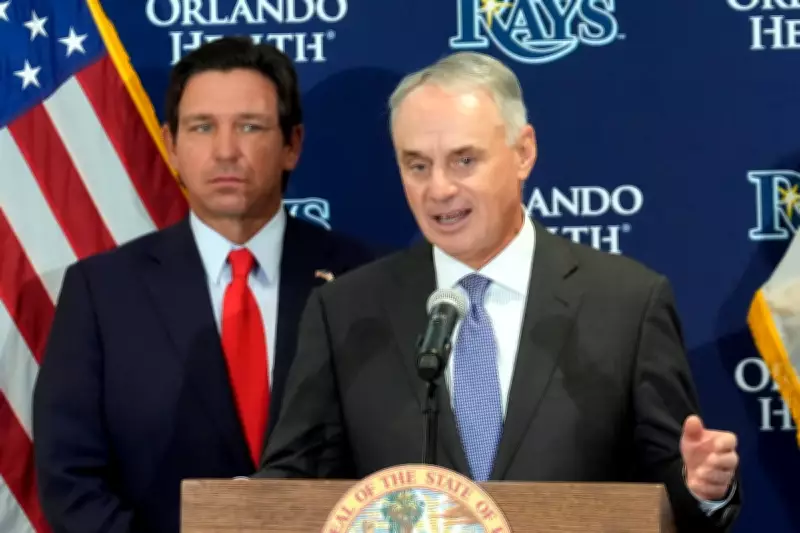
In a significant development for Florida's sporting landscape, Governor Ron DeSantis and Major League Baseball Commissioner Rob Manfred have jointly voiced their support for a proposed new stadium for the Tampa Bay Rays. The announcement, made during a news conference in Tampa, marks a pivotal moment for the franchise as it seeks to secure its long-term future in the Tampa Bay area.
A Critical Juncture for the Franchise
The Rays currently play at Tropicana Field in St. Petersburg under a lease that extends through at least the 2028 season. However, the venue's viability has been called into question following significant damage from Hurricane Milton in 2024, a Category 5 storm that shredded the stadium's roof. Although repairs have since been completed, allowing the team to return for the 2026 season, the incident compounded existing uncertainties.
These were further exacerbated last year when a substantial $1.3 billion redevelopment deal for the Trop site collapsed. This failure prompted former owner Stuart Sternberg to sell the team, ushering in a new ownership group led by CEO Ken Babby. The combination of storm damage and escalating construction costs has created an urgent need for a modern, sustainable home for the Rays.

The Proposed Tampa Location
The newly envisioned ballpark would be situated in Tampa itself, specifically in the shadows of the New York Yankees' spring training facility and directly across the street from Raymond James Stadium, home of the NFL's Tampa Bay Buccaneers. This strategic location aims to integrate the team more deeply into Tampa's sporting and community fabric.
"In the coming days, you'll see the first renderings of our new development and ballpark, the new forever home of the Tampa Bay Rays that will serve as a catalyst for this new community," announced Rays CEO Ken Babby during the conference. The project has been likened to the successful Truist Park development of the Atlanta Braves.
Partnerships and Funding Framework
Commissioner Manfred emphasised the essential role of collaboration in such ventures. "The key to economic success for most sports franchises is a strong partnership between the team, the community and the local government," he stated, adding, "Today's an important day, a milestone along a path that I believe will lead to the Tampa Bay Rays being a part of this community for decades to come."
The financial blueprint for the project is beginning to take shape. Last month, the Rays signed a nonbinding memorandum of agreement with Tampa's Hillsborough College to develop a 113-acre site along Dale Mabry Boulevard. Plans for this mixed-use district include not only the stadium but also a hotel, residential and retail spaces, multiple restaurants and bars, and new educational facilities.
According to documents prepared for the Hillsborough County Commission, the Rays have committed to bearing a minimum of 50% of the ballpark's construction costs. The remaining funding, whose total has not been disclosed publicly, would need to come from public sources. Governor DeSantis clarified that while the state fully supports the proposal, it will not provide direct funding for the stadium itself. However, state assistance could be available for ancillary projects like road improvements and relocating a nearby juvenile justice facility.
The Path Forward and Potential Hurdles
The immediate next step involves the Hillsborough County Commission, which is scheduled to discuss the stadium proposal during its regular meeting. Any final funding framework would require approval from the county commission, the City of Tampa, and the Tampa Sports Authority.
Critical questions remain unanswered, including the total project cost and a definitive timeline for completion. It is also uncertain whether local authorities would be amenable to utilising potential financing mechanisms, such as a local bed tax, to support the public portion of the funding.
The urgency of the situation is palpable. The Rays' lease at Tropicana Field could potentially be extended beyond 2028 if necessary, but the franchise is undeniably "on the clock." Historical discussions have even floated the possibility of relocating the team to Orlando or other markets should a new stadium deal fail to materialise.

Commissioner Manfred, however, sought to downplay a sense of finality. "I do think we're at a point in the history of the club that something needs to get done, but I would be hesitant to characterise it as it's this or never again," he remarked, indicating that while the proposal is crucial, it may not represent an absolute last chance for the Rays in Tampa Bay.
The coming weeks and months will be decisive as renderings are released, costs are clarified, and the necessary political and financial partnerships are solidified to determine if this vision for a new Rays stadium in Tampa can become a reality.